9/11 Takeaways 25 Years Later: The Mamdani Debate
September 13, 2026
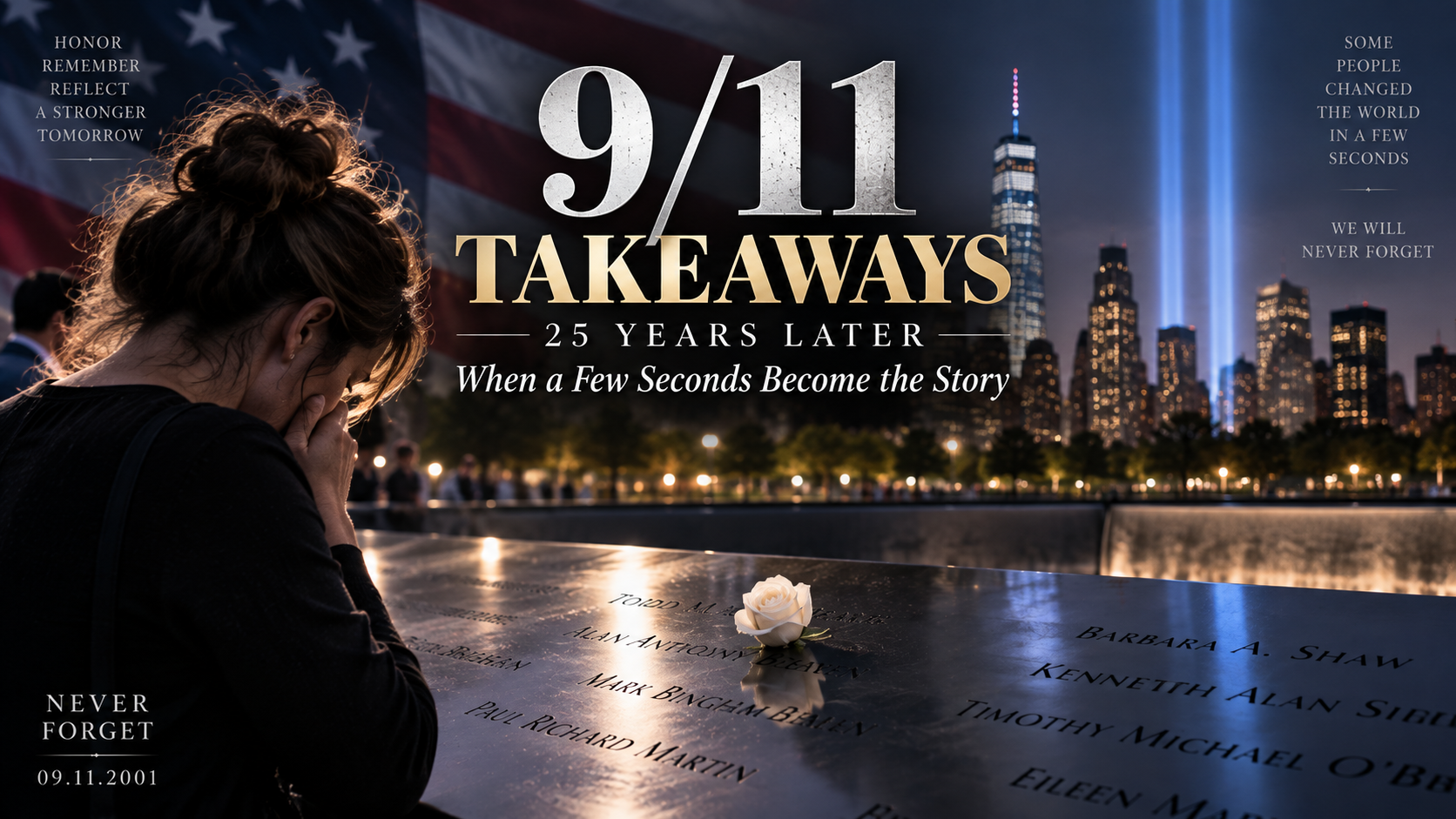
September 11 came and went.
As it has for 25 years, families gathered at Ground Zero. The names of the nearly 3,000 people killed in the September 11 attacks were read aloud. Moments of silence marked the times when the attacks unfolded. Across New York, Washington and Shanksville, Americans gathered to remember a day that changed the country forever.
But this year’s anniversary produced a controversy that has quickly become its own story.
A brief piece of camera footage showed New York City Mayor Zohran Mamdani alongside Rep. Alexandria Ocasio-Cortez during the Ground Zero ceremony. The two appeared to smile and exchange a few words while the names of victims were being read.
The clip lasted only seconds.
The reaction did not.
Critics accused the two politicians of laughing during one of the most solemn portions of the ceremony. The footage spread rapidly online, prompting condemnation from political figures and commentators.
But there is an important question we should ask before turning a few seconds of footage into a definitive judgment:
Do we actually know what was happening in those few seconds?
THE CEREMONY WAS ABOUT THE NAMES
The annual reading of the names is one of the most emotionally powerful traditions surrounding September 11.
Family members take the microphone and read the names of those who were killed.
For many, these aren’t historical figures.
They’re parents.
Children.
Spouses.
Siblings.
Friends.
Coworkers.
Twenty-five years later, the pain remains deeply personal.
Reuters reported that at this year’s ceremony, some relatives were reading the names of family members they had lost while others were remembering relatives they were too young to personally know.
That context explains why the footage involving Mamdani and Ocasio-Cortez struck such a nerve.
At a ceremony built around remembrance, even a moment that appears lighthearted can look profoundly out of place.
THE FOUR SECONDS THAT TOOK OVER THE INTERNET
The controversy centers on a very short video clip.
Mamdani and Ocasio-Cortez can be seen smiling and interacting.
To critics, the footage appeared to show them laughing while the names were being read.
That interpretation quickly spread across social media and conservative media, with critics arguing that the moment demonstrated a lack of respect for the victims and their families.
But there is another side to the story.
Michael Ragusa, a former head of security under Mayor Rudy Giuliani, said the interaction appeared to be a greeting rather than the two politicians laughing at the names being read. Other reporting similarly noted that the brief exchange has been interpreted differently depending on the viewer.
And that’s where this story gets complicated.
Because a camera can show us what happened without necessarily telling us why it happened.
CONTEXT MATTERS
There is an enormous difference between:
“They were laughing at the names of 9/11 victims.”
and
“They were briefly caught smiling and speaking to each other while the names were being read.”
The first is an assertion about intent.
The second is an observation about what the footage appears to show.
Unless someone involved explains exactly what was said and why they reacted the way they did, we should be careful about presenting the first statement as established fact.
That doesn’t mean people aren’t allowed to be offended by the footage.
They absolutely are.
A memorial ceremony has expectations of decorum, particularly during the reading of the names.
But being offended and proving someone’s intent are two different things.
THIS IS WHERE POLITICS MAKES EVERYTHING HARDER
Mamdani’s presence at this year’s ceremony was already politically controversial before the footage emerged.
A petition opposing his attendance reportedly attracted more than 113,000 signatures, including support from some 9/11 family members. Other family members defended his inclusion and argued that the ceremony should remain focused on remembrance rather than political exclusion.
That background matters.
When someone is already controversial, people naturally interpret their actions through the lens of what they already believe about them.
A supporter sees a greeting.
A critic sees disrespect.
A skeptic sees political theater.
A grieving family member may simply see something that feels wrong at a ceremony where every second carries emotional weight.
The same four seconds can produce completely different conclusions.
BUT THERE IS ANOTHER FACT WORTH CONSIDERING
The viral clip isn’t the entire ceremony.
Mamdani remained at the Ground Zero observance and participated in other September 11 commemorations.
Before the anniversary, he had also delivered remarks honoring the FDNY and 9/11 victims and emphasized the continuing sacrifice of first responders.
At a September 11 interfaith memorial service, Mamdani described the attacks as one of the darkest days in New York’s history and spoke about grief, sacrifice, heroism and rebuilding.
That doesn’t automatically erase the controversial footage.
But it does provide context.
And context is precisely what viral clips often remove.
THE BIGGER TAKEAWAY: BE CAREFUL WITH THE CAMERA
Perhaps one of the most important lessons from this year’s anniversary has nothing specifically to do with Mamdani.
It has to do with the way we consume information.
We live in an era where a three-second clip can become a national controversy before anyone watches the three hours surrounding it.
We see the moment.
We form the conclusion.
Then we search for information that confirms what we already believe.
That’s dangerous.
It doesn’t mean videos are unreliable.
It means videos are sometimes incomplete.
A camera can capture a person’s expression.
It may not capture the conversation that caused it.
It can capture a reaction.
It may not capture what happened immediately before it.
It can show us what happened.
It doesn’t always show us why.
THAT DOESN’T MEAN WE SHOULD IGNORE WHAT WE SEE
There is a danger on the opposite side, too.
In our attempt to provide context, we shouldn’t automatically dismiss uncomfortable footage.
If a public official behaves inappropriately at a memorial, the public has every right to question it.
Public officials are held to public standards.
And September 11 is not just another political event.
It is a memorial to nearly 3,000 people.
So the appropriate response isn’t necessarily:
“It’s nothing. Move on.”
Nor should it automatically be:
“This proves they were laughing at dead Americans.”
The responsible position is somewhere in between:
Look at the footage. Look at the full context. Then make the judgment.
THE 25-YEAR LESSON
There was something particularly significant about this controversy occurring on the 25th anniversary.
A quarter-century has passed since the attacks.
An entire generation has grown up without personally remembering September 11.
For many young Americans, the events of 2001 exist only through photographs, documentaries, textbooks and stories from their parents.
That makes the annual ceremony more important—not less.
The names must continue to be read.
The stories must continue to be told.
The sacrifices of the first responders must continue to be remembered.
And the people who were killed must remain more than numbers in a history lesson.
DON’T LET THE POLITICS BECOME BIGGER THAN THE PEOPLE
This may be the most important takeaway of all.
The debate over Mamdani and Ocasio-Cortez has consumed enormous attention.
But the ceremony wasn’t created for them.
It wasn’t created for Republicans.
It wasn’t created for Democrats.
It wasn’t created for conservatives or progressives.
It was created for the people who aren’t here anymore.
The father who never came home.
The mother who never came home.
The firefighter who climbed the stairs.
The police officer who ran toward the towers.
The passenger who fought back aboard Flight 93.
The worker who made one final phone call.
They are the story.
Not the politicians standing behind them.
REMEMBER WHAT THE NAMES MEAN
Twenty-five years later, the reading of the names still matters because a name is personal.
John.
Mary.
Michael.
Susan.
Not statistics.
Not political talking points.
Not hashtags.
People.
The temptation in modern politics is to turn every event into ammunition for the next argument.
September 11 should resist that temptation.
There are plenty of days to fight about politics.
September 11 should primarily be a day to remember.
THE CURRENT NEWS TAKEAWAY
So what should we make of the Mamdani footage?
We should acknowledge what the cameras captured.
Yes, Mamdani and Ocasio-Cortez were briefly seen smiling and interacting during the ceremony while the names were being read. That is a legitimate subject for public scrutiny.
But we should also acknowledge what the footage doesn’t establish.
It doesn’t, by itself, prove that either person was laughing at the names of the victims.
There are reports that the moment was simply a greeting or brief exchange, and Mamdani’s broader participation in the day’s commemorations provides additional context.
We can believe the moment looked inappropriate without pretending we know exactly what was happening inside their heads.
That’s not defending Mamdani.
That’s applying the same standard we should apply to everyone.
See the footage.
Ask the questions.
Consider the context.
Don’t manufacture certainty where the evidence doesn’t provide it.
And above everything else:
Don’t let four seconds of political controversy overshadow the nearly 3,000 names that were read that morning.
Twenty-five years later, the greatest takeaway from September 11 isn’t who smiled, who spoke, who attended or who didn’t.
It’s that nearly 3,000 people had names worth remembering.
And they still do.
Never Forget.