Charlie Kirk Murder Case Moves to Trial After Ruling
A Utah judge found probable cause on all charges against Tyler Robinson, allowing the Charlie Kirk murder case to proceed to jury trial with death penalty eligibility.
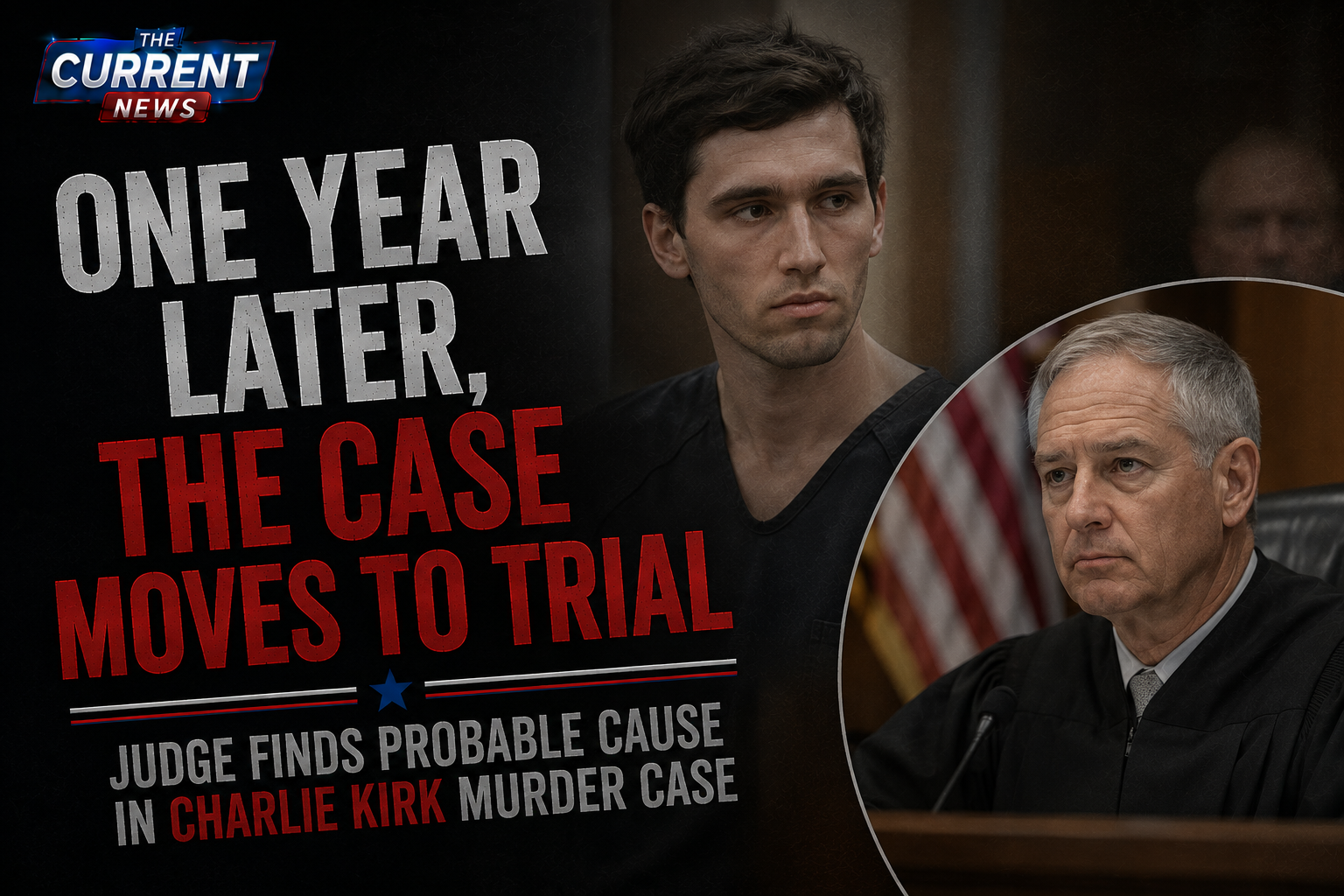
Nearly one year after Charlie Kirk was killed in front of a crowd at Utah Valley University, the case that has captivated the country has officially moved into its next chapter.
On Tuesday, September 1, Judge Tony Graf ruled that prosecutors had presented sufficient evidence to establish probable cause on all seven counts against Tyler Robinson, including the aggravated murder charge stemming from Kirk’s death.
The decision means Robinson will stand trial.
And perhaps most significantly, the aggravated murder charge remains intact—meaning prosecutors can continue pursuing the death penalty if Robinson is ultimately convicted and the applicable capital-punishment requirements are satisfied.
But before we rush toward a verdict, there’s something important to understand:
Yesterday was not the end of the case.
It was the beginning of the next phase.
A YEAR OF QUESTIONS
On September 10, 2025, Charlie Kirk was fatally shot while speaking at an outdoor event at Utah Valley University.
Nearly a year later, the accused shooter has finally crossed one of the most significant legal thresholds in the case.
The preliminary hearing process has been lengthy.
Prosecutors presented evidence over a five-day hearing in July, followed by weeks of written arguments and Tuesday’s final arguments over whether the case should proceed to trial.
Judge Graf ultimately concluded that the state had met its burden of showing probable cause.
His ruling was based on the evidence presented during the preliminary proceedings, including video evidence, DNA evidence and other evidence prosecutors say connects Robinson to the shooting.
Now the case moves forward.
PROBABLE CAUSE IS NOT A CONVICTION
This distinction matters.
A judge finding probable cause does not mean:
“Tyler Robinson is guilty.”
It means something much narrower:
There is sufficient evidence for the case to proceed to trial.
Judge Graf himself emphasized that the probable-cause determination was not a final determination of guilt.
That determination belongs to a jury.
Robinson pleaded not guilty to all charges following the ruling.
So despite the headlines, the trial has not happened yet.
The evidence has not been finally adjudicated.
The defense has not had its final opportunity to present its case before a jury.
And Robinson remains legally presumed innocent unless and until proven guilty in court.
BUT THE DEATH PENALTY IS STILL ON THE TABLE
This is perhaps the biggest legal consequence of Tuesday’s ruling.
The defense had specifically challenged the aggravated-murder designation and argued that the evidence did not establish the aggravating circumstance necessary to make Robinson eligible for the death penalty.
One of the central disputes concerned whether the alleged shooting placed other people at grave risk of death.
The defense argued that Robinson fired a single shot at Kirk and did not reload the bolt-action rifle, suggesting he specifically targeted one person rather than creating the type of broader danger necessary for the capital aggravator.
Prosecutors argued the opposite.
They pointed to the circumstances surrounding the shooting: Kirk was speaking at a public event with thousands of people present, and the shot was allegedly fired from hundreds of feet away.
Judge Graf sided with prosecutors at this stage.
That doesn’t guarantee a death sentence.
It means the capital charge can proceed.
THE DEFENSE HAS NOT DISAPPEARED
It’s easy to look at Tuesday’s ruling and assume the prosecution has won.
It hasn’t.
The defense has already challenged several elements of the state’s case.
They have disputed the prosecution’s characterization of the shooting.
They have challenged evidence.
They have questioned the DNA evidence.
And they have argued against the aggravating factor that makes the death penalty possible.
The defense also disputes the prosecution’s characterization of Robinson’s motive.
Those arguments haven’t disappeared.
They simply move to the next stage.
THE EVIDENCE WILL NOW FACE A DIFFERENT TEST
This is where the upcoming jury trial becomes so important.
A preliminary hearing asks a relatively narrow question:
Is there enough evidence for this case to go forward?
A trial asks a much bigger question:
Has the prosecution proved its case beyond a reasonable doubt?
Those are completely different standards.
The state cleared the first hurdle.
Now it has to clear the second.
And the second is considerably higher.
WHAT WILL THE JURY HAVE TO DECIDE?
At trial, jurors will have to evaluate the evidence for themselves.
They will hear the prosecution’s witnesses.
They will hear the defense’s witnesses.
They will see physical and forensic evidence.
They will hear arguments about motive.
They will hear arguments about the shooting itself.
They will hear competing interpretations of the evidence.
And ultimately, they will determine whether the prosecution has met its burden.
The jury—not the judge from Tuesday’s hearing—will decide whether Robinson is guilty.
THE POLITICAL MOTIVE QUESTION
One of the most consequential issues may be why Kirk was allegedly targeted.
Prosecutors have argued that the shooting was politically motivated and have pointed to evidence they say demonstrates opposition to Kirk’s political positions.
Among the evidence discussed publicly are alleged writings attributed to Robinson and other evidence prosecutors say demonstrates his motive.
The defense disputes aspects of the state’s characterization of motive.
That means the jury may eventually have to consider not only:
Did Robinson fire the shot?
but also:
What was his intent?
What motivated him?
What did he know?
What did he intend to accomplish?
Those questions can become critical in a criminal trial.
THE CROWDED CAMPUS MATTERS
There is another reason the aggravated charge has become such an important part of this case.
Kirk wasn’t killed in an isolated room.
He was speaking at a public event.
Thousands of people were nearby.
The prosecution says the alleged shot was fired from a rooftop roughly 400 feet away and that the circumstances created a grave risk to others.
The defense has emphasized that only one shot was fired and that Kirk was the intended target.
That disagreement could become one of the most important legal battles at trial.
THE CASE IS NOW HEADED FOR A JURY
And this is where the public conversation should change.
For almost a year, much of the discussion has revolved around:
Will there be a trial?
Now we know.
There will be.
The question becomes:
What will the jury ultimately believe?
That’s a much harder question.
Because unlike social media, a jury can’t simply pick the explanation that sounds best.
They have to weigh admissible evidence.
They have to follow the judge’s instructions.
They have to apply the law.
And if the prosecution seeks a conviction, the burden remains with the state.
SOCIAL MEDIA WILL HAVE TO WAIT
This case has already generated an extraordinary amount of online speculation.
The shooting itself became a national political flashpoint.
Then came the investigation.
Then the arrest.
Then the preliminary hearings.
Then the evidence.
Then the competing theories.
And now the trial is coming.
That means the online commentary is likely to become even louder.
But here’s the danger:
The internet has already tried this case multiple times.
Some people decided Robinson was guilty the day he was arrested.
Others have questioned virtually every piece of evidence.
Some have created elaborate theories around the shooting.
Others have attempted to explain motive before the full case has even reached a jury.
But none of those people get a vote.
THE JURY DOES
That’s why Tuesday’s ruling matters.
The case has finally crossed the bridge from:
“Is there enough evidence to try him?”
to:
“Now let’s have the trial.”
And that trial will be the real test.
WHAT HAPPENS NEXT?
The case will proceed toward jury trial, with additional hearings expected before the trial itself begins.
A hearing is currently expected on October 23, where further proceedings and scheduling issues can be addressed.
A trial date has not yet been established.
That means we’re still potentially some distance away from opening statements.
There will likely be more motions.
More evidence disputes.
More legal arguments.
And more opportunities for the defense and prosecution to challenge one another.
THE WAIT ISN’T OVER
That may be frustrating to hear.
After nearly a year, people want answers.
They want justice for Charlie.
They want accountability if Robinson is responsible.
And they want a fair trial if the accused is going to be convicted.
But those goals aren’t mutually exclusive.
Justice requires both accountability and due process.
We don’t honor Charlie Kirk by abandoning the legal process.
We honor him by allowing the process to work.
ONE YEAR LATER, THE NEXT CHAPTER BEGINS
There is something almost surreal about the timing.
Nearly one year ago, Charlie Kirk walked onto a Utah college campus to speak to young Americans.
He never walked away.
Since then, the country has watched his death become a national political and cultural dividing line.
His name has become synonymous with debates over political violence.
His family has lived through an unimaginable loss.
His organization has continued without him.
And the man accused of killing him has now been formally ordered to face a jury.
The preliminary phase is over.
The trial phase is coming.
DON’T CONFUSE A COURT RULING WITH A VERDICT
This may be the most important takeaway from Tuesday.
Judge Graf did not declare Tyler Robinson guilty.
He did not determine that every piece of evidence presented by prosecutors was ultimately true.
He determined that the state had presented enough evidence to proceed.
That’s what probable cause means.
Now comes the harder part.
The prosecution must prove its case.
The defense gets its opportunity to challenge that case.
And ultimately, a jury will decide.
THE QUESTION WE’VE BEEN WAITING TO ASK
For nearly a year, we’ve asked:
Will this case ever reach a jury?
Now we have our answer.
Yes.
The case against Tyler Robinson will proceed to trial.
The aggravated murder charge survived the preliminary stage.
The death penalty remains a possible punishment if Robinson is convicted and the capital process ultimately permits it.
But none of that is the verdict.
The verdict belongs to the jury.
And until that jury hears the evidence, deliberates and reaches its decision, there is only one legally appropriate conclusion:
The case isn’t over.
In fact, after nearly a year of waiting—
the most consequential chapter is only beginning.
THE CURRENT NEWS QUESTION
Charlie Kirk’s death changed the national conversation about political violence.
Now the legal process moves into its next phase.
What should the public be watching most closely when the jury trial begins?
The forensic evidence?
The alleged motive?
The DNA?
The video evidence?
The aggravated-murder question?
Or the defense’s attempt to challenge the state’s entire narrative?
One thing is certain: