Cornell 7 Case: Texts, Consent and Reputation
Newly reported Cornell 7 messages raise questions about consent, changing accounts, campus rumors and the reputations of everyone involved.
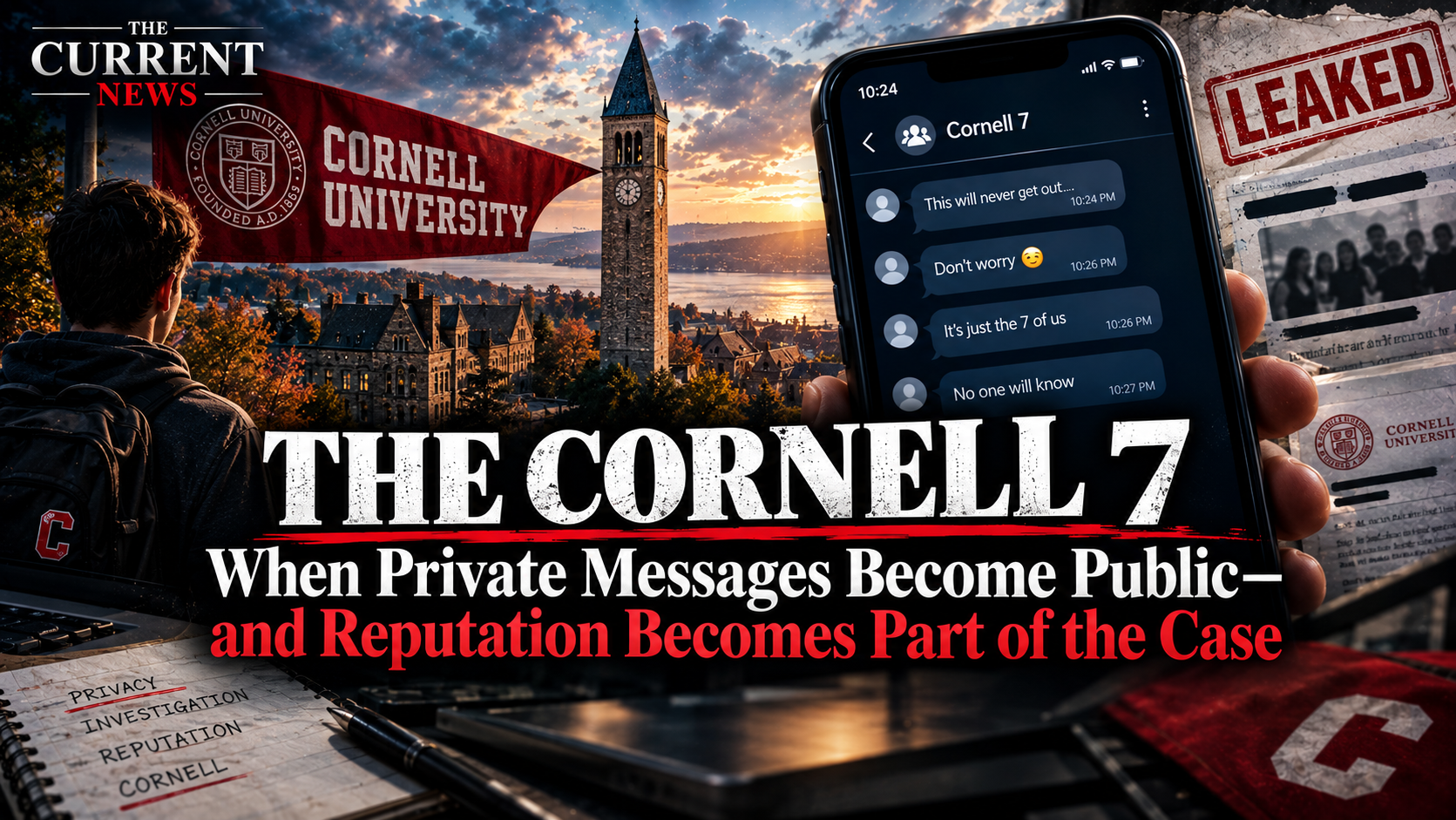
The Newly Released Texts Raise Difficult Questions About Consent, Sexuality, and What Happened Behind Closed Doors
A college party. A series of sexual encounters. Messages exchanged in the hours and days afterward. A young woman telling someone that her reputation has been destroyed. And now, nearly two years later, those private conversations are being dissected by the entire country.
The case known as the “Cornell 7” has become a national controversy after a former Cornell University student, identified in court filings as Jane Doe, accused seven former fraternity members of sexually assaulting her at a Chi Phi fraternity house in October 2024.
Her civil lawsuit alleges that she was pressured to consume drugs and alcohol, became incapacitated, and was sexually assaulted by multiple men. The defendants have not all publicly responded, and attorneys for some have denied wrongdoing. No criminal charges were filed in the original investigation, which has since been reopened.
But newly reported text messages have added a complicated dimension to the story.
The messages show Jane Doe discussing the sexual encounter in ways that initially appear different from the account she would later give investigators. They also show her expressing distress about rumors spreading across campus and saying that her reputation had been damaged.
That creates two questions that must be considered separately:
What do the messages actually establish about the encounter?
And what happens when a woman’s private sexual experiences become public property, debated by strangers who believe they can determine her credibility from a handful of screenshots?
Both questions matter. Neither can be answered responsibly by cherry-picking the messages that support a preferred conclusion.
OCTOBER 19–20, 2024: THE NIGHT THAT STARTED THE CASE
According to the civil lawsuit and records reviewed by news organizations, Jane Doe was a 20-year-old Cornell student when she went to the Chi Phi fraternity house during the early hours of October 20, 2024, after drinking earlier in the evening.
She alleges that she was given additional alcohol, marijuana, and ketamine and that multiple men engaged in sexual activity with her after she became incapacitated.
One of the most troubling pieces of evidence reported in the lawsuit is a fraternity group-chat message allegedly inviting others to participate in sexual activity with a woman upstairs. The message reportedly referred to “free” sex in crude terms. <Cite refs={[”turn838304search2”,”turn954892news9”]}/>
That message raises serious questions about how some people in the group were discussing the woman and the encounter.
It does not, by itself, establish what every person did, what each person understood, or whether a particular sexual act occurred without consent. Those are questions that require a careful examination of the full evidence.
But the language matters because it appears to describe a person as an opportunity for sexual access rather than as an individual whose consent must be established.
A group chat is not a substitute for consent. And an invitation from one person cannot establish another person’s consent.
OCTOBER 23: “MY REPUTATION IS DESTROYED”
One of the most revealing developments in the recently reported messages comes just days after the alleged encounter.
Jane Doe exchanged texts with Matthew Ingalls, one of the fraternity members she would later accuse in her lawsuit. They discussed rumors spreading about what had happened.
In the messages reported by TMZ, Jane Doe wrote that everyone seemed to know about the encounter and that she was extremely stressed. She described the rumors as ruining her life temporarily and said her reputation was destroyed and she was ashamed. <Cite refs={[”turn954892search0”,”turn954892search6”]}/>
This is a significant part of the story.
At that point, her immediate concern, as reflected in those messages, was not simply what had happened in the bedroom. It was also what other students were saying about her.
She was upset that private sexual information was spreading around campus. She was trying to work out who had shared it. She and Ingalls discussed the rumors and who might have been responsible for spreading them. <Cite refs={[”turn954892search0”,”turn954892search1”]}/>
The messages also include her making comments about sexuality, sexual openness, and the idea that people should not be ashamed of consensual sexual experiences.
Those statements deserve to be read in context.
They show what she was communicating at that moment. They do not automatically tell us what she experienced during every sexual act, what she remembered, or how she understood the encounter later.
There is a difference between regretting a consensual encounter, being distressed about public humiliation, and alleging that sexual acts occurred without consent.
Those experiences can overlap, but they are not interchangeable.
The texts make the reputational dimension of this case impossible to ignore.
DOES HER EARLY LANGUAGE CONTRADICT HER LATER ALLEGATIONS?
This is the difficult question—and the one likely to dominate online discussion.
In messages reported by ABC News, Jane Doe initially told one of the men that she liked being with him and that she did not believe the sexual activity was illegal. Nearly two weeks later, she wrote that approximately 90% of what happened had not been consensual and described feeling like a “sex doll.” <Cite refs={[”turn954892search2”,”turn954892search5”]}/>
That is a real change in how she described the encounter.
It should not be ignored.
Investigators should examine the timing, the complete context of the messages, her account of what she remembers, the evidence concerning intoxication and incapacitation, and the accounts of everyone involved.
The men accused in the lawsuit are entitled to have the evidence assessed fairly. Serious allegations should not be treated as proven simply because they have been made.
But the opposite shortcut is also flawed.
An early message expressing affection, sexual interest, or a belief that an encounter was consensual does not automatically establish that every subsequent act was consensual.
Consent must be assessed in relation to the particular activity and the person’s capacity to consent at the time. Someone’s willingness to engage in one sexual act does not grant blanket permission for everything that follows. Nor does a person’s later account automatically prove that an assault occurred.
The question is not whether the messages make the case more complicated. They plainly do.
The question is what the complete evidence establishes.
WAS THIS SEXUAL ACTIVITY—OR WAS A PERSON BEING TREATED LIKE A SPECTACLE?
The language reported in the fraternity’s group chat is disturbing because of the way it allegedly framed the encounter as an opportunity for others to join in.
The lawsuit alleges that additional men entered the room and that Jane Doe became increasingly uncomfortable and felt trapped. In accounts documented during Cornell’s internal investigation, she described feeling surrounded and defenseless. <Cite refs={[”turn954892news8”,”turn838304search2”]}/>
If the allegations are substantiated, this would raise questions that extend beyond whether an individual initially agreed to sexual activity.
Who understood what was happening?
Who knew how much alcohol or ketamine she had consumed?
Who could recognize whether she was capable of making decisions?
What did each person observe when entering the room?
And what did the messages encourage others to believe about her willingness?
These are factual questions, not conclusions.
There is no need to claim that the encounter was literally filmed or produced as pornography to recognize the concern raised by the reported group-chat language. The available reporting describes messages discussing sexual access and inviting others to participate; it does not establish that the encounter was a deliberately recorded pornographic production.
The distinction matters. Sensational language may attract attention, but it can also obscure the precise conduct that investigators need to evaluate.
If a person is treated as though her consent is already guaranteed, that is a serious concern. Whether any individual committed a crime still depends on the evidence of that individual’s conduct and the applicable law.
THE REPUTATION QUESTION CUTS BOTH WAYS
The newly reported texts reveal that Jane Doe was concerned about her reputation almost immediately after the encounter.
That deserves attention, but not a simplistic interpretation.
Some people will argue that her early messages show she initially viewed the encounter as consensual and only later characterized it as assault. That is a legitimate evidentiary question for investigators to explore.
Others will point out that the messages show a young woman distressed by rumors, shame, and the loss of control over private information. That context also matters.
Neither interpretation should be accepted automatically.
A person’s concern about reputation does not prove that an assault occurred. It also does not prove that an assault did not occur.
And a person’s willingness to discuss sex openly does not eliminate the need to establish consent for each act.
The public should resist the temptation to turn one text into a verdict.
A message can be authentic and still tell only part of the story.
THE ACCUSED ALSO HAVE REPUTATIONS AT STAKE
Sensitivity must extend to everyone involved in a case like this.
Seven former fraternity members have been named in the civil lawsuit. They face allegations that can carry profound personal, professional, and social consequences.
Some of the accused have denied wrongdoing through their attorneys. No criminal charges were filed in the initial investigation, although the criminal case has since been reopened. <Cite refs={[”turn954892news9”,”turn838304search5”]}/>
It would be irresponsible to portray every defendant as guilty simply because the allegations are disturbing.
It would also be irresponsible to conclude that the allegations are false simply because some of the messages appear inconsistent with the woman’s later account.
The proper approach is to examine the evidence individually.
What did each defendant allegedly do? What did that person know? What do the contemporaneous messages show? What do the witnesses say? What does the forensic evidence establish? And what evidence supports or contradicts the allegations against each individual?
Those questions matter more than assigning collective guilt to everyone associated with a fraternity.
THE INVESTIGATION HAS NOW REOPENED
The case is no longer limited to the initial investigation that ended without criminal charges.
Following the filing of Jane Doe’s civil lawsuit and new reporting about the records, Tompkins County District Attorney Matthew Van Houten confirmed that the criminal investigation had been reopened. New York Gov. Kathy Hochul subsequently appointed state Attorney General Letitia James as special prosecutor. <Cite refs={[”turn954892news9”,”turn838304search2”]}/>
That is an important development.
It means the evidence and the handling of the original investigation are receiving renewed scrutiny. It does not mean the allegations have been proven or that criminal charges are inevitable.
The university also conducted its own Title IX investigation, which involved extensive interviews and disciplinary proceedings. Cornell has reported disciplinary action against some students, although the outcomes differed among the individuals involved. University discipline and criminal guilt are separate determinations governed by different standards. <Cite refs={[”turn838304search6”,”turn954892news8”]}/>
The reopened investigation should examine the messages in their full context, including the communications that appear favorable to the accused as well as those that raise questions about their conduct.
That is what a fair process requires.
THE PUBLIC HAS A RESPONSIBILITY, TOO
There is a final issue that deserves more attention than it has received: the release and circulation of intimate, private communications.
Jane Doe’s texts about shame and reputation were written in the immediate aftermath of a deeply personal experience. They were not written as a public statement for millions of strangers to analyze.
Now those messages are being circulated, quoted, and used to argue about her character.
That does not mean the messages are irrelevant. Contemporaneous communications can be important evidence in a legal case.
But there is a difference between reporting on evidence and humiliating someone with it.
The same principle applies to the accused. Their names, photographs, personal information, and allegations against them have also circulated widely. Recent reporting has documented a court’s decision to seal certain case documents after an unrelated individual was mistakenly identified through an address in a filing and subsequently targeted. <Cite refs={[”turn954892search7”]}/>
The internet can transform a legal dispute into a public punishment long before a court determines what happened.
And once intimate information spreads, the damage may be impossible to reverse.
The public can demand transparency without spreading private material unnecessarily. It can scrutinize allegations without treating a person as a target. It can insist on accountability while preserving the presumption that the accused are not guilty unless proven guilty.
THE CURRENT NEWS BOTTOM LINE
The newly reported Cornell messages add important context to the case.
They show Jane Doe discussing the encounter in apparently positive terms at first, then later describing much of it as nonconsensual. They also show her expressing distress over campus rumors and saying that her reputation had been damaged. <Cite refs={[”turn954892search0”,”turn954892search2”]}/>
Those details deserve serious examination.
But they do not independently establish the full truth of what happened in that room.
The lawsuit alleges that drugs and alcohol left Jane Doe incapacitated and that multiple men sexually assaulted her. The accused are entitled to contest those allegations. The criminal investigation has been reopened, and the evidence must be assessed rather than decided through online outrage.
There are two easy conclusions people may want to reach.
One is that the allegations must be true because the reported group-chat language is disturbing.
The other is that the allegations must be false because some of her early messages sound different from her later account.
Neither conclusion follows automatically from the available texts.
The more difficult task is to determine what happened, what each person knew, whether consent was present at each stage, and whether the evidence establishes criminal conduct.
Meanwhile, the reputation issue has become part of the story itself.
A woman says she was harmed and that her reputation was damaged. The men she has accused face allegations that may affect their lives for years. The university’s response is under scrutiny. And the public is being asked to interpret private messages without having witnessed the encounter.
That is why this case demands both accountability and restraint.
The Current News Question
Can we demand a full accounting of the evidence in the Cornell 7 case without turning a disputed sexual-assault allegation into a public trial of someone’s character?
The messages deserve scrutiny. The allegations deserve investigation. The accused deserve due process. And the facts—not the loudest online narrative—should determine what happens next.
Editorial & Legal Note
Jane Doe’s allegations are disputed and have not been established in a criminal trial. The named defendants should not be presumed guilty. The text messages discussed here are reported excerpts, not a complete record of the encounter or the parties’ communications. Their meaning must be assessed in context, alongside other evidence. The criminal investigation has been reopened, and the case remains unresolved.