Cornell 7 Part 2: Consent, Intoxication and Boundaries
If drugs and alcohol impaired multiple people in the Cornell 7 case, how should consent and responsibility be assessed for everyone involved?
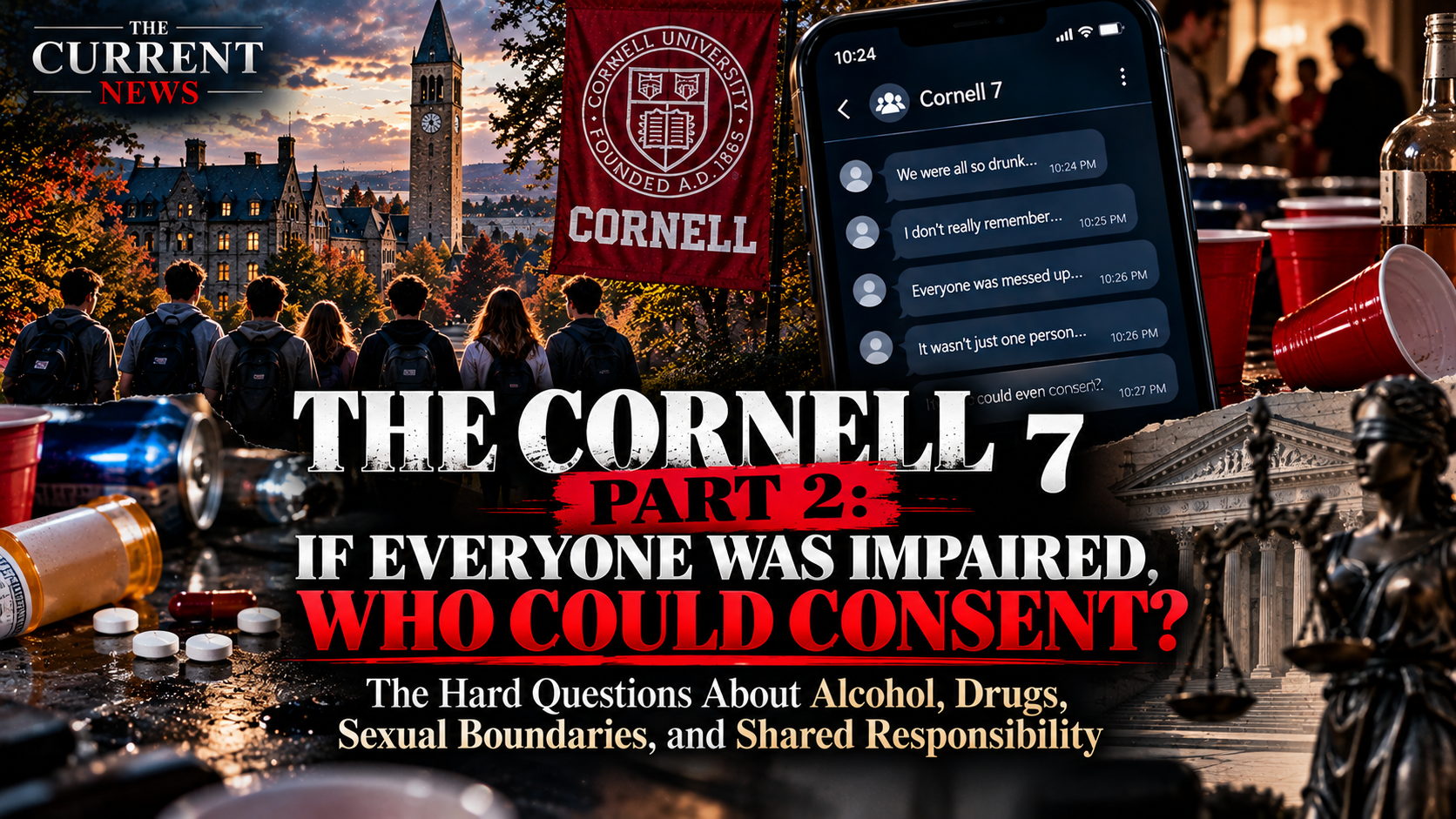
The Cornell 7 case has raised difficult questions about consent, fraternity culture, and the messages young adults receive about sex. But there is another question that deserves serious attention: If alcohol and drugs impaired multiple people during the encounter, how do we determine who was capable of consenting?
That question cuts both ways.
Jane Doe alleges that she was incapacitated and sexually assaulted by members of Cornell University’s Chi Phi fraternity. The men named in the civil lawsuit have denied wrongdoing, and no criminal charges have been filed. Reported text messages, however, suggest that some of the men also believed they were heavily intoxicated and that the situation had gotten out of hand.
In a text dated October 21, 2024, one fraternity member apologized for being too intoxicated to intervene and remove other people from the room. Jane Doe responded that she believed everyone had been extremely drunk and high. She also initially described parts of the encounter positively, while objecting to other men entering the room. On November 3, she wrote that 90% of what happened had not been consensual.
Those messages do not settle the case. They do, however, raise a broader question about what consent means when a sexual encounter unfolds in an environment where drugs, alcohol, and impaired judgment are involved.
If we take consent seriously, we must ask the same fundamental question about every participant: Was this person capable of making a knowing, voluntary decision about the sexual activity taking place?
Being drunk is not the same as being incapacitated
One of the most important distinctions in this debate is the difference between intoxication and incapacity.
A person can consume alcohol, feel its effects, and still be capable of making decisions. Another person may be so impaired by alcohol or drugs that they cannot understand what is happening, make a knowing choice, or communicate a decision.
Those are not equivalent situations.
The same principle applies to drugs. The mere presence of alcohol or ketamine does not, by itself, tell us how impaired every individual was at a particular moment. The amount consumed, the timing, the effects on each person, and the conduct that followed all matter.
New York’s Penal Law recognizes incapacity to consent as a basis for lack of consent in sexual-offense cases. The law distinguishes incapacity from other circumstances in which consent is absent, and the precise legal analysis depends on the offense and facts at issue.
That means a party cannot be evaluated simply by counting how many people were drinking.
The relevant question is what each person was capable of understanding and choosing at the time of the specific sexual act.
If someone is merely tipsy, that does not automatically mean they cannot consent. If someone is incapacitated, apparent participation or a failure to resist does not necessarily establish consent.
The distinction is crucial because both assumptions—“everyone was drunk, so it was all consensual” and “everyone was drunk, so nobody could consent”—go further than the evidence allows.
Could the men have been too impaired to consent, too?
This is a fair question to ask, particularly given the reported messages.
One fraternity member reportedly acknowledged that he and another man had been too intoxicated to stop the situation from escalating. Jane Doe also wrote that she believed everyone was extremely drunk and high.
If the men were genuinely impaired, their condition deserves consideration. The question should not be dismissed simply because they are the accused.
But we need to be precise about what the messages establish.
Being too intoxicated to recognize that a situation is getting out of hand is not necessarily the same as being legally incapable of consenting to sexual activity. Someone might have enough awareness to participate in one activity but not enough capacity to make a different decision. Conversely, a person who appears to be participating may be too impaired to give valid consent.
The reported apology also does not establish that either man was legally incapacitated. It is a statement about their condition and their failure to intervene, and it must be assessed alongside the rest of the evidence.
The law does not automatically excuse a person who initiates sexual activity simply because that person has been drinking or using drugs. New York’s consent guidance states that consent is required regardless of whether the person initiating sexual activity is under the influence.
That is an important boundary: your own intoxication does not give you permission to disregard someone else’s capacity or boundaries.
At the same time, whether a particular person was capable of consenting remains a fact-specific question. It cannot be answered solely from the fact that they attended a party or consumed substances.
When does a consensual encounter stop being consensual?
The reported messages point to another distinction that is often lost in online arguments.
Jane Doe initially wrote that she liked being with two men and did not believe the sexual activity was illegal. She also objected to other men entering the room. Later, she described most of the encounter as nonconsensual.
These statements raise questions about how the encounter unfolded, but they do not necessarily contradict each other in the way some online commentary suggests.
Consent is not a permanent agreement covering everything that happens afterward.
A person may agree to sexual activity with one partner and not another. They may consent to one act but not another. They may change their mind. And if they become incapacitated, they may no longer be capable of consenting to additional activity.
New York’s official consent guidance emphasizes that consent can be withdrawn and that consent to one sexual act or previous sexual activity does not necessarily constitute consent to another act.
That principle applies regardless of whether someone has a conservative view of sex, prefers casual relationships, or has previously had consensual encounters with the people involved.
A person’s sexual history does not grant anyone continuing permission.
The important questions are what happened at each stage, who was involved, what each person communicated, and whether each person had the capacity to consent.
What if nobody clearly understood what was happening?
This is the difficult possibility at the center of a party involving multiple intoxicated people.
Imagine a situation in which two people begin a consensual encounter, additional people enter the room, and everyone has consumed alcohol or drugs. One person may believe the encounter is welcome. Another may be uncomfortable. A third may be too impaired to recognize that someone else has objected. Someone else may be incapacitated altogether.
In such a situation, the fact that the encounter began consensually would not answer whether every subsequent act was consensual.
Nor would the fact that everyone had been drinking automatically establish that a crime occurred.
The evidence would need to show what each person did, what they could reasonably understand, whether someone expressed or demonstrated a boundary, and whether a participant was capable of making a knowing decision.
The Cornell 7 allegations make these questions especially important because they involve claims about intoxication, additional men entering the room, and sexual activity that Jane Doe says she did not consent to.
The messages also reportedly contain an acknowledgment from one man that he had been too intoxicated to intervene. That statement is relevant to the discussion, but it does not tell us everything about his capacity, what he witnessed, or what he understood at the time.
Those are matters for a careful investigation—not conclusions to be drawn from a few screenshots.
Responsibility does not disappear when judgment is impaired
There is a broader cultural issue here.
Modern social life often treats heavy drinking and drug use as ordinary features of parties. In some environments, people are encouraged to push boundaries, experiment sexually, and treat spontaneous encounters as part of the college experience.
But if people knowingly enter environments where intoxication is common, they still need to understand that sexual consent has limits.
That does not mean every person who drinks is responsible for anything that happens afterward. Nor does it mean that someone who voluntarily consumes alcohol forfeits the right to refuse sexual activity.
It means that people must recognize the risks of combining substances with sexual decisions—and that a person’s freedom to participate does not eliminate everyone else’s responsibility to respect boundaries.
A conservative perspective can make this point without resorting to victim-blaming: sexual freedom carries responsibilities, and those responsibilities apply to every participant.
If someone is too impaired to consent, the answer is not to argue that the person chose to attend the party. If someone initiates sexual activity, their own intoxication does not automatically excuse disregarding another person’s capacity. And if the facts are disputed, the public should not substitute assumptions for evidence.
Responsibility is not a one-sided concept. It must be assessed according to each person’s actions and circumstances.
What should investigators be asking?
The central questions are not especially complicated, even if the answers may be difficult to establish.
Capacity: How impaired was each participant at the relevant time? What evidence shows whether they could understand and voluntarily choose to participate?
Boundaries: What did each person communicate, verbally or through their conduct, about the sexual activity?
Changes in the encounter: Who entered the room, what changed, and what did each participant understand about the situation?
Knowledge: What did each person know or reasonably perceive about another person’s condition and boundaries?
Timeline: How do the messages, witness accounts, physical evidence, and investigative records fit together?
These questions should be applied consistently to the accuser and the accused. They do not presume guilt, and they do not assume that the encounter was consensual simply because some messages initially described it positively.
The purpose of an investigation is to establish what happened—not to confirm a narrative that was formed before all the evidence was considered.
The Current News Bottom Line
The Cornell 7 case forces us to confront a question that extends beyond one fraternity house: What does consent mean when alcohol, drugs, and impaired judgment are involved?
The reported messages suggest that multiple participants may have been heavily intoxicated. They also show that Jane Doe initially described parts of the encounter positively before later stating that most of it was nonconsensual. Neither fact settles the case.
Being intoxicated does not automatically mean a person cannot consent. Being incapacitated can mean they cannot. And a person’s own intoxication does not grant permission to disregard someone else’s boundaries.
The answer must be based on the circumstances of each act and each participant—not a blanket assumption that everyone consented because they were at a party, or that nobody could consent because everyone had been drinking.
A culture that values sexual freedom must also take the limits of consent seriously. And a justice system that values fairness must examine those limits consistently for everyone involved.
The Current News Question
If drugs and alcohol were affecting multiple people during the Cornell encounter, how should investigators determine who was capable of consenting—and what responsibility did each person have to recognize when someone else could not?
That is the boundary worth examining: not whether someone attended a party or embraced a particular sexual lifestyle, but whether the people involved were capable of making choices and respecting one another’s limits.
Editorial & Legal Note
This article discusses publicly reported text messages and the allegations in the Cornell 7 civil lawsuit. The messages do not independently establish the capacity or intent of any participant at the time of each sexual act. The accused men have denied wrongdoing, no criminal charges have been filed, and the allegations remain disputed. The legal discussion summarizes general principles under New York law and is not a determination of liability or guilt.