Lindsay Clancy Case: What Happens After the Mistrial?
Lindsay Clancy's mistrial left her case unresolved. Here are five possible paths, from acquittal and double jeopardy to retrial or a plea deal.
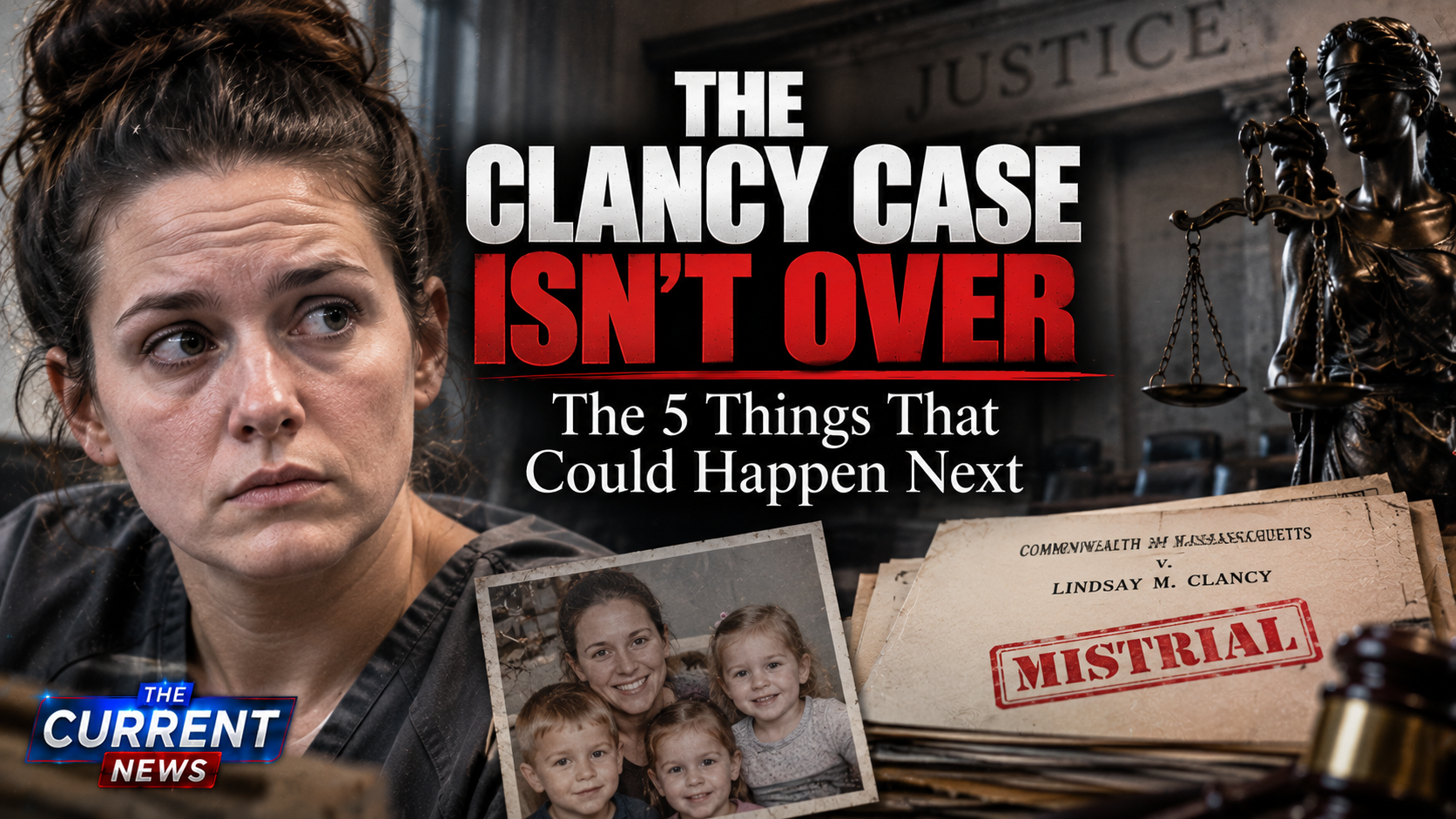
The jury is gone.
The courtroom has emptied.
But the Lindsay Clancy case is nowhere near finished.
After more than five weeks of testimony, seven days of deliberations and a jury that ultimately could not reach a unanimous verdict, Judge William Sullivan declared a mistrial on September 4.
There was no conviction.
There was no acquittal.
And there was no final answer to the question that has surrounded this case from the beginning: Was Lindsay Clancy criminally responsible for the deaths of her three children?
Now the case enters an entirely different phase.
Clancy’s defense is fighting to prevent another trial altogether. Prosecutors have not yet said whether they intend to try her again. And even President Donald Trump has now been pulled into the public discussion after Clancy’s attorney asked him for a pardon—only for Trump to point out that this is a Massachusetts state case, not a federal one.
So what happens now?
Here are the five biggest possibilities.
1. THE JUDGE COULD FIND CLANCY NOT GUILTY
This is perhaps the most immediate development to watch.
Defense attorney Kevin Reddington has filed a renewed motion asking Judge Sullivan to enter a required finding of not guilty based on insufficient evidence.
The defense’s argument is straightforward: the prosecution had the burden of proving criminal responsibility beyond a reasonable doubt, and Reddington argues the evidence presented at trial could not legally support that conclusion.
This isn’t simply an argument that the jury made the wrong decision.
It is an argument that the evidence itself was legally insufficient to sustain a conviction.
Massachusetts Rule of Criminal Procedure 25 allows a judge to enter a finding of not guilty when the evidence is insufficient as a matter of law to support a conviction. The rule also allows the defense to renew such a motion after a jury has been discharged without reaching a verdict.
That’s important.
If Judge Sullivan grants the motion, the case could effectively be over.
There would be no second jury.
No second trial.
And no opportunity for prosecutors to obtain a conviction on those charges.
The hearing is scheduled for September 29.
But there is a major obstacle for the defense:
Judges do not simply replace a jury because they disagree with the jury.
The legal question is whether the Commonwealth’s evidence was sufficient under the applicable standard.
That’s a much higher hurdle than simply arguing that another jury might have reached a different conclusion.
2. THE DEFENSE COULD WIN A DOUBLE-JEOPARDY FIGHT
This may be the most complicated legal battle ahead.
Reddington has also indicated that he intends to challenge any attempt to retry Clancy on double-jeopardy grounds.
Normally, a mistrial caused by a genuinely deadlocked jury does not prevent prosecutors from trying the case again.
Massachusetts law recognizes that a jury must reach a unanimous verdict, and the state’s criminal procedure rules specifically contemplate a mistrial when jurors cannot agree.
But there is an important exception.
A mistrial generally must be supported by what the law calls “manifest necessity” if the defendant objected to ending the trial.
That is where the Clancy defense sees an opening.
During deliberations, the jury repeatedly indicated that it was unable to reach a unanimous decision. Defense attorneys argued that Judge Sullivan should have taken additional steps concerning the lone holdout juror rather than ending the trial.
Reddington argues that the mistrial was therefore not legally necessary and that another prosecution should be barred.
Massachusetts precedent says courts examining such a claim look at whether the judge carefully considered alternatives to a mistrial and whether counsel had a full opportunity to be heard.
That does not mean the defense automatically wins.
In fact, Massachusetts rules recognize a hung jury as a classic circumstance supporting a mistrial and allowing a retrial.
But the unusual circumstances surrounding the deliberations give the defense an argument worth watching.
If the double-jeopardy motion succeeds, the prosecution could be stopped from trying the case again.
3. PROSECUTORS COULD TRY HER AGAIN
This remains one of the clearest possibilities.
The mistrial did not amount to an acquittal.
There was no unanimous verdict.
And prosecutors have not announced that they are abandoning the case.
The Plymouth County District Attorney’s Office must now decide whether the evidence and circumstances justify another trial.
That decision is anything but simple.
A second trial would mean rebuilding a massive case that already consumed weeks of courtroom time and required testimony from dozens of witnesses.
It would also mean putting the families of Cora, Dawson and Callan through another highly publicized proceeding.
And then there is the biggest question:
Would another jury reach a different conclusion?
Eleven jurors reportedly leaned toward finding Clancy not criminally responsible, while one juror remained opposed. Jurors who have spoken publicly have described the deliberations as deeply divided.
That creates an uncomfortable reality for prosecutors.
They could retry the case.
But they cannot guarantee that a second jury will convict.
And after hearing the evidence once, another jury would enter the courtroom knowing this case has already ended in a hung jury.
That doesn’t determine the outcome.
But it is part of the calculation.
4. A PLEA DEAL COULD END THE CASE
There is another possibility that sometimes gets overlooked when everyone is focused on the words “retrial” and “acquittal.”
The prosecution and defense could negotiate.
Reddington has already indicated that he is open to discussions with Plymouth County District Attorney Timothy Cruz.
A plea agreement could potentially involve different charges or another negotiated resolution.
But this would be an extraordinarily difficult case in which to negotiate.
Three children died.
Clancy has admitted responsibility for the physical acts that caused their deaths, while maintaining that she was experiencing severe mental illness and lacked criminal responsibility.
The defense wants to avoid prison.
The prosecution has spent years pursuing murder charges.
And the victims’ families would inevitably have a profound interest in whatever resolution is proposed.
A plea deal could provide certainty where another trial offers uncertainty.
But certainty does not necessarily mean everyone would consider the result justice.
5. THE CASE COULD BECOME AN EVEN BIGGER DEBATE ABOUT MENTAL ILLNESS
There is one final possibility that has nothing to do with whether the next legal step is a trial, dismissal or plea.
The Clancy case may continue to influence the national conversation about postpartum psychosis and criminal responsibility regardless of what happens in court.
That was one of the themes repeatedly emphasized by the defense.
Reddington has argued that Clancy’s case demonstrates how difficult it can be for the public to understand the difference between someone committing a horrific act and someone who is legally responsible for that act.
The distinction is critical.
A person can commit an act without the law necessarily concluding that the person possessed the mental capacity required for criminal responsibility at that moment.
That is not the same thing as saying the deaths were not horrific.
They were.
It is not the same thing as saying the victims do not matter.
They matter enormously.
And it is not the same thing as saying mental illness automatically excuses criminal conduct.
It does not.
The legal system is being asked to answer a much narrower question:
What was Lindsay Clancy’s mental state when she killed her children, and did that mental state satisfy the legal standard for criminal responsibility?
That question remains unresolved.
AND THEN THERE’S TRUMP
Perhaps the strangest development in the aftermath of the mistrial was the defense’s decision to appeal publicly to President Donald Trump for a pardon.
Reddington acknowledged that Clancy’s case is being prosecuted in Massachusetts state court, meaning the president does not have authority to pardon the state charges. The U.S. presidential pardon power applies to federal offenses.
Trump has now effectively closed that door.
On Sunday, he described the situation as tragic but said it was a state matter, not a federal one.
That doesn’t end the political conversation surrounding the case.
But legally, it is an important distinction.
The White House cannot simply erase a Massachusetts murder prosecution with a presidential pardon.
If Clancy’s case ends, it will most likely be because of a decision made within the Massachusetts justice system—not because the president intervened.
THE CURRENT NEWS BOTTOM LINE
The biggest mistake would be to treat the mistrial as though Lindsay Clancy “won.”
She didn’t.
But prosecutors didn’t win either.
There was no conviction.
There was no acquittal.
There is simply an unresolved case involving the deaths of three children and a profoundly disputed question of criminal responsibility.
And now the next battle moves away from the jury box.
On September 29, Judge William Sullivan is expected to confront some of the most consequential questions yet:
Was the evidence legally sufficient?
Should Clancy be found not guilty?
Can prosecutors legally try her again?
And if they can, should they?
Those questions could determine whether the Clancy case gets another jury—or whether the September 2026 mistrial becomes the final chapter.
For now, nobody knows.
And that may be the most important fact of all.
THE CURRENT NEWS QUESTION
If 11 of 12 jurors were prepared to find Lindsay Clancy not criminally responsible, should prosecutors risk another trial—or is the mistrial the point where this case should finally end?
Editorial & Legal Note
Lindsay Clancy has been accused of killing her three children and has admitted to the physical acts that caused their deaths. She has maintained that she was suffering from severe mental illness and lacked criminal responsibility at the time. Her September 2026 trial ended in a mistrial after the jury could not reach a unanimous verdict. The legal proceedings remain unresolved, and allegations should not be treated as findings of guilt.