Lindsay Clancy Jury Deadlocked: Is Social Media Influencing the Case?
The Lindsay Clancy jury is deadlocked after four days of deliberations. Could years of social-media commentary be influencing this high-profile case?
Four days.
More than 20 hours of deliberation.
And now, for the first time, the Lindsay Clancy jury has told the judge what everyone watching this case has been waiting—and perhaps dreading—to hear:
“We are unable to come to a unanimous decision.”
On Tuesday morning, September 1, the 12 jurors sent Judge William Sullivan a note telling him they had reached an impasse. Instead of declaring a mistrial, Sullivan told them to return to the jury room and continue deliberating.
They continued for several more hours before asking to leave for the day.
They will return Wednesday morning.
And suddenly, another question deserves to be asked:
Could the enormous amount of social-media commentary surrounding this case be making an already difficult decision even harder?
We don’t know.
There is no evidence that these jurors have been watching TikTok videos, listening to podcasts or reading online commentary.
They are instructed not to do so.
But after nearly three years of public discussion surrounding this case, the question is worth examining.
Because the Lindsay Clancy trial isn’t happening in a vacuum.
It is happening in the age of TikTok detectives, YouTube lawyers, true-crime influencers, conspiracy theories and millions of armchair jurors.
And sometimes, the internet can make a complicated case even more complicated.
THE JURY HAS REACHED AN IMPASSE
Let’s start with what we actually know.
The jury began deliberating Thursday, August 27.
By Tuesday morning, they had spent roughly 23 hours deliberating over four days.
Then came the note.
“After many hours of deliberation we are unable to come to a unanimous decision.”
Judge Sullivan acknowledged the extraordinary amount of evidence the jury had been asked to consider—more than 80 witnesses and more than 300 exhibits—and nevertheless instructed them to continue deliberating.
This isn’t a verdict.
It isn’t even necessarily the end of deliberations.
But it is the first official indication that the jury is genuinely divided.
AND THAT CHANGES EVERYTHING
Until Tuesday, people could reasonably say:
“They’re just taking their time.”
And perhaps they still are.
But now the jury itself has told the court:
We cannot agree.
That’s different.
It doesn’t tell us how many jurors favor conviction.
It doesn’t tell us how many favor a finding of lack of criminal responsibility.
It doesn’t tell us whether the disagreement is over first-degree murder versus a lesser offense.
And it doesn’t tell us whether there is a single juror holding out—or whether the jury is divided much more evenly.
The deliberations are secret.
We don’t know.
SO WHERE DOES SOCIAL MEDIA COME INTO THIS?
For the past several weeks, this case has been dissected online from virtually every possible angle.
TikTok creators have analyzed testimony.
YouTubers have examined courtroom footage.
Podcasters have debated psychiatric experts.
Commentators have predicted the verdict.
Some have argued Lindsay was suffering from postpartum psychosis.
Others have described the killings as deliberate and calculated.
Others have gone even further, questioning Patrick Clancy’s actions and promoting alternative theories about what happened.
And then there are the thousands of people who simply watch, comment and share.
The case has become a massive online conversation.
But here’s the important distinction:
We don’t know whether the jury is participating in that conversation.
They are legally prohibited from allowing outside information to influence their deliberations.
So we should not accuse them of doing something for which there is no evidence.
But that doesn’t mean the broader phenomenon isn’t worth discussing.
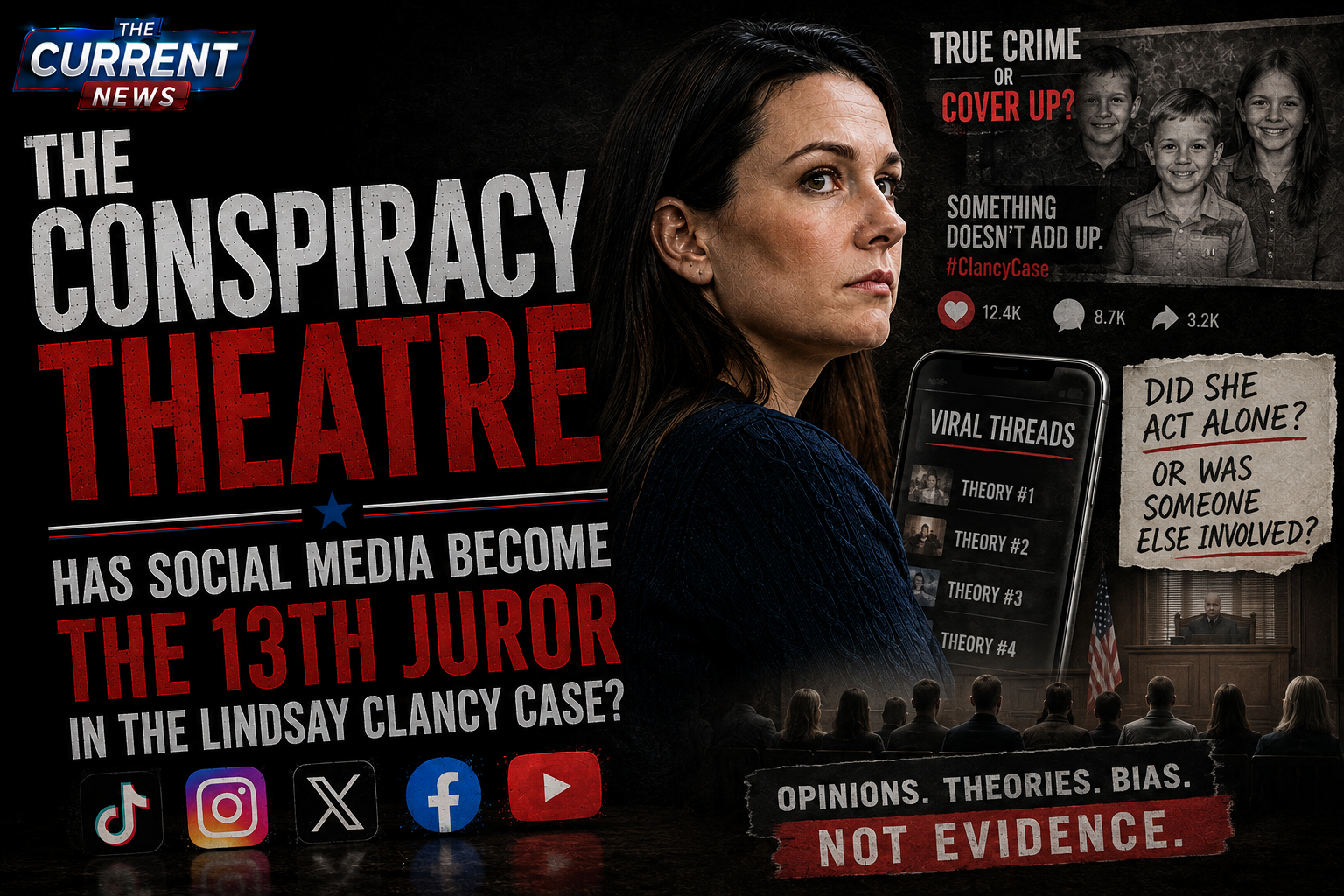
THE 13TH JUROR
Every criminal defendant is supposed to have a jury of 12.
Not 13.
Not 100,000 TikTok users.
Not a podcast audience.
Not a Facebook comment section.
Twelve.
But modern trials have created something that feels increasingly like a 13th juror:
the internet.
The internet doesn’t get a vote.
But it can create narratives.
And those narratives can become incredibly powerful.
Before a jury ever reaches a verdict, millions of people may already have decided who is guilty.
Or who is innocent.
Or who is lying.
Or which expert is credible.
Or what evidence matters.
That creates an unusual environment for any high-profile defendant.
THIS CASE HAS BEEN GOING ON FOR THREE YEARS
That’s another factor that makes the Clancy case unusual.
The killings occurred in January 2023.
It is now September 2026.
Nearly three years have passed.
In that time, the public has watched the case evolve from breaking news into one of the country’s most closely followed criminal trials involving postpartum mental health.
The story has been discussed repeatedly.
The photographs have circulated.
The interviews have circulated.
The legal filings have circulated.
The psychiatric debate has circulated.
The theories have multiplied.
And now the jury is being asked to shut all of that out.
That’s not easy.
But it is their responsibility.
THE JURY IS SUPPOSED TO LIVE IN THE COURTROOM
There’s a reason judges tell jurors not to consume outside information.
A juror who sees a TikTok saying:
“The prosecution destroyed the defense!”
has received information that wasn’t presented in court.
A juror who watches a podcast saying:
“This proves Clancy was psychotic!”
has received another person’s interpretation of evidence.
Neither belongs in the deliberation room.
The jury is supposed to deliberate based on what happened inside the courtroom.
BUT SOCIAL MEDIA IS VERY GOOD AT CREATING CERTAINTY
This may be the biggest problem.
The legal system is comfortable with uncertainty.
The internet isn’t.
A trial can say:
“We don’t know.”
Social media says:
“Here’s what REALLY happened.”
A forensic expert can say:
“The evidence is consistent with X, but there are limitations.”
A TikTok creator says:
“This proves X.”
A psychiatrist can disagree with another psychiatrist.
The internet picks a winner.
A defense attorney can raise a reasonable doubt.
The internet turns it into a conspiracy.
And suddenly, complicated evidence gets reduced to a 45-second video.
THE CLANCY CASE IS PARTICULARLY VULNERABLE
Why?
Because the central issue isn’t simply:
Did she kill the children?
Both sides agree she did.
The central question is:
Was she criminally responsible?
That is extraordinarily complicated.
It requires the jury to evaluate competing psychiatric evidence.
They have heard experts disagree about postpartum psychosis.
They have heard different interpretations of Clancy’s behavior.
They have heard arguments about medications.
They have heard testimony about her treatment history.
They have heard competing explanations for the same actions.
This isn’t a case where a fingerprint either matches or doesn’t.
The jury is being asked to make a judgment about the human mind.
THE SOCIAL-MEDIA PROBLEM WITH PSYCHIATRY
And psychiatry may be one of the easiest subjects for the internet to distort.
One person says:
“She had postpartum psychosis.”
Another says:
“She wasn’t psychotic.”
Another says:
“The medication caused it.”
Another says:
“The medication had nothing to do with it.”
Another says:
“Her behavior proves she knew exactly what she was doing.”
Another says:
“Her behavior proves she was detached from reality.”
And suddenly, the average viewer believes they are qualified to diagnose a person they’ve never met.
That’s dangerous.
The jurors have something the internet commentators don’t:
weeks of testimony from professionals who actually evaluated the evidence.
AND THEN THERE ARE THE CONSPIRACIES
This is where our Conspiracy Theatre series comes in.
We’ve already watched online theories develop around this case.
Some people have suggested Patrick Clancy was somehow responsible.
Others have questioned the investigation.
Others have built elaborate explanations from individual pieces of testimony.
And while questioning the official narrative isn’t inherently wrong, there’s a difference between:
“I have a question.”
and:
“I know the answer.”
The first is skepticism.
The second requires evidence.
WHAT IF THE JURY IS SIMPLY DISAGREEING?
This possibility deserves more attention.
Maybe social media has absolutely nothing to do with it.
Maybe the jurors are divided because the evidence genuinely supports competing interpretations.
That would actually make sense.
Look at the case they were given.
The prosecution says:
Clancy was depressed, suicidal and exhausted—but knew what she was doing.
The defense says:
Clancy was suffering from severe postpartum psychosis and had lost her ability to understand reality.
Those are fundamentally different conclusions.
And reasonable people can disagree about complicated evidence.
THE JURY DOESN’T HAVE TO AGREE WITH US
That’s another lesson.
A jury isn’t required to produce the verdict the public wants.
Maybe the majority of social media believes Clancy should be convicted.
That doesn’t matter.
Maybe another large group believes she should be found not criminally responsible.
That doesn’t matter either.
The jury doesn’t have to satisfy either side.
They have to satisfy the law.
WHAT HAPPENS IF THEY STILL CAN’T AGREE?
This is where things become serious.
If the jury remains deadlocked, Judge Sullivan could eventually issue a Tuey-Rodriguez instruction, sometimes called a “dynamite charge,” encouraging jurors to continue working toward a unanimous verdict. Massachusetts judges can use such an instruction after a jury reports a deadlock, but it isn’t supposed to be given prematurely.
If the jury ultimately cannot reach a unanimous verdict, the judge could declare a mistrial.
And then?
The case wouldn’t simply disappear.
The charges would remain.
Prosecutors would have to decide whether to try Clancy again.
Legal analysts have said a retrial would be a realistic possibility if this jury ultimately hangs.
That would mean starting over with a completely new jury.
THINK ABOUT THAT FOR A MOMENT
Nearly three years after the killings.
Weeks of trial.
More than 80 witnesses.
More than 300 exhibits.
Twenty-plus hours of deliberations.
And potentially...
another trial.
If that happens, we could be looking at years more litigation.
More testimony.
More experts.
More headlines.
More social-media analysis.
More public debate.
More pain for the families involved.
THAT’S WHY THIS CASE NEEDS A VERDICT—BUT NOT A RUSHED ONE
There is an understandable desire for closure.
Three children died.
Their family deserves answers.
The defendant deserves a fair process.
The public wants resolution.
But a jury shouldn’t return a verdict simply because everyone is tired.
They shouldn’t return a verdict because the case has been in the news for three years.
They shouldn’t return a verdict because social media is demanding one.
They should return a verdict when they have reached a conclusion they can conscientiously defend based on the evidence and law.
THE QUESTION WE SHOULD BE ASKING
Instead of:
“Which side is the jury on?”
Maybe ask:
“What is preventing them from agreeing?”
We don’t know the answer.
It could be the psychiatric testimony.
It could be the question of criminal responsibility.
It could be the difference between first-degree murder and a lesser offense.
It could be one specific piece of evidence.
It could be several issues.
Or it could be a fundamental disagreement over the entire case.
Until a juror speaks publicly after the proceedings—or the court provides information—we simply cannot know.
DON’T MAKE THE JURY INTO CONTENT
This is where I think the media—and especially social media—needs to be careful.
The jury isn’t content.
Their facial expressions aren’t content.
Their gender isn’t content.
Their clothing isn’t content.
Their lunch break isn’t content.
Their requests for evidence aren’t secret messages.
And their deliberations aren’t a reality show.
They’re 12 people carrying an enormous responsibility.
THE INTERNET CAN WAIT
The internet wants an answer now.
It wants the verdict.
It wants the conspiracy.
It wants the plot twist.
It wants someone to be right.
But justice doesn’t operate on the internet’s timeline.
Maybe the jury reaches a verdict Wednesday.
Maybe they don’t.
Maybe they eventually agree.
Maybe they don’t.
Maybe there will be another trial.
We don’t know.
And that’s okay.
THREE YEARS OF QUESTIONS
The Clancy case has already demonstrated how difficult it is to separate tragedy from narrative.
A mother killed her three children.
The defense says she was psychotic.
The prosecution says she was responsible.
Experts disagree.
The public disagrees.
And now the jury disagrees.
Perhaps that is the most revealing part of the entire case.
Sometimes the evidence really is that complicated.
Not every unanswered question is a conspiracy.
Not every disagreement means someone is hiding something.
And not every delayed verdict means the justice system is failing.
Sometimes twelve people simply need more time.
THE BOTTOM LINE
Could social media be influencing the jury?
We don’t know.
There is no public evidence establishing that these jurors have been consuming outside commentary, and we shouldn’t accuse them of violating their instructions without evidence.
But could the enormous amount of online commentary surrounding this case make the broader environment more complicated?
Absolutely.
This case has been discussed for nearly three years.
Millions of people have formed opinions.
Influencers have built audiences around competing narratives.
And every development has been analyzed within minutes.
Yet the 12 people who actually have the power to decide Lindsay Clancy’s fate are supposed to ignore all of that and focus exclusively on what they heard in court.
That’s the system.
And we should let it work.
WEDNESDAY MORNING
The jury will return at 9:00 a.m. Wednesday.
They will walk back into the same courtroom.
They will sit in the same jury box.
And they will face the same impossible question:
Was Lindsay Clancy criminally responsible for killing her three children?
The judge has given them another opportunity to reach a unanimous decision.
Whether they can remains to be seen.
But before we turn their deliberations into another internet spectacle, perhaps we should remember something:
They aren’t influencers.
They’re jurors.
And their job isn’t to give us content.
Their job is to give the case a verdict.