Lindsay Clancy Jury: Does Gender Matter?
Nine women and three men are deciding Lindsay Clancy's fate. We examine the possible verdicts, insanity defense and chance of a hung jury.
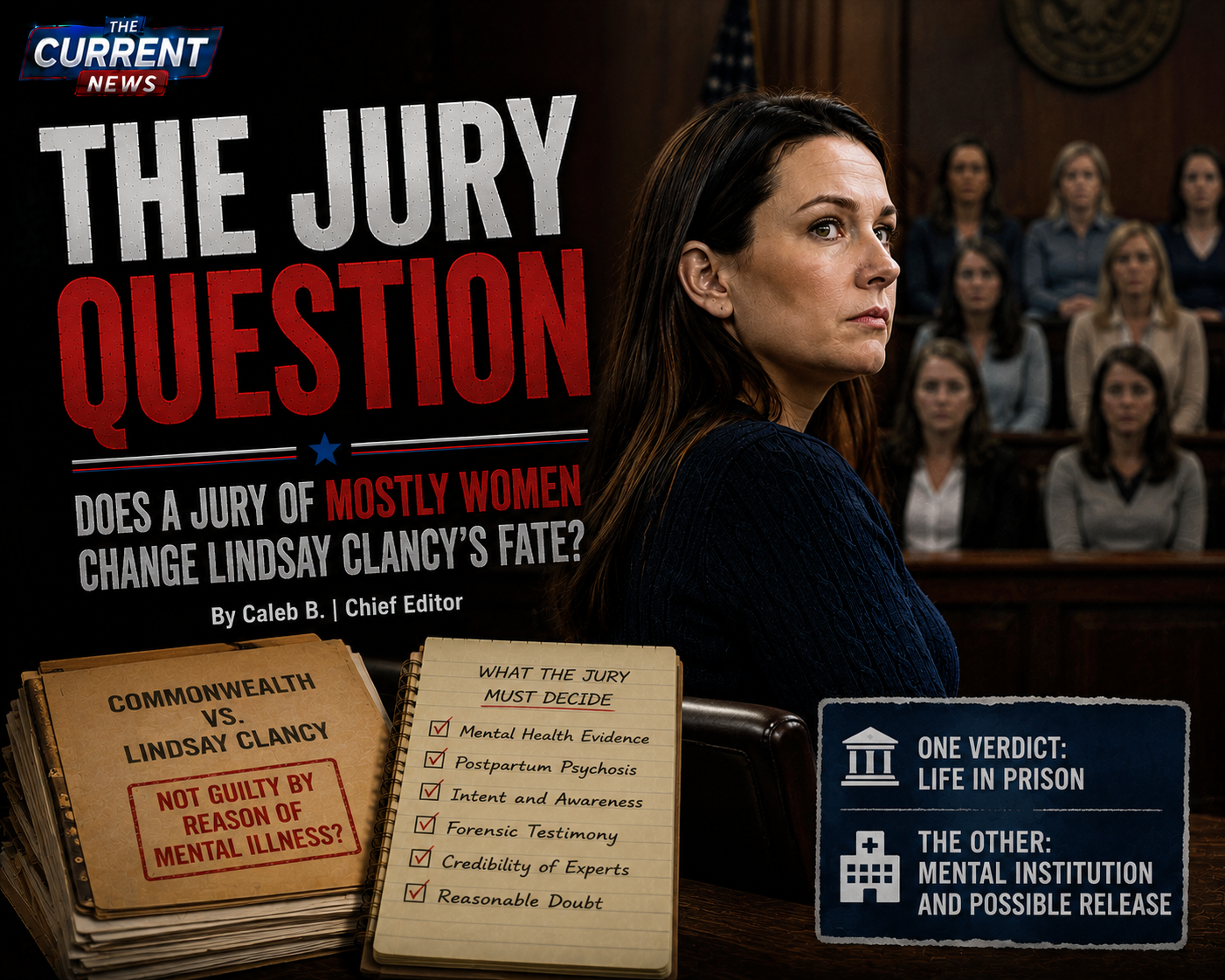
Before the Lindsay Clancy jury walks back into the courtroom Monday morning, there is one question that has been circulating heavily across TikTok, podcasts and other corners of the internet:
Does it matter that the jury is made up mostly of women?
It is an interesting question.
It is also a question that deserves a much more careful answer than social media is giving it.
The 12 jurors who will decide Clancy’s fate are nine women and three men. Six alternate jurors remain, but they will not participate in the final verdict unless circumstances require a substitution. The 12-member panel was selected at random from the 18 jurors who sat through the trial.
And after two days of deliberations, that jury still hasn’t reached a verdict.
They’ll return Monday.
But what exactly could happen when they do?
THE INTERNET HAS ALREADY STARTED PREDICTING
I’ve spent much of this weekend listening to influencers and commentators discuss what they believe the verdict will be.
And one theme keeps coming up:
There are more women than men on the jury.
Some commentators believe that could make the jury more sympathetic to Lindsay Clancy.
Others believe women may be particularly sensitive to the realities of motherhood, postpartum mental illness and the pressure Clancy described experiencing.
Still others argue that being a mother—or being a woman—doesn’t necessarily mean a juror will be more sympathetic to Clancy.
And that’s where we need to pump the brakes.
Because we don’t actually know what any individual juror thinks.
NINE WOMEN. THREE MEN.
Those are the numbers.
But numbers don’t tell us how someone will vote.
A female juror can believe Clancy was criminally responsible.
A male juror can believe she was experiencing psychosis.
A mother can believe Clancy should be convicted.
A woman without children can believe Clancy was not criminally responsible.
A man can sympathize with Clancy’s mental-health struggles.
And another man can believe the prosecution proved its case.
Gender does not come with a predetermined verdict.
The jurors were also instructed by Judge William Sullivan that they must render a fair decision based on the evidence and not their biases.
That is the standard.
SO WHY ARE PEOPLE TALKING ABOUT IT?
Because the case itself is deeply connected to experiences that many people associate with women and motherhood.
Clancy was a mother.
She had recently given birth.
Her defense has centered on postpartum psychosis and severe mental illness.
The trial has included extensive testimony about pregnancy, childbirth, breastfeeding, motherhood, psychiatric treatment and the pressures Clancy was experiencing.
That makes it understandable that people would wonder whether a jury containing nine women might see some aspects of the case differently.
But understanding the circumstances is not the same as excusing the conduct.
And that’s an important distinction.
THE JURY ISN’T DECIDING WHETHER SHE DESERVES SYMPATHY
This may be the most important thing to remember Monday morning.
The jury isn’t supposed to decide:
“Do I feel sorry for Lindsay?”
They’re not supposed to decide:
“Could this happen to me?”
They’re not supposed to decide:
“What would I do if I were in her position?”
And they’re certainly not supposed to decide:
“What does TikTok think?”
Their job is to determine whether the prosecution has established criminal responsibility under the law.
That’s it.
BUT WHAT DOES “NOT GUILTY” ACTUALLY MEAN?
This is where the conversation online has become particularly confusing.
There are several possible outcomes.
The jury could find Clancy guilty of first-degree murder.
They could find her guilty of second-degree murder.
They could find her guilty of manslaughter.
They could find her not guilty.
Or they could find her not guilty by lack of criminal responsibility because of mental disease or defect.
Those last two are not the same thing.
And neither should be casually described as simply “she got away with it.”
OUTCOME ONE: GUILTY OF MURDER
If the jury finds Clancy criminally responsible and convicts her of first-degree murder, she faces life in prison without parole.
That is the prosecution’s ultimate destination.
Prosecutors have argued that Clancy was suffering from mental-health problems but remained capable of understanding what she was doing.
Their case emphasizes evidence they say shows planning and deliberate action.
They argue she manipulated her husband’s movements to create an opportunity to be alone with the children.
They argue she understood that her thoughts and actions were wrong.
And they have challenged the defense’s claim that she was experiencing command hallucinations.
Reuters reported that prosecutors argued Clancy deliberately planned the killings and that her conduct demonstrated awareness and control.
OUTCOME TWO: GUILTY OF A LESSER OFFENSE
The jury isn’t locked into first-degree murder.
They can consider second-degree murder and manslaughter as well.
This is important because jurors could potentially reject the prosecution’s strongest theory of premeditated murder without accepting the defense’s argument that Clancy was completely free of criminal responsibility.
In other words, there is room between:
“She deliberately committed three first-degree murders.”
and
“She wasn’t criminally responsible at all.”
The jury can occupy that middle ground if the evidence and law lead them there.
OUTCOME THREE: NOT GUILTY BY LACK OF CRIMINAL RESPONSIBILITY
This is the outcome the defense has spent the trial fighting for.
Clancy’s attorneys argue that she was experiencing postpartum psychosis and that her mental illness was so severe that she could not appreciate the wrongfulness of her actions or conform her conduct to the law.
Her defense attorney Kevin Reddington told jurors that Clancy’s “mind was gone” when she killed her children and urged them to find her not guilty by reason of insanity.
This is where another misconception needs to be addressed.
This does not necessarily mean Clancy walks free.
A finding of lack of criminal responsibility can result in psychiatric commitment rather than a traditional prison sentence.
In other words, the jury could reject criminal responsibility without declaring that nothing happened.
The children would still be dead.
Clancy would still be confined.
But the legal system would be treating the cause of her conduct as a severe mental disease rather than criminal intent.
OUTCOME FOUR: COMPLETELY NOT GUILTY
This is another possibility.
The jury could theoretically return a straight Not Guilty verdict.
But this is an important distinction.
Clancy’s own defense has acknowledged that she killed her children.
The fight has been over whether she was criminally responsible.
So a straight acquittal would be a much more dramatic rejection of the prosecution’s case.
It is legally possible.
But it isn’t the outcome the defense has primarily asked the jury to reach.
The defense’s central argument has been lack of criminal responsibility, not that Clancy didn’t commit the killings.
OUTCOME FIVE: NO UNANIMOUS VERDICT
And then there is the possibility that the jury simply cannot agree.
This is where another term from social media needs some clarification.
People have been asking:
Could this become a mistrial?
Yes, a hung jury can ultimately result in a mistrial.
But two days of deliberation does not mean a jury is deadlocked.
Not even close.
Juries can deliberate for hours or days while working through complicated evidence.
And this is an extraordinarily complicated case.
The jurors have heard weeks of testimony.
They have been asked to evaluate competing psychiatric experts.
They have reviewed physical evidence.
They’ve heard from Patrick Clancy.
They’ve heard from first responders.
They’ve heard from medical professionals.
They’ve heard arguments about medication.
And they’ve heard fundamentally different interpretations of the same events.
The fact that they haven’t reached a verdict after two days simply means:
They haven’t reached a verdict.
AND THEY’RE TAKING THEIR TIME
That’s actually something we should respect.
The jury spent roughly three and a half hours deliberating Thursday and approximately seven hours Friday before being dismissed for the weekend. They are scheduled to return Monday morning.
That’s not necessarily a sign of disagreement.
It could simply mean they’re being thorough.
And perhaps that’s exactly what the families involved deserve.
WHAT ABOUT THE KNIFE AND MEDICATIONS?
There’s another interesting piece of information from Friday.
The jury requested to examine the knife Clancy used during her suicide attempt and bags containing prescription medication bottles.
That has caused plenty of speculation.
But we should resist interpreting it as a secret message.
We don’t know why they wanted those exhibits.
Maybe they are reconstructing the timeline.
Maybe they are examining the evidence related to Clancy’s mental state.
Maybe one juror had a question about the physical evidence.
Maybe they simply wanted to see the exhibits again.
We don’t know.
And pretending otherwise would be irresponsible.
SO WILL THE WOMEN SAVE LINDSAY?
That’s the question some people are asking.
But I think it’s the wrong question.
Because it assumes the women on the jury will automatically sympathize with Clancy.
What if the opposite happens?
What if some of those women are mothers who look at the evidence and think:
“Being a mother does not make this understandable.”
What if they believe that the defense’s mental-health argument doesn’t overcome evidence of planning?
What if they see Clancy’s actions as an enormous betrayal of the responsibility of motherhood?
We don’t know.
And that’s precisely why demographic speculation is dangerous.
WHAT IF THE WOMEN UNDERSTAND HER BETTER?
The other side of the argument is also possible.
What if some jurors hear the evidence about postpartum psychosis and think:
“This wasn’t a rational mother making a rational decision.”
What if they believe the psychiatric experts who testified for the defense?
What if Clancy’s documented deterioration convinces them that she had crossed a line between severe mental illness and true psychosis?
Again:
We don’t know.
And that’s the point.
THE JURY IS NOT A POLITICAL POLL
This isn’t:
9 women vs. 3 men.
It’s:
12 individual human beings.
Twelve people with different experiences.
Different families.
Different beliefs.
Different understandings of mental illness.
Different life experiences.
Different reactions to the testimony.
They may disagree.
They may persuade one another.
They may change their minds.
That’s what deliberation is.
WHAT IF THEY CAN’T AGREE?
This may be the outcome that nobody wants to talk about.
Imagine spending weeks listening to evidence and then reaching a point where 12 people simply cannot reach the same conclusion.
A unanimous verdict is required.
If the jury becomes genuinely deadlocked and the judge determines further deliberation will not produce an agreement, a mistrial could result.
But even then, the story doesn’t necessarily end.
A mistrial caused by a hung jury is not the same thing as an acquittal.
It doesn’t mean Clancy is declared innocent.
It means the jury couldn’t reach the required unanimous verdict.
The prosecution could potentially seek another trial.
That would create an entirely new chapter in a case that has already lasted more than three years.
THE QUESTION ISN’T “WHAT WILL WOMEN DO?”
Maybe the better question is:
What did the evidence convince them to do?
That’s what we’ll eventually learn.
Not from TikTok.
Not from commentators.
Not from polling.
Not from speculation about their gender.
From the verdict.
THERE IS SOMETHING WE SHOULD LEARN FROM THIS
I’ve spent the weekend listening to people debate this case, and there’s one thing that keeps jumping out:
Everyone wants certainty before the jury has it.
People want to know:
She’s guilty.
She’s innocent.
She’s insane.
She’s a murderer.
The husband did it.
The doctors failed her.
The medications caused it.
The jury will acquit her.
The jury will convict her.
But the people who actually have to decide don’t have the luxury of picking a narrative.
They have to work through the evidence.
LET THEM DELIBERATE
Maybe the best thing we can do Monday morning is stop trying to predict what the jury is thinking.
Let them think.
Let them argue.
Let them examine the evidence.
Let them ask questions.
Let them change their minds.
Let them take their time.
Because at the end of this process, the most important thing isn’t whether the verdict satisfies TikTok.
It isn’t whether it satisfies me.
It isn’t whether it satisfies the prosecution.
It isn’t whether it satisfies the defense.
It’s whether the jury followed the evidence and the law.
MONDAY MORNING
When the jury walks back into the courtroom Monday, they will return to a case that has consumed national attention.
Nine women.
Three men.
Three dead children.
One defendant.
Two competing explanations of what happened inside a Duxbury home on January 24, 2023.
And several possible outcomes.
Maybe Monday will bring a verdict.
Maybe it won’t.
Maybe the jury will find Clancy criminally responsible.
Maybe they will find her not criminally responsible.
Maybe they will acquit her.
Maybe they will reach an impasse.
We simply don’t know.
And perhaps that’s the most honest answer we can give.
THE CONSPIRACY THEATRE QUESTION
Before you predict the verdict, ask yourself one question:
Am I predicting what the evidence will lead the jury to decide—or am I predicting what I want the jury to decide?
Because those aren’t necessarily the same thing.
The jury has one job.
Follow the evidence.
Monday, they’ll go back to work.
And the rest of us will wait.
What do you think?
Do you believe the jury’s gender makeup could meaningfully influence how they view the postpartum-psychosis defense?
Or is focusing on nine women and three men simply another form of trying to predict a verdict we cannot actually know until the jury announces it?
And which outcome do you think is most likely?
First-degree murder?
A lesser offense?
Not guilty by lack of criminal responsibility?
A full acquittal?
Or a hung jury?
Tell us what you think—but more importantly, tell us what evidence gets you there.
Editorial & Legal Note
The final deliberating jury consists of nine women and three men, selected randomly from the 18 jurors who sat through the trial. The six alternates do not participate in deliberations unless a substitution becomes necessary.
The jury has five verdict categories available for each of the three murder counts: not guilty; not guilty by lack of criminal responsibility; first-degree murder under deliberate premeditation or extreme atrocity and cruelty; second-degree murder; or manslaughter.
The jury has completed two days of deliberations without reaching a verdict and is scheduled to resume Monday morning. The jury’s request to review the knife from Clancy’s suicide attempt and prescription medication evidence has been confirmed, but the reason for that request has not been publicly established.