Lindsay Clancy Jury Split 11–1 Before Mistrial
The Lindsay Clancy jury reportedly split 11–1 before a mistrial. Nine women and three men deliberated for seven days without reaching a unanimous verdict.
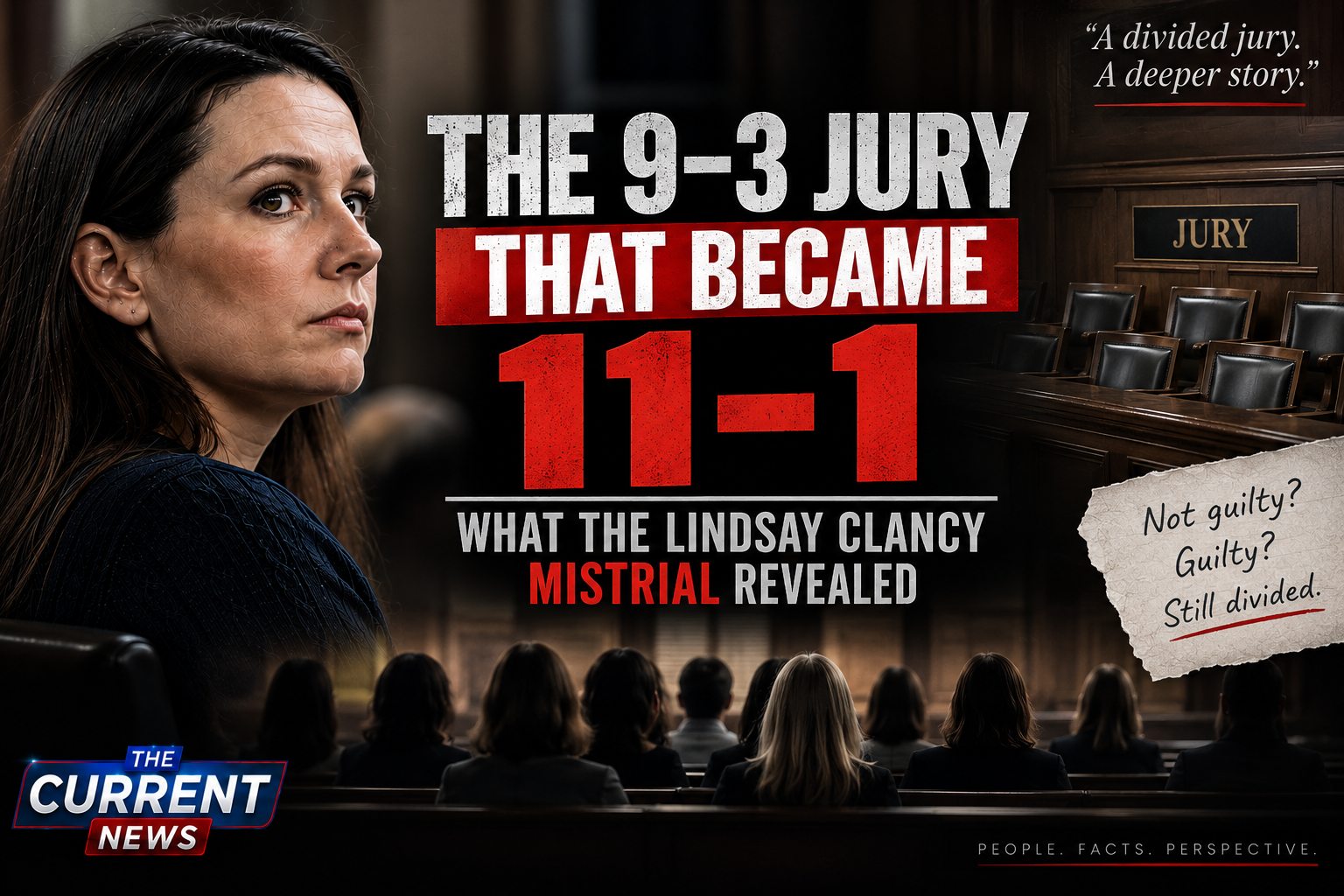
Earlier in our coverage of the Lindsay Clancy trial, we asked a question that generated plenty of discussion:
Could the makeup of the jury matter?
Nine women.
Three men.
Twelve people tasked with deciding whether Lindsay Clancy should be held criminally responsible for the deaths of her three children.
At the time, we didn’t know how those jurors would ultimately divide.
Would the women see the case differently?
Would the men?
Would motherhood, mental health, postpartum psychosis or the circumstances surrounding Clancy’s case influence the deliberations?
We didn’t know.
And we repeatedly cautioned against assuming that gender would determine the verdict.
Now, after seven days of deliberations and a mistrial, we know something we didn’t know then.
The reported split was 11–1.
And according to reporting from inside the courtroom, the lone holdout was a male juror.
The other 11 jurors apparently favored a finding that Clancy was not criminally responsible.
The result?
No verdict.
A mistrial.
And a case that still isn’t over.
When we previously wrote about the jury composition, the discussion was never supposed to be:
“Women will automatically side with Lindsay Clancy.”
That would have been an unfair assumption.
A juror doesn’t check their gender at the courthouse door, but neither does gender automatically determine someone’s legal reasoning.
The question was whether having nine women and three men might create an interesting dynamic in a case so heavily centered around motherhood, postpartum mental illness and the death of three children.
Now we have an extraordinary result.
Nine women.
Three men.
And apparently one man stood apart from the other eleven jurors.
That doesn’t prove gender caused the division.
But it certainly makes the jury’s composition more interesting in hindsight.
THE NUMBER THAT CHANGED EVERYTHING: 11–1
The jury spent roughly 40 hours deliberating over seven days.
They repeatedly informed Judge William Sullivan that they were unable to reach a unanimous decision.
At one point, a note from the foreperson indicated that a single juror was preventing unanimity.
The defense argued that the lone juror was refusing to apply the reasonable-doubt standard.
Judge Sullivan declined to remove the juror.
The deliberations continued.
Eventually, the jury remained deadlocked.
The judge declared a mistrial.
But here’s where we need to be careful.
The jury did not publicly announce an 11–1 vote.
The reported split came through courtroom reporting and statements from Clancy’s defense attorney.
Defense attorney Kevin Reddington characterized the split as 11–1 and said the majority favored acquittal on the criminal-responsibility issue.
That is different from saying:
“The jury officially announced that 11 jurors voted not guilty.”
We don’t have that public record.
And responsible reporting requires that distinction.
BUT IF THE REPORTING IS CORRECT...
Think about what that means.
Eleven jurors apparently reached the conclusion that Clancy should not be held criminally responsible.
One juror did not.
That one vote was enough.
Not because that juror had more power than the other eleven.
But because criminal convictions require unanimity.
Twelve people must agree.
Eleven isn’t enough.
Ten isn’t enough.
Nine isn’t enough.
Even eleven-to-one isn’t enough.
One juror can stop a conviction.
And in this case, one juror appears to have stopped the jury from reaching any verdict at all.
THE IRONY OF OUR EARLIER QUESTION
This is where the story becomes particularly fascinating.
We spent part of our earlier coverage examining the jury’s gender makeup.
Nine women.
Three men.
Social media naturally began asking:
Would the women be more sympathetic to Clancy?
Would mothers see the case differently?
Would male jurors approach the evidence differently?
Those questions were always speculative.
And now the reported outcome turns that speculation upside down.
If the reported 11–1 split is accurate, the lone holdout was a man.
The other two men apparently joined the majority.
Meaning the jury did not divide neatly along gender lines.
Instead:
Two of the three men apparently agreed with nine women.
One man apparently did not.
That is far more complicated than simply saying:
“The women voted one way and the men voted another.”
MAYBE GENDER WAS NEVER THE REAL DIVIDING LINE
And perhaps that’s the lesson.
We love demographic explanations.
Race.
Gender.
Age.
Political affiliation.
Religion.
Education.
Geography.
We want to find a category that explains why people reach different conclusions.
But twelve individual jurors are still twelve individual people.
They brought their own experiences into that courtroom.
Their own understanding of mental illness.
Their own interpretation of the testimony.
Their own reading of the evidence.
And their own understanding of reasonable doubt.
Maybe the nine women weren’t thinking as nine women.
Maybe the three men weren’t thinking as three men.
Maybe they were thinking as twelve individual jurors.
WHAT WERE THE 11 SEEING?
That’s another question we’ll probably never completely answer.
The prosecution presented the argument that Clancy was depressed and suicidal but nevertheless understood what she was doing.
Prosecutors argued that she intentionally killed her children and believed they would be unable to live without her.
The defense presented a dramatically different picture.
Clancy’s attorneys argued that she suffered from severe postpartum psychosis and that her mental illness prevented her from being criminally responsible for the killings.
The trial lasted nearly six weeks.
The jury heard extensive testimony about Clancy’s mental state, medications, treatment and behavior before the killings.
Apparently, eleven jurors found the defense’s position persuasive enough to prevent a unanimous guilty verdict.
One did not.
THIS WAS NEVER REALLY ABOUT WHETHER SHE KILLED THEM
That distinction remains critical.
Clancy admitted that she killed her three children.
The defense wasn’t asking jurors to decide whether the physical acts occurred.
The central question was whether she was criminally responsible for those acts.
That’s an enormous legal distinction.
A person can commit an act and still raise a legal defense based on mental disease or defect.
The jury had to wrestle with that distinction.
And after nearly 40 hours of deliberation:
They couldn’t agree.
THE HOLDOUT JUROR BECAME THE STORY
Once the jury’s division became known, public attention naturally shifted.
Who was the holdout?
Why wouldn’t he agree?
Was he interpreting the evidence differently?
Did he believe Clancy understood right from wrong?
Did he reject the defense’s psychiatric theory?
Did he believe the prosecution proved criminal responsibility beyond a reasonable doubt?
We don’t know.
And we shouldn’t pretend that we do.
The jurors’ private deliberations are private for a reason.
We can report what has been publicly disclosed.
We cannot manufacture the rest.
THE DEFENSE WAS FURIOUS
Clancy’s attorney Kevin Reddington was openly critical of the holdout juror after the mistrial.
He argued that the juror effectively prevented eleven other jurors from reaching the outcome they believed was justified.
Reddington also criticized the prosecution and urged against a retrial.
But again, there’s another side.
From the perspective of the lone juror, there wasn’t necessarily a “failure.”
The juror may have genuinely believed the evidence supported a different conclusion.
And the law gives that juror the right to maintain an honest disagreement.
That’s precisely why unanimity exists.
WAS THE JUROR RIGHT?
That’s the question social media will fight over.
And it’s a question we can’t answer.
The public hasn’t seen the juror’s reasoning.
We haven’t sat in that deliberation room.
We don’t know exactly how that juror interpreted every piece of evidence.
We don’t know what persuaded the other eleven.
We don’t know whether the holdout was correct.
We don’t know whether the majority was correct.
That’s the point of the mistrial.
There was no unanimous answer.
THIS IS WHERE SOCIAL MEDIA GETS DANGEROUS
Almost immediately, people started turning the holdout into a character.
Hero.
Villain.
Brave.
Stubborn.
Biased.
Principled.
Misguided.
Those labels are easy.
They’re also unsupported unless we know exactly what happened inside that jury room.
And we don’t.
We’ve spent months watching social media turn the Clancy case into competing realities.
Some people became convinced Patrick Clancy was secretly responsible.
Others believed Clancy was unquestionably guilty.
Others believed postpartum psychosis explained everything.
Others believed the medical system was ultimately responsible.
And others believed the entire prosecution was wrong.
Now the jury has produced an outcome that doesn’t fit neatly into any of those narratives.
ELEVEN JURORS DIDN’T MAKE THE CASE DISAPPEAR
This is another important point.
If the reported 11–1 split is accurate, some people will inevitably say:
“That proves she was innocent.”
It doesn’t.
A jury deadlock is not an acquittal.
There was no finding of not guilty.
There was no finding of not criminally responsible.
There was no conviction.
There was simply no unanimous verdict.
The criminal case remains unresolved.
ONE JUROR DIDN’T MAKE HER GUILTY EITHER
The opposite argument is equally flawed.
Some may say:
“One juror knew she was guilty.”
That’s also not what happened.
A juror’s disagreement doesn’t establish guilt.
It establishes disagreement.
That’s it.
The prosecution still has the burden of proving criminal responsibility beyond a reasonable doubt if the case is retried.
THE 9–3 QUESTION WAS NEVER THE WHOLE STORY
Looking back now, perhaps we were asking the wrong question.
We asked:
Could nine women and three men produce an unusual outcome?
The better question may have been:
What happens when twelve people are asked to decide an extraordinarily difficult case involving mental illness, motherhood, murder and criminal responsibility?
The answer?
Sometimes twelve people can’t agree.
Even after seven days.
Even after nearly 40 hours.
Even after a six-week trial.
AND NOW THE CASE RETURNS TO THE BEGINNING
The mistrial means the legal story doesn’t end here.
Clancy remains in state psychiatric custody.
The charges remain pending.
A September 29 hearing is scheduled to address what happens next.
Prosecutors must determine whether they want to retry the case.
They could pursue a new trial.
The parties could potentially explore another resolution.
And the defense will undoubtedly continue fighting the charges.
COULD A SECOND JURY LOOK COMPLETELY DIFFERENT?
Absolutely.
The next jury could have a completely different demographic makeup.
Different ages.
Different backgrounds.
Different experiences.
Different interpretations.
And potentially:
A completely different outcome.
That’s one of the most unsettling realities of jury trials.
The evidence remains largely the same.
But twelve different people can interpret that evidence differently.
WHAT WE SHOULD LEARN FROM THIS
Perhaps the biggest lesson isn’t about women.
It isn’t about men.
It isn’t even about Lindsay Clancy.
It’s about how badly human beings want simple explanations for complicated events.
We saw nine women and three men.
We wanted to know whether that would matter.
Then the reported outcome showed us something more complicated.
Two men apparently joined nine women.
One man apparently stood apart.
That doesn’t prove that gender was irrelevant.
But it certainly demonstrates that gender alone cannot explain the outcome.
THE JURY DID ITS JOB
This may be unpopular to say.
But the jury’s inability to agree doesn’t necessarily mean the jury failed.
The jurors listened.
They deliberated.
They told the judge they couldn’t agree.
They were sent back to deliberate again.
They were given additional instructions.
They tried again.
And ultimately, they still couldn’t reach unanimity.
The justice system has a mechanism for precisely this situation.
Mistrial.
THREE CHILDREN ARE STILL AT THE CENTER OF THIS
Cora.
Dawson.
Callan.
Three children whose deaths brought this case into the courtroom.
Their mother admitted to killing them.
But the legal system still has to answer a much harder question:
Was she criminally responsible for what she did?
One jury couldn’t answer that unanimously.
Now another chapter begins.
THE CURRENT NEWS BOTTOM LINE
Earlier in this trial, we asked whether the jury’s unusual makeup—nine women and three men—could produce an unusual outcome.
We never claimed gender would determine the verdict.
And now we have evidence of just how complicated the jury actually became.
The reported division was 11–1, with one male juror apparently standing against the other eleven.
The other two men reportedly joined the nine women in the majority position.
But because the jury could not reach unanimity, there was no verdict.
No guilty.
No not guilty.
No definitive finding of criminal responsibility.
Just a mistrial.
And perhaps that’s the most important lesson from this entire episode:
Twelve people walked into a jury room.
Eleven apparently reached one conclusion.
One did not.
And in the American justice system, sometimes one person saying:
“I don’t agree.”
is enough to send the entire case back to the drawing board.
The Lindsay Clancy case isn’t over.
It’s starting another chapter.