Lindsay Clancy Trial: Insanity or Murder?
The Lindsay Clancy trial reaches closing arguments. The jury must decide whether she was criminally responsible for killing her three children in 2023.
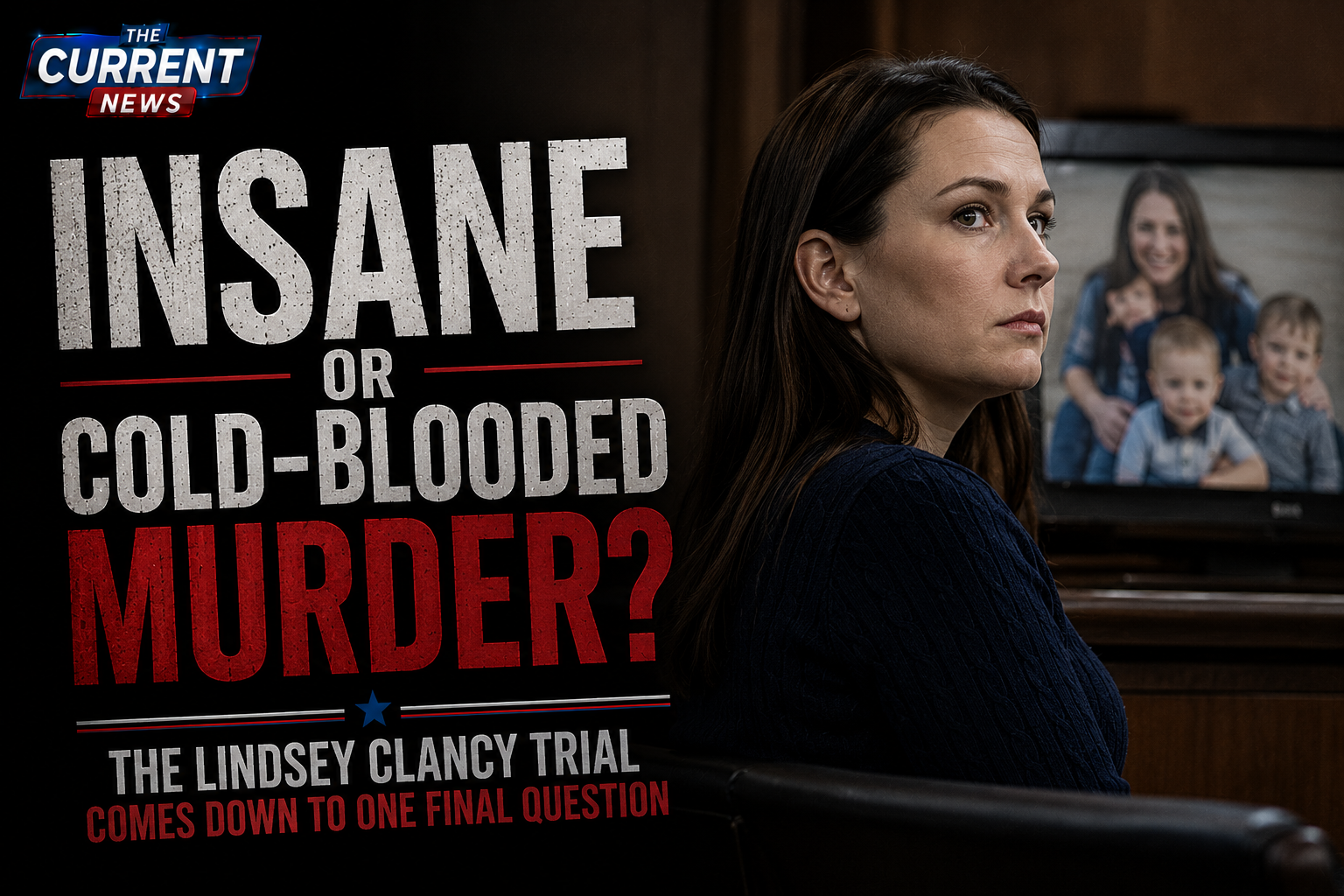
After more than five weeks of testimony, dozens of witnesses and competing psychiatric explanations, the Lindsay Clancy trial is entering its final hours.
Today, the attorneys will make their closing arguments.
Then the jury will receive its instructions from the judge.
And then the case will finally leave the courtroom and enter the hands of the people who will decide Clancy’s fate.
But this case has never really been about whether Lindsay Clancy killed her three children.
She has admitted that she did.
The question has always been something much more difficult:
Was Lindsay Clancy criminally responsible for what she did?
THREE CHILDREN. ONE TERRIBLE NIGHT.
On January 24, 2023, Cora, 5, Dawson, 3, and Callan, just 8 months old, were killed inside their family’s Duxbury, Massachusetts, home.
Clancy has admitted to strangling the children with exercise bands.
Afterward, she attempted to take her own life by cutting herself and jumping from a second-story window, leaving her paralyzed.
There is no dispute that the children died at their mother’s hands.
The dispute is why.
And legally, that distinction could determine whether Clancy spends the rest of her life in prison or is found not criminally responsible because of severe mental illness.
THE DEFENSE: SHE WASN’T IN REALITY
Clancy’s attorneys have built their case around postpartum psychosis.
Their argument is that Clancy was suffering from a severe psychiatric condition that included hallucinations and delusions and that she was unable to appreciate the wrongfulness of what she was doing.
Her defense experts testified that she was experiencing psychosis when she killed her children.
Dr. Phillip Resnick, a prominent forensic psychiatrist who has testified in other high-profile cases, told jurors that Clancy was “frankly psychotic” at the time of the killings and was not in control of her actions.
According to the defense theory, Clancy had been deteriorating for months.
She had reported frightening thoughts.
She had received psychiatric treatment.
She had been hospitalized at McLean Hospital.
She had been prescribed multiple medications.
And her attorneys argue that everything ultimately came together in a catastrophic psychotic episode.
Their position isn’t:
“She didn’t kill them.”
It is:
“She killed them, but she wasn’t legally responsible for what she was doing.”
That distinction is at the heart of the trial.
THE PROSECUTION: SHE KNEW WHAT SHE WAS DOING
The prosecution tells a very different story.
Prosecutors acknowledge that Clancy suffered from mental-health problems.
But they argue that mental illness does not automatically equal legal insanity.
Their theory is that Clancy was depressed and suicidal, but still understood what she was doing and understood that killing her children was wrong.
They have pointed to the events leading up to the killings as evidence of planning and control.
They have argued that she created an opportunity to be alone with the children.
They have highlighted communications and actions they say demonstrate deliberate decision-making.
And they brought expert after expert to the stand to challenge the idea that Clancy was experiencing a psychotic break.
THE FINAL WITNESS
The last witness was Dr. Gregory Saathoff, a forensic psychiatrist affiliated with the FBI’s Behavioral Analysis Unit and the University of Virginia.
His testimony may become one of the most important pieces of the prosecution’s closing argument.
Saathoff told jurors that he did not believe Clancy’s account that a voice ordered her to kill her children.
He described the reported hallucination as highly unusual and pointed to what he viewed as inconsistencies in Clancy’s descriptions of the events.
Perhaps most importantly, he focused on the sequence of events.
According to Saathoff, Clancy was able to carry out a series of actions without the alleged voice giving her detailed instructions.
He argued that this suggested she maintained control over what she was doing.
The prosecution’s argument is essentially:
She wasn’t simply acting on an uncontrollable command.
She was making decisions.
BUT THE DEFENSE HAS ITS OWN QUESTIONS
The defense didn’t simply accept the prosecution’s experts.
Attorney Kevin Reddington challenged Saathoff’s experience with postpartum psychosis and questioned how much could really be concluded from an evaluation conducted more than three years after the killings.
Reddington also emphasized Clancy’s efforts to obtain mental-health treatment before the killings.
That raises a legitimate question:
If someone is actively telling people that something is seriously wrong, seeking psychiatric care and ultimately ends up committing an unimaginable act, does that tell us something about the state of their mind?
The defense says yes.
The prosecution says it does—but not in the way the defense wants the jury to interpret it.
THE JURY HAS MORE THAN TWO OPTIONS
This is another important point.
The jury isn’t simply deciding:
Insane or guilty.
Judge William Sullivan has indicated that the jury will have several possible verdicts.
They can find Clancy guilty of:
first-degree murder,
second-degree murder,
or manslaughter.
They can also find her not guilty by reason of lack of criminal responsibility.
A straight not-guilty verdict is technically possible, although it would be unusual given that Clancy’s own defense acknowledges that she killed the children.
That means the jury has an enormous responsibility.
They aren’t simply deciding whether something horrible happened.
They are deciding what legal responsibility belongs to the person who did it.
THIS IS WHERE “INSANE OR COLD-BLOODED” FALLS SHORT
The headline is emotionally powerful.
Insane or cold-blooded murder?
But the law is more complicated than that.
Mental illness isn’t the same thing as insanity.
A person can have bipolar disorder.
A person can suffer from depression.
A person can experience postpartum mental-health complications.
And a person can still be legally responsible for their actions.
The question before this jury is whether Clancy’s mental disease or defect left her without the substantial capacity required under Massachusetts law to appreciate the wrongfulness of her conduct or conform her conduct to the law.
That’s much more precise than asking whether she was simply “crazy.”
AND THEN THERE IS THE VOICE
Perhaps the most haunting part of the case is Clancy’s reported claim that she heard a man’s voice telling her to kill her children and then herself.
The defense has used that claim as evidence of psychosis.
The prosecution’s experts have attacked it.
Saathoff testified that he found the reported hallucination unusual, particularly because Clancy reportedly experienced it during the killings and it then stopped.
That doesn’t automatically prove that she fabricated it.
And it doesn’t automatically prove that she was psychotic.
It is something the jury has to evaluate alongside everything else.
WHAT ABOUT THE WOMAN BEFORE THE KILLINGS?
This may be one of the most important questions for the jury.
Who was Lindsay Clancy in the days and weeks before January 24?
Was she:
A mother suffering a rapidly worsening psychiatric illness?
Or:
A woman who was depressed and suicidal but remained capable of planning and understanding what she was doing?
Both sides have presented evidence to support their interpretation.
That’s why this trial has been so difficult.
The prosecution and defense aren’t necessarily disagreeing that Clancy suffered.
They’re disagreeing over what that suffering did to her ability to understand and control her actions.
TOMORROW, THE STORY CHANGES
For five weeks, the jury has listened.
They have heard witnesses.
They have seen evidence.
They have listened to psychiatrists, psychologists, family members, investigators and people who interacted with Clancy before and after the killings.
Now the attorneys get one final opportunity to put the entire case together.
Each side will have an hour for closing arguments. After that, Judge Sullivan will instruct the jury on the law and the jury will begin deliberating.
And then the attorneys will have to stop talking.
The experts will have to stop talking.
The public will have to stop talking.
The jury will talk.
THE CHILDREN CANNOT SPEAK
There is an uncomfortable truth underneath all of the psychiatric debate.
Cora cannot tell us what happened.
Dawson cannot tell us what happened.
Callan cannot tell us what happened.
Three children are gone.
Their father will never watch them grow up.
Their siblings, grandparents and extended family will never get to see the lives those three children might have lived.
Whatever happens to Lindsay Clancy, that cannot be undone.
And that is why this case deserves something more than internet arguments.
It deserves careful consideration.
COMPASSION AND ACCOUNTABILITY CAN EXIST TOGETHER
One of the most important lessons from this trial may be that these aren’t necessarily opposing ideas.
We can recognize that postpartum mental illness can be devastating.
We can acknowledge that women experiencing postpartum psychiatric emergencies need better access to treatment.
We can recognize that families need to know the warning signs.
We can believe that someone was seriously mentally ill.
And still ask whether that person was legally responsible for what they did.
Those aren’t mutually exclusive positions.
THE JURY’S JOB IS NOT TO PUNISH HER
This is worth remembering.
The jury’s job isn’t to decide whether Lindsay Clancy deserves punishment.
Their job is to determine what the evidence and law require.
They aren’t supposed to decide based on:
public outrage,
sympathy,
social media,
headlines,
television commentary,
or what strangers on the internet think.
They’re supposed to consider the evidence presented in court and the legal instructions given by the judge.
That’s what due process looks like.
THE FINAL QUESTION
Today, when the attorneys stand before the jury, they will tell two very different stories about the same night.
One side will say:
A deeply depressed but mentally aware mother made a calculated decision to kill her children.
The other will say:
A severely mentally ill mother experienced a psychotic break and lost the ability to understand what she was doing.
The facts of what happened are horrific.
But the legal question is narrower.
Was Lindsay Clancy criminally responsible for her actions on January 24, 2023?
Twelve jurors will eventually have to answer that question.
And they will have to live with their answer.
THE BOTTOM LINE
This is not a story where we should rush to declare:
“She’s evil.”
Nor should we rush to declare:
“She was simply a victim of mental illness.”
The evidence is more complicated than either slogan.
The children deserve justice.
The defendant deserves due process.
Mental illness deserves serious consideration.
And the jury deserves the space to make its decision based on the evidence—not on the court of public opinion.
Tomorrow, the final arguments begin.
Then the jury deliberates.
And after more than three years of waiting, the question that has haunted this case may finally have an answer.
Was this the act of a mother who knew exactly what she was doing—or a woman whose mind had become so severely distorted that she could no longer understand the wrongfulness of her actions?
The jury will decide.
This article uses "insane or cold-blooded murder" as a discussion headline, not as a legal conclusion. Clancy has admitted killing her children but has pleaded not guilty by reason of lack of criminal responsibility. The jury will determine whether the prosecution has established criminal responsibility under Massachusetts law. Closing arguments are scheduled for Thursday, August 27, followed by jury instructions and deliberations.