Meta's Social Media Restrictions: Will Kids Lie About Age?
Meta's new child-safety restrictions rely on age verification. Will they protect kids—or simply encourage teenagers to get better at lying about their age?
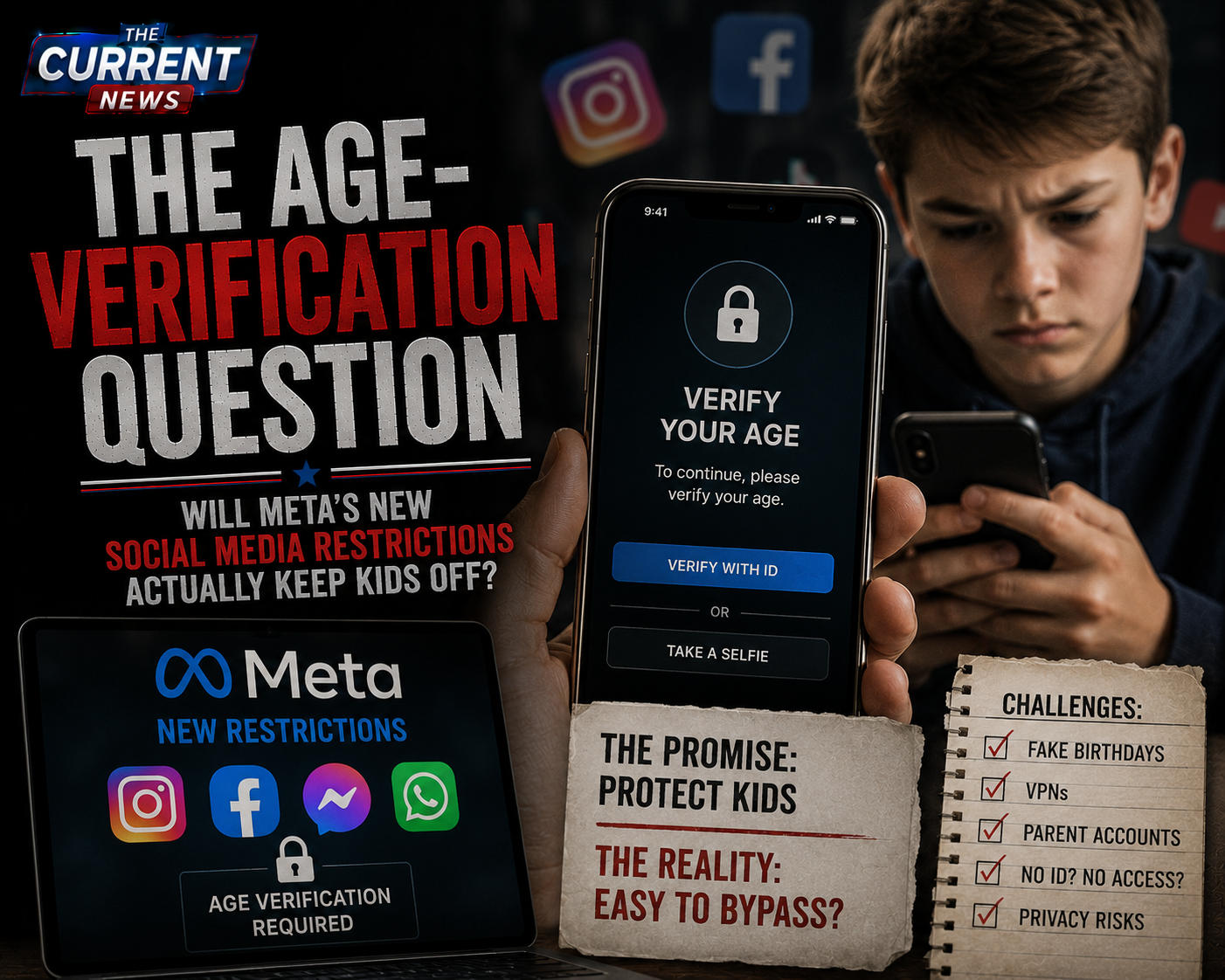
America has spent years asking a difficult question:
Are social-media companies doing enough to protect children?
Now, after years of lawsuits and growing pressure from parents, states and lawmakers, Meta is being forced to make some of its biggest changes yet.
And on paper, they sound significant.
But there’s one question I can’t get out of my head:
What happens when the kid simply lies about their age?
Because the success of almost every restriction in this settlement depends on one thing:
Meta knowing who is actually using the account.
And teenagers have been lying about their ages on the internet for years.
So are we actually solving the problem—or simply creating a new game of cat and mouse between children and technology companies?
WHAT JUST HAPPENED?
Meta has agreed to a landmark settlement with dozens of states and other U.S. jurisdictions following allegations that Facebook and Instagram were designed in ways that encouraged compulsive use and exposed children to harmful content.
Meta agreed to pay up to roughly $17 billion to the states, with some of the final amount dependent on whether other platforms adopt similar protections. Meta has denied wrongdoing.
But the money isn’t the most interesting part.
The changes to how teenagers use Instagram and Facebook are.
Under the proposed settlement, Meta will implement measures including:
Default daily usage limits for users under 18
Overnight restrictions
School-hour notification restrictions
Stronger age-assurance technology
Enhanced parental controls
Hidden “like” and reaction counts
Restrictions on cosmetic-procedure filters
More options for non-personalized feeds
Additional protections against harmful content
Independent auditing of compliance
On paper, this sounds like a substantial change.
But there is a fundamental problem.
None of these restrictions work very well if the platform thinks a 14-year-old is 19.
THE AGE QUESTION
Think about how social media works today.
A teenager creates an account.
The platform asks:
“What’s your birthday?”
The teenager enters a birthday that makes them older.
Account created.
That problem isn’t new.
In fact, allegations that Meta relied too heavily on users simply reporting their own ages have been part of the legal controversy for years.
The new settlement attempts to address exactly that problem.
Meta will have to strengthen its age-assurance technology and use additional tools to identify users who are under 18 and children under 13. The system will also be subject to outside auditing.
That is a significant improvement over simply asking someone to type in a birthday.
But it creates a new question.
WILL KIDS JUST GET BETTER AT LYING?
This is the part I think parents should be watching closely.
If a teenager knows:
“If Instagram thinks I’m 17, I get a two-hour limit.”
but:
“If Instagram thinks I’m 18, I don’t.”
What’s the teenager’s incentive?
To tell the truth?
Or to figure out how to convince the system they’re an adult?
We’ve already seen teenagers find workarounds for parental controls, screen-time restrictions and age requirements.
And technology doesn’t exist in a vacuum.
If Meta improves its age detection, teenagers will inevitably try to improve their ability to fool it.
That’s not necessarily a reason not to implement age verification.
It’s a reason to recognize that age verification is going to be an arms race.
META KNOWS THIS IS A PROBLEM
This isn’t speculation on our part.
Meta itself acknowledges that it cannot guarantee every teen account will be perfectly identified.
The company’s systems use various signals to estimate age, and Meta has said it will invest in stronger tools.
But reporting on the settlement has highlighted a significant weakness: teenagers can create additional accounts, and Meta cannot guarantee that every attempt to circumvent the system will be detected.
And there’s another problem.
Fake parents.
WHAT IF THE CHILD CREATES A FAKE PARENT?
The new system gives parents significantly more control.
That’s good.
But parental controls create another potential loophole.
What happens if a teenager creates a fake parent account?
Or convinces an adult to create one?
Or uses someone else’s information?
Or creates the account on another device?
Meta has acknowledged that it cannot guarantee that every supervising account actually belongs to the teen’s parent.
That’s important.
Because now we’re not just asking:
“Can Meta determine whether this person is 16 or 18?”
We’re asking:
“Can Meta determine whether the person claiming to be the parent actually is the parent?”
That’s considerably harder.
THE TECHNOLOGY WILL HAVE TO GET SMARTER
Meta is already using artificial intelligence and behavioral signals to estimate a user’s age.
The new settlement requires stronger age-assurance measures and independent oversight.
But age estimation isn’t perfect.
A 17-year-old can look 20.
A 20-year-old can look 17.
Someone can deliberately alter their appearance.
Someone can borrow another person’s identification.
Someone can use another person’s account.
And behavioral analysis can make mistakes.
That’s why experts have warned that the effectiveness of these new protections will depend heavily on how accurately Meta can identify users.
AND NOW WE HAVE A PRIVACY PROBLEM
Here’s where the solution gets complicated.
If we want social-media companies to know our actual ages, how should they verify them?
One option:
Government identification.
Another:
Facial age estimation.
Another:
Behavioral analysis.
Another:
Third-party verification.
Every option comes with tradeoffs.
Government ID means people potentially have to submit extremely sensitive information simply to use social media.
Facial verification creates biometric-data concerns.
Behavioral analysis can make mistakes.
Third-party verification creates another company that potentially handles sensitive information.
And once information exists somewhere, there’s always a cybersecurity question.
TechCrunch quoted experts warning that age verification creates a classic tension between child safety and privacy, particularly because transmitting identification or biometric information introduces additional privacy risks.
So we have to ask:
How much privacy are we willing to sacrifice to prove our age?
THIS ISN’T JUST A CHILDREN’S QUESTION
That’s an important point.
Suppose you’re 35.
You want an Instagram account.
Why should you have to submit a government ID or facial scan to prove you’re 35?
Maybe you don’t mind.
But another person might.
And what happens when age verification becomes the standard for everything online?
Social media today.
Pornography tomorrow.
Online shopping.
Political websites.
Forums.
News websites.
Eventually, the question becomes:
Do we want an internet where everyone must prove their identity before they can participate?
That isn’t necessarily a bad thing.
But it is a very different internet.
And we should have that conversation deliberately.
THERE IS ALSO A BIG DIFFERENCE BETWEEN RESTRICTION AND PROTECTION
This is where I think Meta’s settlement deserves some credit—but also skepticism.
A two-hour daily limit sounds good.
Blocking social media between midnight and 6 a.m. sounds good.
Reducing notifications during school sounds good.
Hiding “likes” sounds reasonable.
Removing certain cosmetic filters could help reduce social comparison.
But none of these measures eliminate the underlying content.
The algorithms remain.
Infinite scrolling remains.
Social interaction remains.
Peer pressure remains.
And teenagers can still encounter harmful material.
AP reported that critics remain concerned that recommendation algorithms and other potentially harmful features haven’t been eliminated.
So the question becomes:
Are we treating the symptoms or the disease?
WHAT IF THE KID IS 15 AND LIES?
Let’s take the simplest example.
A 15-year-old wants Instagram.
They enter:
July 14, 2007.
The system now believes they’re 19.
If the age-assurance system catches them, restrictions apply.
If it doesn’t, the teenager potentially gets an adult experience.
That’s the vulnerability.
And it’s why I don’t think this settlement should be judged by the restrictions alone.
It should be judged by how accurately those restrictions are applied to the people they’re supposed to protect.
MEASURE RESULTS, NOT INTENTIONS
This is where I think the settlement gets something right.
There will be independent auditing.
That’s important.
Because Meta shouldn’t get to say:
“We tried really hard.”
The question should be:
Did it work?
How many underage accounts were identified?
How many weren’t?
How many false positives occurred?
How many teenagers successfully circumvented the restrictions?
How many fake parent accounts were created?
How quickly did Meta identify them?
How often were restrictions bypassed?
What percentage of age assessments were wrong?
Those are the numbers I want to see.
DON’T JUST MEASURE HOW MANY KIDS WERE CAUGHT
There’s an important statistical trap here.
Suppose Meta says:
“We caught 10 million underage accounts!”
That sounds impressive.
But what if 5 million more slipped through?
The better question is:
What percentage of underage users are actually being identified?
That’s why independent auditing matters.
The settlement specifically includes external oversight of Meta’s compliance and age-assurance efforts.
And that should remain a critical part of evaluating the program.
WHAT ABOUT KIDS WHO JUST MOVE TO ANOTHER PLATFORM?
Here’s another enormous problem.
Instagram isn’t the internet.
A teenager who gets restricted on Instagram can open:
TikTok.
YouTube.
Snapchat.
Discord.
Reddit.
Or another platform that hasn’t adopted equivalent restrictions.
Meta itself has argued that the solution needs to be industry-wide because teenagers move between platforms.
And that’s why part of the settlement’s financial structure is tied to other platforms adopting similar standards.
If only one company changes, kids may simply move somewhere else.
THIS COULD BECOME THE NEXT DIGITAL WHACK-A-MOLE
Restrict Instagram.
Kids move to TikTok.
Restrict TikTok.
Kids move to Snapchat.
Restrict Snapchat.
Kids find another platform.
Eventually, we aren’t actually solving the underlying problem.
We’re playing digital whack-a-mole.
And technology moves faster than regulation.
Today’s social-media platform may not even be tomorrow’s dominant platform.
AI-powered social networks could emerge.
Virtual worlds could become more popular.
Private messaging communities could replace public feeds.
New platforms could be created specifically to avoid existing regulations.
That’s why rules based entirely on today’s technology may age quickly.
SO SHOULD WE DO NOTHING?
Absolutely not.
That’s not the answer.
Children deserve protection online.
Parents deserve better tools.
Companies should be held accountable when their products cause foreseeable harm.
And social-media platforms shouldn’t be allowed to simply say:
“We have a birthday box. Whatever age you type is your problem.”
The technology needs to improve.
The protections need to improve.
The transparency needs to improve.
And parents need better control.
But we shouldn’t pretend that a court settlement has magically solved the problem.
PARENTS STILL MATTER
This may be the least technologically exciting part of the entire conversation.
But it’s probably one of the most important.
Parents.
Technology cannot replace parenting.
A two-hour limit isn’t a substitute for talking to your child.
A nighttime block isn’t a substitute for knowing who your child communicates with.
An age-verification system isn’t a substitute for teaching a child why lying about their age matters.
And an algorithm isn’t a substitute for a parent noticing that their child is struggling.
Technology can help.
It cannot do everything.
THERE IS A MIDDLE GROUND
I don’t think the answer is:
“Ban every child from social media.”
Nor do I think the answer is:
“Let children have unrestricted access to everything.”
There is a middle ground.
Age-appropriate accounts.
Real parental controls.
Better age assurance.
Default safety settings.
Limits on addictive design.
Independent audits.
Transparency.
Strong consequences for companies that repeatedly violate the rules.
And perhaps most importantly:
Giving parents the ability to actually know what’s happening.
BUT LET’S NOT FOOL OURSELVES
If we’re honest, some kids are going to lie.
Some will find loopholes.
Some will create fake accounts.
Some will borrow someone else’s phone.
Some will find another platform.
Some will figure out how the system works faster than their parents do.
That’s not a reason to abandon the effort.
It’s a reason to build a system that expects circumvention.
Security engineers don’t design systems assuming nobody will try to break them.
They design them assuming someone will.
Maybe social-media safety needs the same mindset.
THE REAL TEST STARTS NOW
The settlement sounds impressive.
Billions of dollars.
New restrictions.
Age verification.
Parental controls.
Audits.
Time limits.
Nighttime blocks.
But none of that tells us whether the system will actually work.
Implementation will.
And that’s what parents should watch.
Not the press release.
Not the dollar figure.
Not the political speeches.
The results.
Because if a 13-year-old can still enter “I’m 18” and walk straight through the front door, then we’ve built an impressive-looking lock without actually checking whether the door is locked.
THE QUESTION WE SHOULD BE ASKING
So here’s my question:
Will Meta’s new restrictions actually protect children—or will they simply encourage children to become better at hiding their age?
Maybe the new technology will work.
Maybe AI will become incredibly effective at detecting age.
Maybe independent audits will expose weaknesses and force Meta to correct them.
Maybe teenagers will eventually give up trying to circumvent the restrictions.
Or maybe we’ll discover that the internet’s most determined users are teenagers who really, really want to get around a parental control.
I suspect we’ll see some of both.
THE BOTTOM LINE
I support the goal.
Protect children.
That’s not controversial.
But the implementation deserves scrutiny.
Meta’s settlement represents a significant shift toward default restrictions, stronger age assurance and greater parental involvement.
That’s progress.
But age verification remains the critical vulnerability.
And if children can successfully lie about their age, create duplicate accounts or establish fake parental supervision, then the effectiveness of the entire system becomes questionable.
We shouldn’t oppose the restrictions simply because they might be circumvented.
We should demand that Meta prove they work.
Don’t measure the system by how good the rules sound.
Measure it by how many children actually slip through.
Because at the end of the day, the question isn’t:
“Did Meta create new restrictions?”
The question is:
“Did the restrictions actually protect the kids they were designed to protect?”
That’s the report card that matters.
THE CURRENT NEWS QUESTION
Parents, what do you think?
Would your child actually tell the truth about their age if lying meant getting around a two-hour limit?
Should social-media companies require government ID or facial age verification?
Or does that create a privacy problem that could ultimately be worse than the problem we’re trying to solve?
And perhaps the biggest question:
Should the responsibility ultimately belong to Big Tech, parents, government—or all three?
Tell us what you think.
Editorial Note
This article discusses the proposed nationwide settlement involving Meta and a coalition of state attorneys general. The settlement remains subject to court approval and requires Meta to implement age-assurance systems, default youth safety restrictions, parental controls and independent auditing. Meta has denied wrongdoing.
The concern that children may attempt to circumvent age restrictions is not merely hypothetical; reporting on the settlement notes existing challenges involving false ages, duplicate accounts and fake parental supervision. However, the effectiveness of the new system cannot yet be determined because the measures are still being implemented.