Miami Plane Crash: 5 Dead After Runway Overrun
An Amazon cargo plane overran a Miami airport runway, struck vehicles and caught fire, killing five people and injuring five others.
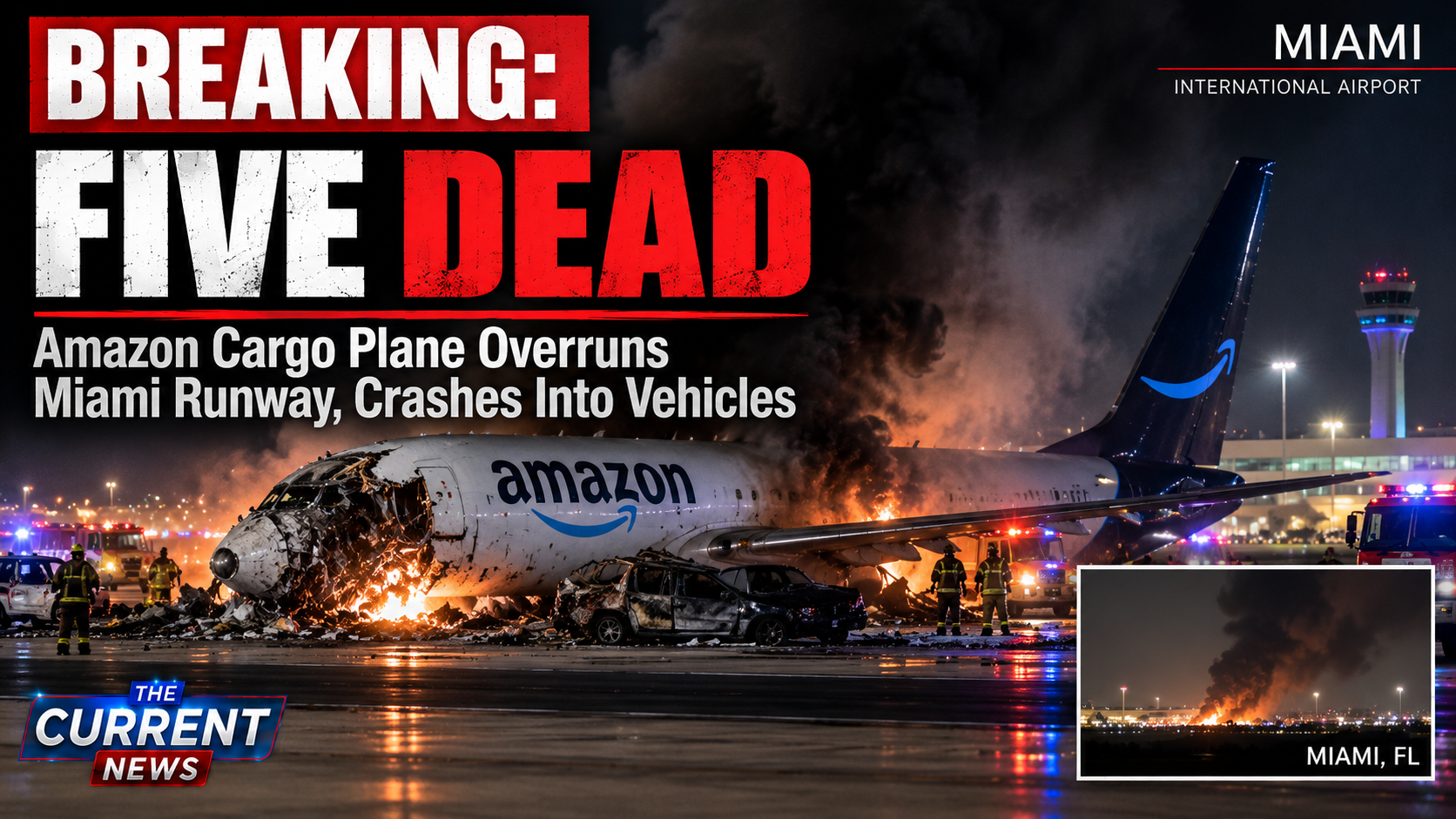
A Sunday afternoon at one of Florida’s busiest airports has turned into a scene of devastation.
An Amazon Prime Air cargo plane overran a runway at Miami International Airport, crossed beyond the airport boundary, struck multiple vehicles and erupted into flames, leaving at least five people dead and five others injured.
Three of those injured are reportedly in critical condition.
The crash happened at approximately 1:58 p.m. Sunday afternoon as the aircraft arrived in Miami from San Juan, Puerto Rico.
And tonight, federal investigators are beginning the difficult task of answering one question:
What went wrong?
A ROUTINE LANDING TURNS TRAGIC
The aircraft was Prime Air Flight 7598, a Boeing 767-300 freighter operated by North Carolina-based cargo carrier 21 Air on behalf of Amazon.
The plane had departed Luis Muñoz Marín International Airport in San Juan, Puerto Rico, bound for Miami.
According to officials and flight-tracking information, the aircraft came in to land at Miami International Airport Sunday afternoon.
But something went terribly wrong.
The aircraft failed to stop within the usable portion of the runway.
It continued beyond the runway, crossed roads surrounding the airport and collided with several vehicles before coming to rest in an adjacent field.
A massive fire followed.
Thick black smoke could be seen rising above the airport as emergency crews rushed toward the wreckage.
FIVE PEOPLE ARE DEAD
Miami-Dade County officials confirmed that five people lost their lives.
Five others were transported for medical treatment.
Three of those injured were reported to be in critical condition, while two others suffered less severe injuries.
Authorities initially had not released the identities of those killed.
They also had not immediately determined whether the fatalities were people aboard the aircraft, people inside the vehicles that were struck, or a combination of both.
That determination will be part of the ongoing investigation.
Behind those numbers are families who tonight are facing something no family should have to face:
A phone call telling them someone they love is not coming home.
THE PLANE CAME TO REST OFF THE RUNWAY
The aircraft eventually came to rest in a grassy area beyond the runway.
Images from the scene showed the Boeing 767 sitting nose-down with its tail elevated, while emergency crews battled the fire.
The aircraft had sustained significant damage.
Firefighters also had to deal with a fuel leak as they worked to secure the scene.
More than 60 emergency units and approximately 200 emergency personnel responded.
The response included firefighters, rescue crews and other emergency personnel working to reach people trapped in vehicles and inside the aircraft.
PILOTS WERE TRAPPED
The crash wasn’t simply a runway excursion where the aircraft slid harmlessly into an open field.
The plane struck vehicles and sustained significant damage.
According to authorities, the pilot and co-pilot were trapped in the cockpit, while emergency crews also had to rescue people from vehicles affected by the crash.
One person was reportedly pinned beneath a vehicle.
The rescue operation became a complicated combination of aircraft fire suppression, vehicle extrication and medical response.
THE AIRPORT WAS THROWN INTO CHAOS
Miami International Airport is one of the country’s busiest aviation hubs.
When the crash occurred, airport operations were temporarily halted.
Flights were grounded as emergency crews responded and officials secured the area.
The disruption eventually resulted in more than 160 cancellations and approximately 325 delays, according to reporting citing airport data.
Some flights were diverted to other airports, including Orlando International Airport.
For travelers, what began as a normal Sunday afternoon at MIA suddenly became a massive transportation disruption.
But tonight, those delays are secondary.
Five families are grieving.
WHAT CAUSED THE PLANE TO OVERRUN THE RUNWAY?
That is the question investigators are now trying to answer.
And right now, we don’t have the answer.
The National Transportation Safety Board has launched an investigation.
NTSB Chairwoman Jennifer Homendy is leading the federal response, with investigators traveling to Miami to begin examining the aircraft, runway, flight data and circumstances surrounding the crash.
The Federal Aviation Administration is also investigating.
Boeing and 21 Air have said they will cooperate with the investigation.
WEATHER MAY BECOME PART OF THE INVESTIGATION
Weather conditions were present in South Florida Sunday.
Thunderstorms were in the area, and wind gusts reportedly reached approximately 30 mph.
However, investigators have not established that weather caused the crash.
That’s an important distinction.
Weather was present.
That does not mean:
Weather caused the accident.
Investigators will have to determine whether wind, runway conditions, visibility, aircraft performance or another factor played a role.
WAS THE PLANE TOO FAR DOWN THE RUNWAY?
Another question investigators will likely examine is exactly where the aircraft touched down.
Flight-tracking data indicates the Boeing 767 was traveling at approximately 112 knots—about 129 mph—when it left the usable runway area.
Aviation investigators will examine the aircraft’s approach, touchdown point, braking, speed and runway remaining.
They’ll also examine the condition of the aircraft itself.
At this stage, however, it would be irresponsible to declare a cause.
That’s what the investigation is for.
A 32-YEAR-OLD AIRCRAFT
The Boeing 767 involved in the crash was approximately 32 years old.
But age alone does not mean an aircraft was unsafe.
The aircraft originally operated as a passenger plane before being converted into a freighter in 2015.
It had spent years operating under different owners and operators before eventually becoming part of the cargo network serving Amazon.
Investigators will examine its maintenance history, mechanical systems, flight controls, engines and other components.
The age of the aircraft will undoubtedly attract public attention.
But investigators—not social media—will determine whether it was relevant.
THE RUNWAY ITSELF WILL ALSO BE EXAMINED
Another question emerging from the crash involves what happens when a large aircraft doesn’t stop.
Miami International Airport reportedly does not have certain runway-end arresting systems that can provide additional stopping capability for overrunning aircraft.
Experts have raised questions about runway safety features and whether additional systems could have changed the outcome.
But again, that is not the same as saying the absence of such a system caused Sunday’s deaths.
That question requires engineering analysis and investigation.
THIS IS WHY WE HAVE THE NTSB
When an aviation disaster occurs, there is a natural temptation to immediately find someone—or something—to blame.
The pilot.
The airline.
The aircraft.
The weather.
The airport.
Maintenance.
The runway.
Human error.
Mechanical failure.
But aviation accidents are rarely that simple.
Investigators will reconstruct the final moments of the flight.
They will examine the cockpit.
They will analyze flight data.
They will examine the aircraft’s maintenance records.
They will study weather.
They will examine the runway.
They will look at the debris field.
And they will talk to witnesses.
The goal isn’t to find the fastest explanation.
The goal is to find the correct one.
THE HUMAN COST
It’s easy to write:
Five dead.
It’s harder to remember what those words actually mean.
Five people had plans for Sunday.
Five people had families.
Five people had people waiting for them.
Five people had lives that were supposed to continue.
Tonight, those families are beginning to understand that their lives have changed forever.
And five other people are fighting to survive.
MIAMI’S AIRPORT WILL KEEP MOVING
Airports don’t stop forever.
Flights eventually resume.
Runways reopen.
Passengers eventually board their aircraft.
Cargo continues moving.
The schedules return.
But for the families affected by Sunday’s crash, there is no return to normal.
Their normal ended when Flight 7598 left the runway.
WHAT WE KNOW
At this point, investigators have established several important facts:
An Amazon Prime Air cargo flight operated by 21 Air crashed at Miami International Airport.
The aircraft was a Boeing 767-300.
It arrived from San Juan, Puerto Rico.
The aircraft overran Runway 30 at approximately 1:58 p.m.
It crossed beyond the runway and struck multiple vehicles.
The aircraft caught fire.
Five people were killed.
Five others were injured, including three critically.
More than 60 emergency units and roughly 200 emergency personnel responded.
The NTSB and FAA are investigating.
The identities of the victims had not yet been publicly released.
WHAT WE DON’T KNOW
And these questions remain unanswered:
Why did the aircraft overrun the runway?
Where exactly did it touch down?
Was weather a factor?
Was there a mechanical problem?
Was there a problem with braking or aircraft performance?
Did human factors play a role?
Could runway-end safety systems have changed the outcome?
Who were the five victims?
Those answers will come.
But they shouldn’t be guessed at tonight.
A TRAGEDY IN SOUTH FLORIDA
Miami is accustomed to seeing aircraft come and go.
For decades, Miami International Airport has connected South Florida with the Caribbean, Latin America and the rest of the world.
Sunday’s crash transformed that familiar sight into something horrifying.
An aircraft designed to carry cargo came down the runway.
It didn’t stop.
It crossed beyond the airport.
Vehicles were struck.
Fire erupted.
And five people lost their lives.
THE CURRENT NEWS BOTTOM LINE
Tonight, South Florida is mourning.
At least five people are dead following the crash of an Amazon Prime Air cargo plane at Miami International Airport.
Five more people were injured.
Three remain in critical condition.
The aircraft was operated by 21 Air and had arrived from San Juan, Puerto Rico.
The NTSB and FAA are now investigating what caused the Boeing 767 to leave the runway.
And while speculation will undoubtedly fill social media tonight, there is one thing worth remembering:
We don’t know yet.
We know what happened.
We know people died.
We know families are grieving.
But we don’t yet know why.
That answer belongs to the investigators.
And when they find it, The Current News will be here to report it.
For tonight, our thoughts are with the victims, their families, the injured and the first responders who ran toward the danger while everyone else was running away.
Five lives lost.
Five families changed forever.
One investigation just beginning.
LIVE FROM ORLANDO, FL — This is The Current News.