Nolan Wells Case: What the DA’s Grand Jury Update Reveals
The Nolan Wells grand jury returned no indictment. Here's what the DA said, what the investigation found and why the family still wants answers.
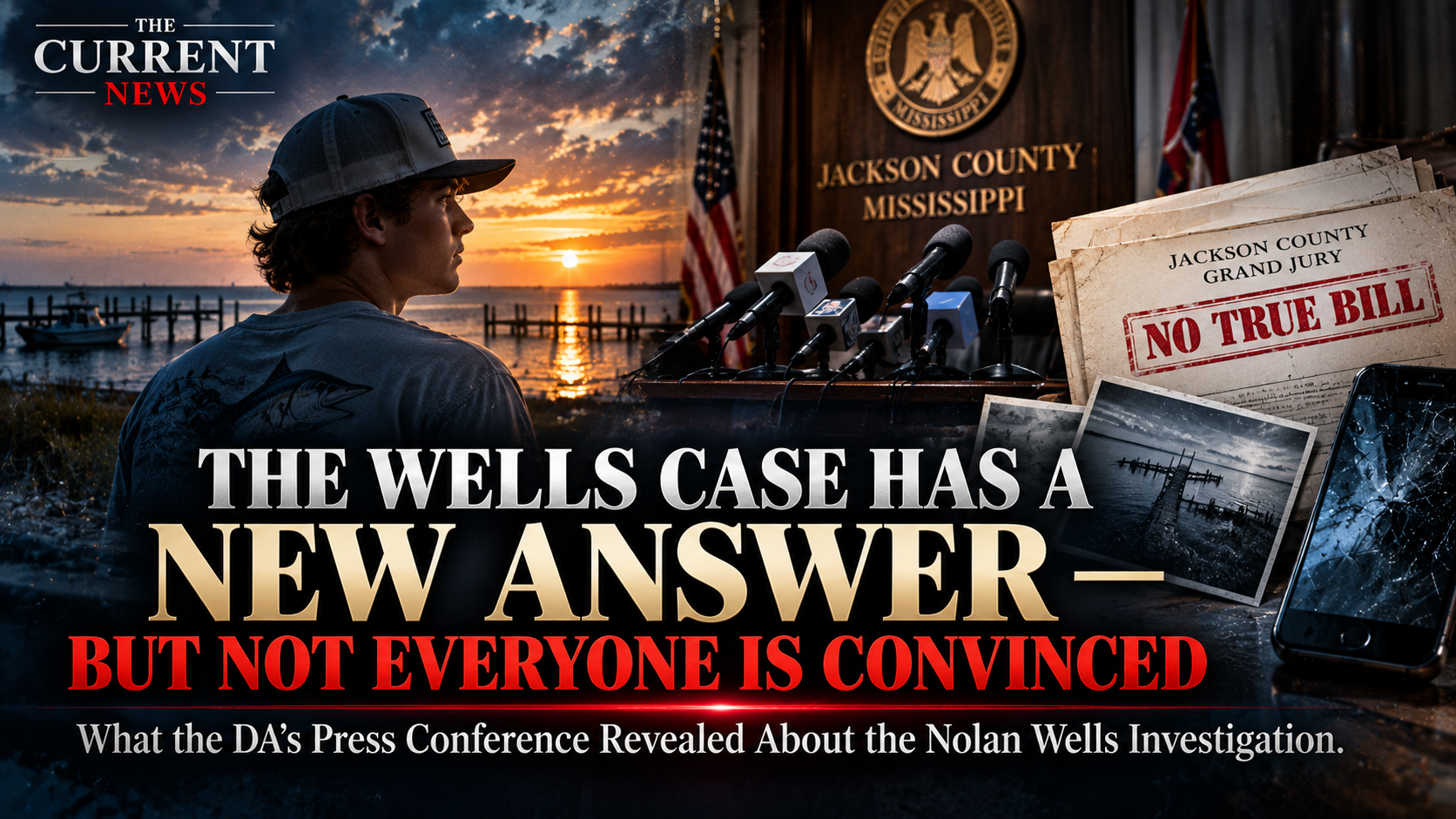
For months, the death of 18-year-old Nolan Wells has generated questions that seemed to multiply every time a new piece of information surfaced.
Was Nolan’s death an accident?
Was there foul play?
Why did he remain on Horn Island?
Why did his friends leave without him?
What caused the injuries documented on his body?
And perhaps the most politically charged question of all:
Did race have anything to do with what happened to Nolan Wells?
Now, after months of investigation, a Mississippi grand jury has given the public its first major legal answer.
No one will be indicted.
But that doesn’t mean every question surrounding Nolan’s death has disappeared.
And after a press conference from Nolan’s family and attorney Ben Crump, followed by a new examination of his cellphone, the debate is far from over.
THE GRAND JURY’S DECISION
On September 21, Jackson County District Attorney Angel Myers McIlrath announced that a grand jury had unanimously returned a “no true bill” in the investigation into Nolan Wells’ death.
In practical terms, that means the grand jury did not find sufficient evidence to indict anyone.
The investigation was not based on a handful of interviews.
According to the grand jury report, investigators issued 132 subpoenas and heard from 43 witnesses. The grand jury reviewed cellphone information, forensic reports, photographs, video, GPS data and investigative material.
That is a substantial amount of evidence.
And it is important because much of the online conversation surrounding the Wells case has revolved around the assumption that authorities simply weren’t investigating.
The grand jury’s report presents a different picture.
There was a substantial investigation.
The disagreement now centers on what that investigation actually established.
THE DA’S MESSAGE WAS BLUNT
McIlrath did not simply announce the grand jury’s decision.
She directly addressed one of the biggest narratives that had developed online.
Race.
In her statement, McIlrath said there was “absolutely no evidence” that Nolan’s disappearance or death was racially motivated.
She also criticized what she described as outsiders and influencers attempting to exploit Nolan’s death to divide the community.
The DA specifically pushed back against the simplified version of the story that had spread across social media:
Three white boys went to an island with a Black boy—and only the three white boys came home.
McIlrath said that description was false.
According to the investigation, Nolan had traveled to Horn Island with a larger group of friends and interacted with additional people while there. The grand jury also found that Nolan was not the only Black person on the island that day.
That matters.
Because a narrative built around four people can look very different when the actual circumstances involve a much larger gathering.
THE GRAND JURY ALSO ADDRESSED WHY NOLAN MAY HAVE REMAINED
One of the biggest questions surrounding the case has been why Nolan stayed on Horn Island while his friends eventually returned to the mainland.
The grand jury considered that question as well.
Its report stated that remaining on Horn Island was not inherently unusual and that the circumstances did not establish criminal conduct by the people who left.
The report also noted that Nolan’s phone was not the only phone to return to the mainland without its owner.
That doesn’t necessarily answer every question the Wells family has.
But it does challenge one of the assumptions that became central to online speculation:
That the decision to leave Nolan behind was inherently evidence of wrongdoing.
The grand jury did not reach that conclusion.
THEN THERE IS THE DROWNING QUESTION
This is where the story becomes considerably more complicated.
The grand jury found that the position, condition, time of discovery and location of Nolan’s body were consistent with drowning.
But there is an important distinction.
“Consistent with drowning” is not the same thing as “the cause of death was definitively determined to be drowning.”
Both the Mississippi medical examiner and the independent forensic pathologist hired by Nolan’s family listed the cause and manner of death as undetermined.
The grand jury report acknowledged that distinction.
It also noted that accidental drowning was consistent with the evidence and that the evidence did not rule it out.
That leaves a difficult reality:
The grand jury did not establish exactly how Nolan died.
It concluded that the evidence did not establish a criminal act.
Those are two different conclusions.
WHAT ABOUT THE INJURIES?
This may be the strongest remaining point of contention.
Nolan’s family has continued to question injuries identified during the examinations of his body.
The independent forensic pathologist retained by the family reported recent blunt-force injuries to the back of Nolan’s head and other areas of his body.
The grand jury heard evidence concerning those injuries.
A witness testified that Nolan had slipped awkwardly from the side of a boat around 3:30 p.m. on July 4.
That witness could not say whether Nolan struck his head.
The witness did testify that Nolan continued socializing afterward and did not appear injured.
The grand jury concluded that the exact cause of the head injury remained uncertain.
And critically, it found no evidence establishing that the injury was fatal or that it resulted from a criminal act.
That doesn’t necessarily satisfy Nolan’s family.
And it shouldn’t be presented as though it does.
THE FAMILY IS NOT ACCEPTING THE CONCLUSION
The grand jury’s decision did not end the Wells family’s search for answers.
The day after the grand jury decision, Nolan’s parents appeared alongside Ben Crump at a press conference in Atlanta.
Their message was essentially the opposite of the DA’s:
There are still too many unanswered questions.
The family has questioned the conclusions surrounding the drowning theory and has continued to focus on the injuries found on Nolan’s body.
Crump has called for continued investigation and has raised the possibility of federal involvement. The family has also requested greater transparency concerning the investigative file and the full medical-examiner materials.
This creates two very different narratives.
The DA: The investigation was extensive, the grand jury found no evidence of criminal conduct, and there is no evidence of racial motivation.
The family: The investigation may have answered some questions, but fundamental questions about Nolan’s death remain unresolved.
Both positions are now part of the public record.
AND NOW THERE IS THE PHONE
Just when it appeared the grand jury decision might bring the investigation to a close, another development arrived.
Today, September 24, Ben Crump and independent digital-forensics investigators announced findings from their examination of Nolan’s cellphone. The examination was conducted by Garrett Discovery, a forensic firm retained by the Wells family.
According to the forensic team, Nolan last used his phone at approximately 2:18 p.m. on July 4.
The examination also reportedly identified messages that were deleted after Nolan’s final phone activity.
The investigators said they could not determine who deleted those messages or why.
That distinction is critical.
Deleted messages do not automatically establish foul play.
But they are certainly the kind of information that can generate additional questions in an already disputed investigation.
The forensic examination reportedly produced hundreds of pages of records, much of them involving Snapchat and Instagram communications.
That information will now become another piece of the larger puzzle.
SO DID RACE MATTER?
This is where our previous “Race to Racism” article comes back into the conversation.
The original question wasn’t whether racial concerns were legitimate.
It was:
Why did race become the default explanation before the evidence had been fully established?
Now we have something that didn’t exist when that article was written:
A grand jury has reviewed the evidence.
And that grand jury found no evidence that Nolan’s death was racially motivated.
That doesn’t mean someone is prohibited from asking whether racial bias could have played a role.
It means that, based on the evidence presented to the grand jury, the racial-motivation theory was not established.
That distinction matters.
A theory can be investigated without becoming a fact.
A question can remain legitimate without the answer automatically being “yes.”
BUT THE OPPOSITE EXTREME IS ALSO A PROBLEM
There is a temptation now to go too far in the other direction.
The grand jury said no one should be indicted.
That does not mean every mystery surrounding Nolan’s death has been solved.
The official cause and manner of death remain listed as undetermined.
The family disputes the interpretation of the evidence.
And new digital evidence is now being presented by the family’s independent forensic team.
So saying:
“The grand jury found no criminal evidence”
is accurate.
Saying:
“We now know exactly what happened to Nolan”
would not be.
Those are very different statements.
THE CASE IS NOT NECESSARILY CLOSED FOREVER
There is another important detail buried in the grand jury’s findings.
The report leaves open the possibility of further action if credible new evidence emerges suggesting Nolan’s death was not accidental.
Mississippi has no statute of limitations for murder.
That means a future development could potentially bring the matter back before a grand jury.
So Monday’s decision isn’t necessarily the permanent end of every legal question surrounding Nolan Wells.
It is the end of this particular grand-jury presentation without an indictment.
WHAT WE SHOULD LEARN FROM THIS
The Nolan Wells case has become a perfect example of the danger of allowing a story to outrun its evidence.
First came the questions.
Then came social media theories.
Then came accusations.
Then came political interpretations.
And now, months later, we finally have a grand jury report containing information that was not publicly available when many of those theories first spread.
Some theories survived.
Others did not.
And some questions remain unanswered.
That’s how investigations work.
Evidence doesn’t always give us the ending we want.
Sometimes it gives us an uncomfortable middle.
THE CURRENT NEWS TAKEAWAY
The Nolan Wells investigation now sits at a complicated crossroads.
A Mississippi grand jury reviewed extensive evidence and unanimously declined to indict anyone.
The DA says there is no evidence Nolan’s death was racially motivated.
The grand jury found the circumstances surrounding the discovery of Nolan’s body consistent with drowning.
But both the state medical examiner and the family’s independent pathologist listed the cause and manner of death as undetermined.
Nolan’s family remains unconvinced.
And now an independent digital-forensics examination of Nolan’s cellphone has introduced additional information that the family says deserves further scrutiny.
So perhaps the most responsible conclusion isn’t:
“The case is solved.”
And it isn’t:
“The conspiracy has been proven.”
It is much simpler:
The grand jury found no evidence sufficient to charge anyone.
But the family still wants to know exactly how Nolan Wells died.
Those two statements can exist at the same time.
And if credible new evidence emerges, the grand jury’s own report leaves the door open for the matter to be reconsidered.
For now, though, one thing has changed dramatically from where this story began:
The question is no longer simply “Why isn’t anyone investigating?”
We now know there was an extensive investigation.
The harder question is:
Did that investigation find the truth—or simply find that there wasn’t enough evidence to prove a crime?
That is a question the public may continue debating.
And it is one the Wells family clearly isn’t prepared to stop asking.
Editorial & Legal Note
The grand jury’s no-true-bill decision means no indictment was returned; it is not a judicial finding that every factual question surrounding Nolan Wells’ death has been resolved. The cause and manner of death remain reported as undetermined. Claims made by the Wells family, Ben Crump and independent forensic investigators about possible injuries or deleted cellphone data should be understood as allegations or investigative findings unless independently established by authorities or a court.