Nolan Wells Timeline: What the DA Says Really Happened
A detailed timeline of the Nolan Wells case, comparing the DA's account with claims made publicly by Ben Crump and examining what the evidence shows.
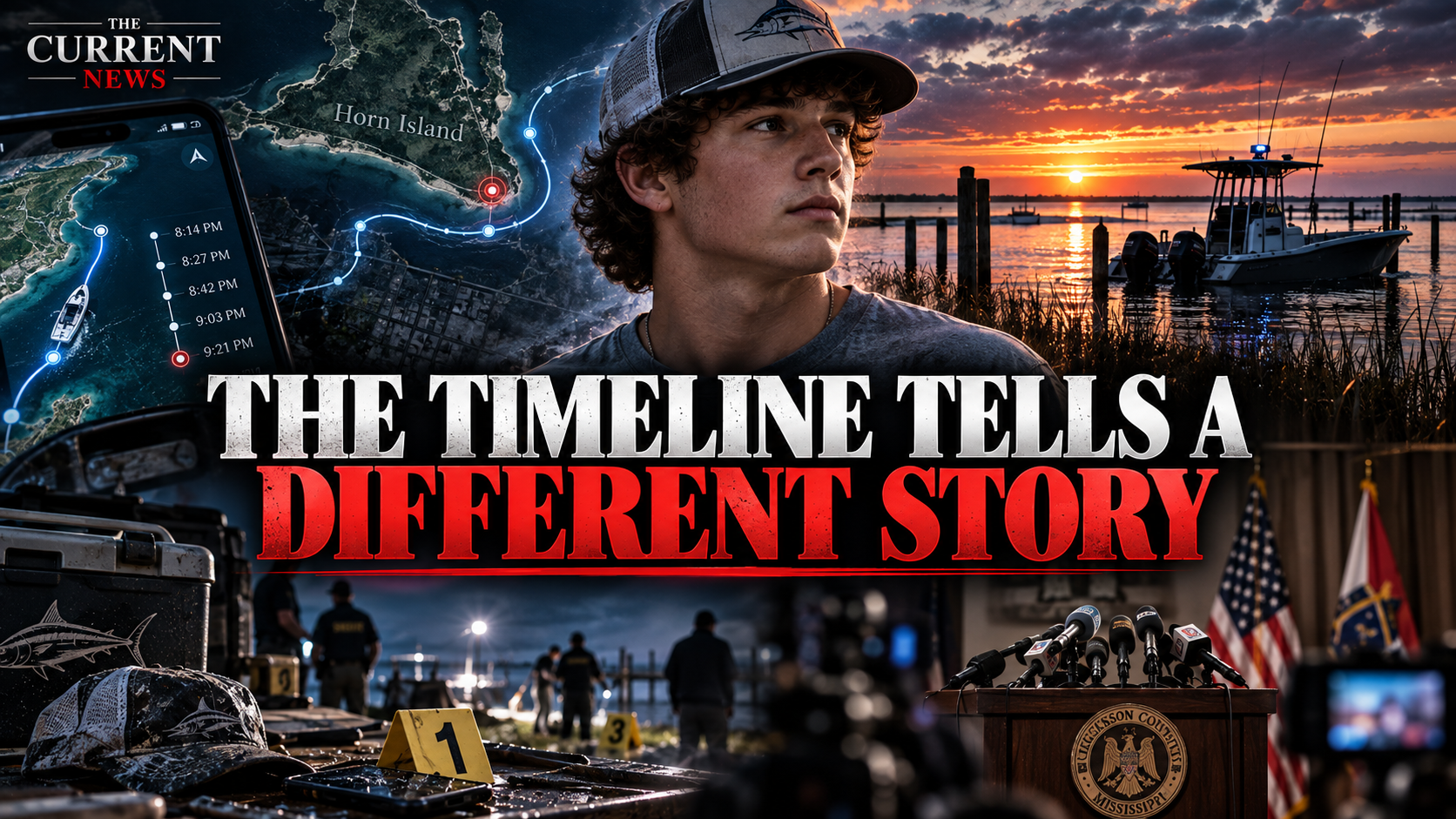
For weeks, the Nolan Wells case has been defined by questions.
Why did Nolan Wells remain on Horn Island?
Why did his friends leave without him?
What happened during the final hours of July 4?
Was there an altercation?
Was Nolan’s phone taken?
And perhaps most importantly:
Did the public receive the full story—or a story built around incomplete information?
After the Jackson County grand jury unanimously declined to indict anyone in Nolan’s death, District Attorney Angel Myers McIlrath released a roughly 15-minute statement addressing not only the grand jury’s findings, but also what she described as false narratives that had circulated throughout the investigation.
Her statement was unusually direct.
She challenged claims about racial motivation, the handling of Nolan’s phone, the autopsy, the investigation itself—and the circumstances surrounding Nolan’s decision to remain on Horn Island.
And when the timeline is placed next to some of the claims that had been publicly presented by attorney Ben Crump and others, a more complicated picture emerges.
This isn’t an argument that every question has been answered.
It is an attempt to separate what was alleged, what investigators established, and what remains unknown.
FIRST: WHAT WE ACTUALLY KNOW
Nolan Wells, 18, traveled to Horn Island on July 4 with friends aboard a group of boats.
According to Mississippi Department of Marine Resources data reported by local media, the boat carrying Nolan departed the Ocean Springs area at approximately 9:56 a.m. and arrived at Horn Island around 11:14 a.m.
Nolan was later reported missing.
His body was discovered by a National Park Service ranger on the morning of July 6 at the northwestern end of Horn Island.
Those basic facts aren’t really in dispute.
The disagreement begins with what happened between those two points.
9:56 A.M. — THE TRIP BEGINS
The timeline begins in Ocean Springs.
The boat carrying Nolan and his friends left the private dock at approximately 9:56 a.m.
That matters because some of the later online narratives reduced the trip to a much smaller group than investigators say was actually present.
The DA’s office says Nolan was part of a larger gathering on Horn Island and interacted with other people once there.
The grand jury specifically found that the popular description that “three White boys and a Black boy went to an island and only three White boys came back” was false.
According to the grand jury report, Nolan was not the only Black person on the island that day, and the group encountered additional people while there.
That doesn’t answer what happened to Nolan.
But it changes the starting point.
11:14 A.M. — THEY ARRIVE AT HORN ISLAND
GPS data placed the boat at Horn Island at approximately 11:14 a.m.
This was not a deserted island.
Horn Island was reportedly crowded with people celebrating the Fourth of July.
Nolan spent several hours there.
According to accounts considered during the investigation, he socialized with friends and interacted with other people on the island.
That becomes important later because one of the major questions is whether Nolan was forcibly separated from the group.
The evidence presented to the grand jury did not establish that.
AROUND 3:00 P.M. — THE LAST SIGHTING
This is where the timeline becomes particularly important.
One of Nolan’s friends, Warren Hudson, said he last saw Nolan at approximately 3 p.m. Hudson reportedly described Nolan as being with a woman on the island.
That account became significant because the question eventually became:
Was Nolan trying to leave with his friends—or had he decided to remain on the island?
Crump publicly questioned the timeline surrounding Nolan’s departure.
At an earlier press conference, Crump emphasized that the friends reportedly didn’t leave until approximately 4:30 p.m.
He asked:
“Where was Nolan for that hour?”
That was a reasonable question to ask.
But the DA’s presentation provides an explanation for what investigators say happened during that period.
THE ALLEGED ALTERCATION
Another major component of the public narrative involved a video circulating online that was initially described as potentially showing Nolan involved in an argument.
At a July press conference, Crump referred to audio in the video and said someone could be heard saying:
“Give me my freaking phone. What are you freaking doing?”
Crump said multiple people identified the voice as Nolan’s.
But there was an important development.
A friend named Tracestin Shepherd later told ABC that the voice was his—not Nolan’s.
That’s significant.
Because the original interpretation of the video became part of the broader suspicion surrounding Nolan’s disappearance.
But the available reporting does not establish that the video showed Nolan being assaulted.
The sheriff’s office asked the public to provide original photographs and videos concerning an alleged altercation because investigators were attempting to establish what actually happened.
In other words:
A viral video became evidence only after investigators could establish what—or whom—it actually showed.
THE BOAT PROBLEM
Now we reach approximately 4:00–4:30 p.m.
This is another area where the competing narratives have differed.
Crump questioned why the friends left Nolan behind.
One explanation offered by people connected to the group was that the boat began experiencing problems and taking on water.
Ashlee Cole, the mother of one of Nolan’s friends, said her son told her that the boat was having problems with the bilge pump and that the group needed to leave.
The grand jury considered evidence regarding the boat and the group’s departure.
The DA’s account says Nolan had an opportunity to leave but chose to remain on the island.
McIlrath went even further in her statement:
“Nolan chose to stay on the island that day, and there is not a scintilla of evidence to contradict that.”
That is the central factual dispute.
THE QUESTION OF THE GIRL
Crump had previously pointed to what appeared to be a contradiction.
The friends reportedly said Nolan was staying behind because he was talking to a girl.
But the woman involved reportedly gave an account suggesting Nolan intended to return to the boat.
Crump highlighted that apparent contradiction publicly:
Which account was correct?
The DA’s presentation indicates that investigators had significantly more information than what was publicly available when that question was first raised.
The grand jury reviewed witness testimony and other evidence concerning the events on the island.
Ultimately, it found no credible evidence that Nolan’s friends engaged in criminal conduct.
That doesn’t necessarily mean every witness remembered every detail perfectly.
It means the grand jury did not find the inconsistencies sufficient to establish a criminal case.
4:31 P.M. — THE BOAT LEAVES
Available GPS reporting places the boat’s departure from Horn Island at approximately 4:31 p.m.
This is an important timestamp.
Because one of the strongest public narratives surrounding the case was:
They left Nolan behind.
But the legal question isn’t whether Nolan remained behind.
He did.
The question is:
Was he intentionally abandoned in circumstances demonstrating criminal conduct?
The grand jury said the evidence did not establish that.
According to the DA, Nolan made a decision to remain.
And the grand jury found no credible evidence that the people involved in the trip committed a crime related to his death.
WHAT ABOUT NOLAN’S PHONE?
This became one of the most controversial elements of the case.
Nolan’s phone eventually returned to the mainland with members of the group.
That understandably generated questions.
Why would Nolan’s phone leave the island if Nolan didn’t?
But again, the timeline is more complicated than the viral version.
The DA specifically addressed claims that her office had refused to allow the family to examine the phone.
According to McIlrath, Nolan’s family and Crump’s legal team maintained control over the phone and had control over when, where and how it would be examined.
That directly contradicts the suggestion that the DA’s office simply prevented an examination.
And eventually, the family did conduct an independent forensic examination of the phone.
That examination reportedly identified deleted communications—but investigators said they could not determine who deleted them or why.
So again:
A suspicious-looking fact is not automatically evidence of a crime.
JULY 6 — NOLAN IS FOUND
The search continued after Nolan failed to return.
On July 6, a National Park Service ranger discovered his body near the northwestern end of Horn Island.
The discovery was reported at approximately 8:45 a.m.
Nolan’s family was notified.
His body was transported for examination.
And the investigation shifted from a missing-person search into a death investigation.
THEN THE AUTOPSIES CREATED ANOTHER QUESTION
This is where we need to be particularly careful.
The grand jury concluded that the position, condition, time of discovery and location of Nolan’s body were consistent with drowning.
But both the state medical examiner and the independent forensic pathologist retained by the Wells family listed the cause and manner of death as undetermined.
So the DA is not saying:
“The medical examiner definitively proved drowning.”
The evidence is more nuanced.
Drowning remained a possible explanation.
The evidence did not establish a fatal injury.
And the grand jury did not find evidence sufficient to establish criminal conduct.
Those distinctions matter.
WHAT ABOUT THE BRUISES?
The Wells family’s independent pathologist reported blunt-force injuries to Nolan’s head and other areas of his body.
That became one of the family’s strongest reasons for continuing to question the official investigation.
The grand jury considered those injuries.
According to the findings reported publicly, the evidence did not establish that the injuries were fatal or that they were caused by a criminal act.
There was also testimony that Nolan had slipped from the side of a boat earlier that afternoon.
The witness could not establish that Nolan struck his head, but reportedly said Nolan continued interacting normally afterward.
Again, there is a difference between:
“There were injuries.”
and
“Those injuries prove someone murdered Nolan.”
The available evidence does not establish the second conclusion.
AUGUST 13 — A DETAIL THAT DESERVES ATTENTION
Perhaps one of the most significant claims made by McIlrath during her statement involved the Wells family’s own investigation.
According to the DA, on August 13, after the Crump team had completed its independent autopsy and received hundreds of tips, the family’s legal team told the DA’s office that they had found no evidence of a crime being committed against Nolan.
That is a striking claim.
If accurately characterized, it means that the same legal team that had been publicly demanding answers had, at that point, told prosecutors that its investigation had not uncovered evidence establishing a crime.
That doesn’t mean the family stopped having questions.
It doesn’t mean the cause of death was suddenly known.
And it doesn’t mean Crump’s later calls for additional investigation were illegitimate.
But it is an important part of the timeline.
SEPTEMBER — THE GRAND JURY
The grand jury eventually reviewed an enormous amount of information.
According to the DA’s office, investigators issued 132 subpoenas and heard from 43 witnesses.
The grand jury considered:
Witness testimony
Cellphone evidence
GPS information
Photographs
Video
Forensic evidence
Independent investigative material
The grand jury ultimately returned a no true bill.
No indictment.
No criminal charges.
And no finding that the death was racially motivated.
SO WHAT EXACTLY DID THE DA SAY WAS FALSE?
This is perhaps the most important section.
McIlrath specifically pushed back against several narratives that had circulated.
Claim #1: Nolan’s death was racially motivated.
The DA says investigators found no evidence supporting that.
Claim #2: Three white friends took Nolan to the island and simply left him behind.
The DA says that characterization ignored the larger group of people on the island and the additional people Nolan interacted with.
Claim #3: Nolan was forcibly prevented from returning.
The DA says the evidence indicated Nolan chose to remain.
Claim #4: The DA withheld Nolan’s autopsy and toxicology results from the family.
McIlrath says she contacted Nolan’s mother after receiving the report and, when she did not respond, provided the information to one of the family’s Mississippi attorneys.
Claim #5: The DA prevented the family from examining Nolan’s phone.
McIlrath says the family and Crump’s team maintained control over the phone and therefore controlled when and how it would be examined.
Claim #6: The investigation was never really conducted.
The grand jury record points to an investigation involving 132 subpoenas, 43 witnesses and extensive digital, forensic and physical evidence.
BUT HERE’S WHAT THE DA’S TIMELINE DOESN’T ANSWER
This is where we need to be fair.
The DA’s account challenges a number of narratives.
But it does not magically answer every question.
We still have an official cause and manner of death listed as undetermined.
We still don’t know precisely how Nolan died.
The family’s independent forensic examination identified injuries that the family continues to question.
The cellphone investigation reportedly found deleted messages, although there is no established evidence publicly showing who deleted them or why.
And Nolan’s family continues to demand additional investigation.
So there is a legitimate distinction between:
“The grand jury found insufficient evidence for criminal charges.”
and
“Every question surrounding Nolan Wells has been definitively answered.”
The first is established.
The second is not.
THE BIGGER PROBLEM: HOW STORIES GET BUILT
The Nolan Wells case may ultimately become a case study in how modern investigations unfold in the age of social media.
A piece of video appears.
Someone interprets it.
A lawyer discusses it.
An influencer repeats it.
Thousands of people share it.
Soon, the interpretation becomes accepted as fact.
Then investigators release information contradicting the original interpretation.
But by then, the original story has already taken on a life of its own.
That’s exactly why the timeline matters.
Chronology is one of the best defenses against misinformation.
Not because chronology automatically proves someone’s innocence or guilt.
But because it forces us to ask:
What did we actually know at the time?
What was alleged?
What was later verified?
What remains unknown?
THE CURRENT NEWS TAKEAWAY
Ben Crump was right about one thing from the beginning:
Nolan Wells deserved answers.
His family deserved transparency.
The public deserved a serious investigation.
And questions surrounding an 18-year-old’s unexplained death should not simply be dismissed.
But demanding answers and establishing a criminal theory are two different things.
The DA’s timeline and the grand jury findings now provide substantially more information than the public had when the first theories began spreading.
And some of the strongest claims made publicly about Nolan’s final hours have not been established by the evidence presented to the grand jury.
The alleged argument may not have involved Nolan.
The racial-motivation theory was not supported by the evidence presented to the grand jury.
The claim that authorities simply refused to investigate is difficult to reconcile with the documented scope of the investigation.
And the claim that the family was prevented from examining Nolan’s phone is directly disputed by the DA.
None of this means the Wells family must stop asking questions.
It means we should ask those questions based on what the evidence actually shows.
Because there is a difference between:
A mystery.
A suspicion.
A theory.
An allegation.
And a proven fact.
The Nolan Wells case has contained all five.
The challenge now is determining which is which.
And perhaps the most important lesson from the DA’s timeline is this:
Before we decide what happened to Nolan Wells, we should first make sure we’re telling the story of what actually happened.
Editorial & Legal Note
This article distinguishes between statements made by District Attorney Angel Myers McIlrath, claims previously made publicly by attorney Ben Crump or others, and facts established through publicly reported investigative findings. Descriptions of disputed events should not be interpreted as findings of guilt or wrongdoing. The grand jury returned a no-true-bill and did not indict anyone. The official cause and manner of Nolan Wells’ death remain reported as undetermined. Where the DA disputes a prior claim, that dispute is attributed to her rather than presented as an independent finding by The Current News.