One Year Later: Remembering Charlie Kirk
One year after Charlie Kirk's death, we examine his faith, political movement, Turning Point USA, and the legacy he left for America's next generation.
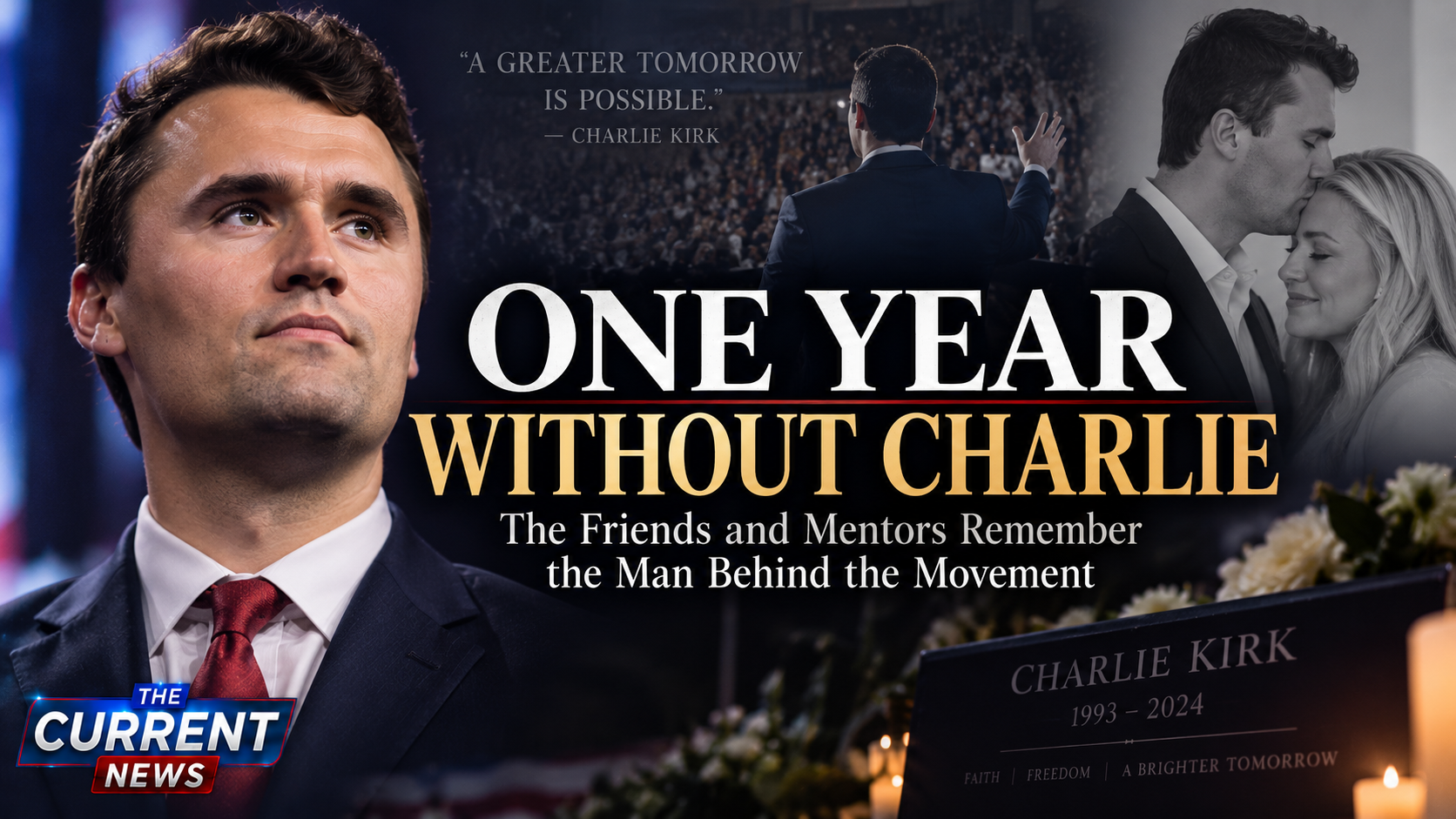
Nearly one year ago, the conservative movement lost one of its most recognizable voices.
Charlie Kirk was assassinated in September 2025.
In the days and months that followed, the political world debated what his death meant, what would happen to Turning Point USA, and whether the movement he helped build could survive without him.
But as the anniversary of his death approaches, perhaps the better question isn’t simply:
What happened to Charlie Kirk?
It’s:
What did Charlie Kirk leave behind?
MORE THAN A POLITICAL COMMENTATOR
Charlie Kirk wasn’t simply a man who appeared on television or spoke at political rallies.
He built an organization.
He built a movement.
And perhaps most importantly, he built a generation of young conservatives who had been told that politics wasn’t something they needed to stay away from.
Through Turning Point USA, Kirk helped bring political discussion onto college campuses and into the lives of young Americans.
His approach was often confrontational.
Sometimes controversial.
Sometimes intentionally provocative.
But it was rarely quiet.
Charlie understood something that many political organizations didn’t:
If you want to influence the next generation, you have to actually talk to the next generation.
THE CAMPUS BECAME HIS BATTLEGROUND
Kirk’s political career began when he was still remarkably young.
Instead of waiting for a political establishment to give him permission to participate, he went directly to college campuses.
That became one of the defining characteristics of his career.
He debated students.
He challenged professors.
He spoke with people who disagreed with him.
He built a massive social-media presence.
And he turned Turning Point USA into one of the most recognizable organizations in American conservative politics.
The strategy was simple:
Go where young people are.
And talk to them.
HIS FAITH WAS PART OF THE STORY
For Charlie Kirk, conservatism wasn’t completely separated from Christianity.
His Christian faith became increasingly visible throughout his public life.
He spoke openly about God.
He spoke about Jesus.
He spoke about marriage and family.
He spoke about the importance of biblical principles.
And he increasingly described his political convictions through the lens of his Christian worldview.
That matters because Charlie’s legacy can’t simply be measured by votes, endorsements or political victories.
For many of his supporters, his greatest contribution was encouraging young people to think seriously about what they believed and why they believed it.
HE DIDN’T JUST PREACH TO PEOPLE WHO AGREED WITH HIM
One of the more interesting aspects of Charlie’s career was his willingness to debate people who disagreed with him.
That doesn’t mean every debate was perfect.
It doesn’t mean every argument was persuasive.
And it certainly doesn’t mean everyone who watched him became conservative.
But it created something increasingly rare:
A willingness to have the conversation.
Political disagreement has increasingly become personal.
People don’t simply disagree about policies.
They question each other’s intelligence.
They question each other’s morality.
They question each other’s character.
Charlie Kirk often walked directly into that environment.
He would sit across from someone who disagreed with him and say, essentially:
Let’s talk.
That approach helped make him famous.
It also made him controversial.
THE MAN BEHIND THE MOVEMENT
Charlie Kirk was also a husband and father.
That part of his story became even more significant following his assassination.
His wife, Erika Kirk, suddenly found herself facing a future she never expected.
She lost her husband.
Their family lost a father.
And Turning Point USA lost the person who had become synonymous with the organization.
The transition that followed was extraordinary.
Erika eventually stepped into a leadership role within the organization Charlie had built.
That transition has itself become part of Charlie’s legacy.
Because the question after the assassination wasn’t simply whether Turning Point USA would continue.
It was:
Could the organization continue without Charlie Kirk?
THE MOVEMENT DIDN’T DIE WITH THE MAN
That’s perhaps the most important lesson.
Organizations built entirely around personalities often collapse when the personality disappears.
But Turning Point USA had something Charlie spent years building:
A network.
A structure.
Young activists.
Campus chapters.
Media platforms.
Supporters.
Donors.
A generation that had grown up with the organization.
Charlie was the face.
But he wasn’t the only person who believed in the mission.
That’s why his death didn’t automatically mean the end of the movement.
THE FIGHT OVER HIS LEGACY
And this is where the story becomes complicated.
Whenever someone influential dies, people immediately begin fighting over their legacy.
Some want to preserve everything that person represented.
Others want to redefine it.
Some want to soften the controversial parts.
Others want to emphasize them.
Some want the movement to become more politically powerful.
Others want it to become more explicitly Christian.
And some simply want to use the person’s name to advance their own agenda.
Charlie Kirk’s legacy is therefore unlikely to belong to one person.
It will be contested.
It will be interpreted.
And it will evolve.
THE CONSPIRACIES DON’T DEFINE THE LEGACY
Since Charlie’s death, the internet has produced countless theories surrounding his assassination and the people around him.
Some questions deserve investigation.
Some deserve skepticism.
And some simply aren’t supported by evidence.
That distinction matters.
A person’s legacy shouldn’t be determined by whichever conspiracy theory happens to be trending on social media.
Charlie spent his career arguing that people should think critically.
His legacy should therefore be approached with the same principle:
Follow the evidence.
Not the algorithm.
Not the loudest influencer.
Not the most viral video.
The evidence.
CHARLIE’S GREATEST LEGACY MAY BE THE PEOPLE HE INSPIRED
Perhaps the easiest way to measure Charlie Kirk’s influence isn’t by looking at his follower count.
It’s by looking at the people who came after him.
Young conservatives who joined campus organizations.
Students who learned how to debate.
Young Americans who became politically active.
People who began reading about politics because they saw Charlie speaking on their campus.
People who began asking questions about Christianity because Charlie talked about his faith.
People who discovered that they didn’t have to remain silent simply because their opinions were unpopular.
That is a legacy that can’t be measured on a balance sheet.
BUT LEGACY COMES WITH RESPONSIBILITY
The people who say they want to continue Charlie’s work have a responsibility.
If they want to honor him, they can’t simply repeat his name.
They have to carry forward the principles they believe he stood for.
That means engaging people.
It means defending ideas.
It means encouraging young people to participate.
It means being willing to debate.
And, for those who emphasize Charlie’s Christian faith, it means remembering that political victory isn’t the same thing as spiritual victory.
A movement can win elections and still lose its moral compass.
A movement can gain millions of followers and still forget why it began.
And a movement can become so obsessed with personalities that it forgets the principles that originally brought people together.
WHAT WOULD CHARLIE WANT?
That’s ultimately a question none of us can answer.
We shouldn’t pretend to know exactly what a person who is no longer here would say about every political controversy that comes afterward.
But we can look at what he actually said and did while he was alive.
He believed in political engagement.
He believed in debate.
He believed in young people.
He believed in Christianity.
He believed America was worth fighting for.
And he believed people should have the courage to stand for what they believed was right.
Those are the pieces of his legacy that don’t require speculation.
ONE YEAR LATER, THE QUESTIONS HAVE CHANGED
Immediately after Charlie’s death, the question was:
Who will replace him?
Now the question is:
Who will carry the mission forward?
Those aren’t the same thing.
Nobody will simply “replace” Charlie Kirk.
A person can take over an organization.
A person can inherit a title.
A person can stand on the same stage.
But they cannot recreate another human being.
The goal shouldn’t be to create another Charlie Kirk.
It should be to create thousands of young people who are willing to take responsibility for their own convictions.
THE NEXT GENERATION
Perhaps that is where Charlie’s story ultimately leads.
Not back to Charlie.
Forward.
Toward the young Americans who watched him.
Toward the students who debated him.
Toward the activists who joined his organization.
Toward the Christians who heard him talk about faith.
Toward the conservatives who found their voice through his platform.
Toward the people who disagreed with him but were willing to have the conversation.
A legacy isn’t truly alive because people keep talking about the person who died.
It’s alive when the principles that person believed in continue influencing people who are still here.
REMEMBER THE MAN, NOT JUST THE BRAND
It is easy in modern politics to turn people into brands.
A logo.
A podcast.
A social-media account.
A political organization.
A merchandise line.
A slogan.
Charlie Kirk became all of those things.
But before he was a brand, he was a person.
A husband.
A father.
A Christian.
A political activist.
A son.
A friend.
And a man who believed strongly enough in his convictions to spend his life defending them publicly.
That is worth remembering.
THE CURRENT NEWS BOTTOM LINE
Nearly one year after Charlie Kirk’s assassination, the conservative movement is still dealing with the question of what comes next.
Turning Point USA continues.
Erika Kirk has stepped into a leadership role.
Young conservatives continue to organize.
And Charlie’s name remains one of the most recognizable in modern conservative politics.
But his greatest legacy may not be the organization that bears his fingerprints.
It may be the generation of people who learned from him that political participation wasn’t reserved for politicians.
That debate wasn’t something to fear.
That faith didn’t have to be hidden.
And that young people could have a voice in the direction of their country.
Charlie Kirk’s life ended violently.
But the ideas he spent his life discussing did not.
And perhaps that is the real test of his legacy.
Not whether people continue to say his name.
But whether they continue to think, debate, believe and act.
One year later, Charlie Kirk is gone.
But the movement he helped create is still here.
And now, it belongs to the generation he spent his life trying to reach.