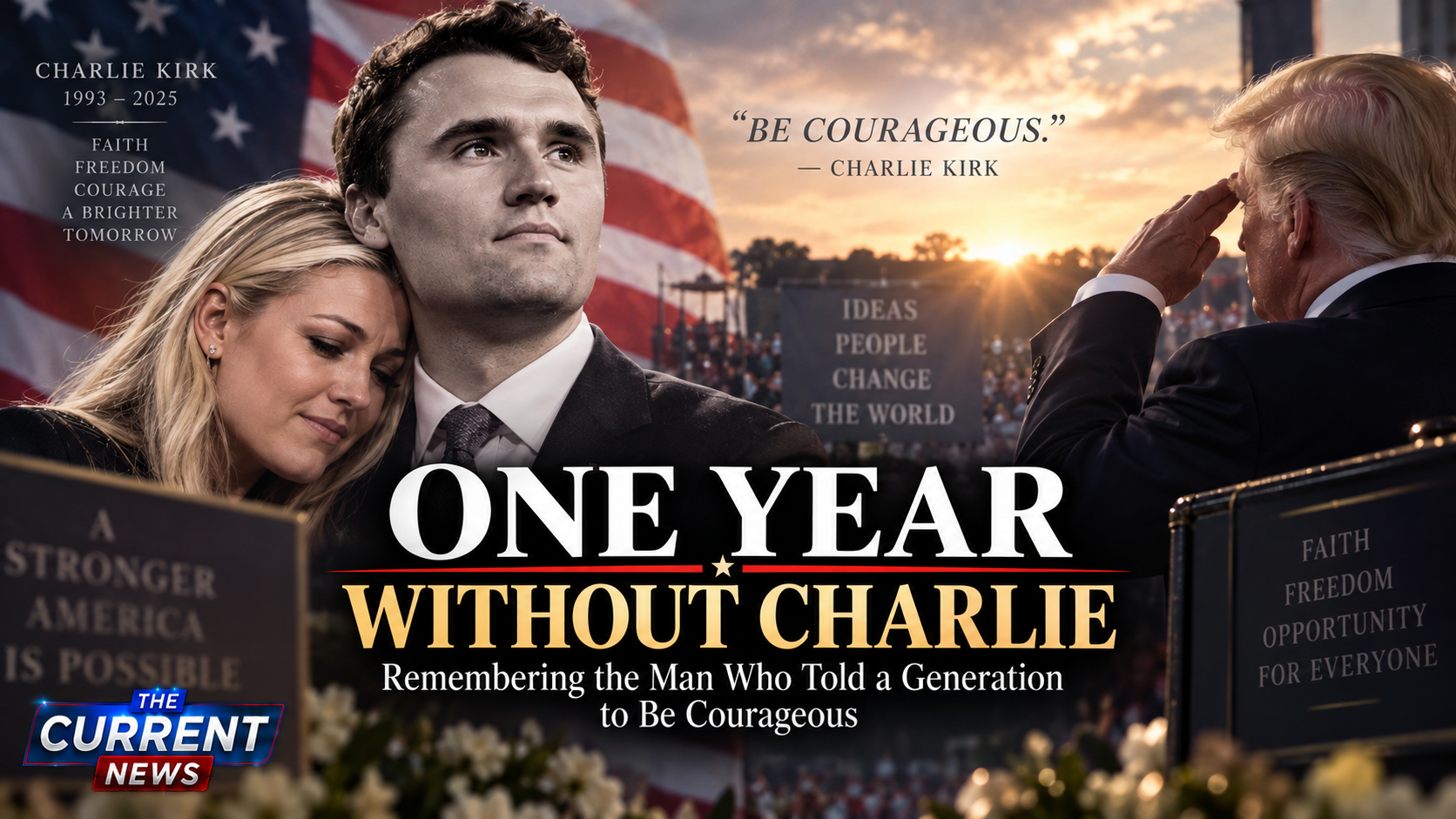
ONE YEAR WITHOUT CHARLIE | Remembering the Man Who Told a Generation to Be Courageous
One year after Charlie Kirk's death, we remember his faith, family, courage, and the lasting movement he built for America's next generation.
There are some days you remember exactly where you were.
September 10, 2025, is one of those days.
A young husband and father went to a college campus in Utah to do what he had done countless times before.
He went to talk.
He went to debate.
He went to challenge people to think.
And he never came home.
Today marks one year since Charlie Kirk was assassinated.
One year since a voice that had become familiar to millions was suddenly silenced.
One year since a wife lost her husband.
One year since children lost their father.
One year since Turning Point USA lost its founder.
And one year since America was forced to confront something we should never become comfortable with:
Political disagreement must never become an excuse for political violence.
TODAY ISN’T ABOUT THE POLITICS
Charlie Kirk was a political figure.
There is no denying that.
He was conservative.
He was outspoken.
He was controversial.
He had people who passionately supported him and people who passionately opposed him.
But today isn’t about deciding whether Charlie Kirk was right about every political issue.
It isn’t about pretending he never said something controversial.
It isn’t about rewriting history.
And it isn’t about turning him into something he wasn’t.
Today is about remembering a human being.
A husband.
A father.
A son.
A friend.
A Christian.
And a young man who believed that his generation could still change the direction of the country.
HE STARTED WITH A SIMPLE IDEA
Charlie founded Turning Point USA when he was only 18 years old.
What began as a young conservative activist’s effort eventually became a national political organization with a massive presence among young Americans.
Today, Turning Point says it has more than 3,500 high-school chapters and more than 1,500 college chapters, representing significant growth since Kirk’s death.
That growth tells us something important.
Charlie may have been the face of the movement.
But he wasn’t the entire movement.
He built infrastructure.
He built relationships.
He built a network.
And most importantly, he built people.
HE TOLD YOUNG PEOPLE THEY DIDN’T HAVE TO SIT ON THE SIDELINES
Perhaps Charlie’s greatest contribution wasn’t convincing everyone to become conservative.
It was convincing young people that their voices mattered.
You didn’t have to wait until you were 40.
You didn’t have to become a politician.
You didn’t have to have millions of dollars.
You didn’t have to be famous.
You could show up.
You could ask questions.
You could debate.
You could organize.
You could vote.
You could speak.
You could lead.
And perhaps most importantly:
You could disagree without being afraid.
That message resonated with a generation.
HE WASN’T AFRAID OF THE COLLEGE CAMPUS
Charlie could have stayed in friendly environments.
Instead, he repeatedly went to places where people disagreed with him.
College campuses became one of his most recognizable stages.
He would stand behind a microphone and invite students to challenge him.
Sometimes the conversations were civil.
Sometimes they became heated.
Sometimes Charlie won the argument.
Sometimes his opponent landed a better point.
But the underlying premise remained:
Let’s have the conversation.
In an era when Americans increasingly retreat into political echo chambers, that willingness to engage was part of what made him different.
HIS FAITH MATTERED
For Charlie, Christianity wasn’t merely a private belief.
As his public life developed, his faith became increasingly central to his message.
He spoke about Jesus Christ.
He talked about biblical principles.
He talked about marriage.
He talked about family.
He talked about the importance of raising children with faith.
And he increasingly viewed the cultural battles of his generation through a Christian worldview.
That doesn’t mean every Christian agreed with every political position he held.
They didn’t.
Christians can disagree about politics.
But Charlie wasn’t shy about saying that his faith shaped the way he understood the world.
And for many young Christians, that mattered.
THEN EVERYTHING CHANGED
On September 10, 2025, Charlie was speaking at Utah Valley University.
He was doing something familiar:
Engaging in political discussion.
Then a gunman shot him.
Charlie was 31 years old.
The man accused of killing him, Tyler Robinson, is facing aggravated murder and other charges. A Utah judge has ruled prosecutors may pursue the death penalty.
A year later, the criminal case is still moving through the courts.
But today isn’t about the accused.
It’s about the person who was lost.
ERIKA’S YEAR OF GRIEF
Perhaps nobody understands the cost of September 10 more personally than Charlie’s wife, Erika.
She didn’t lose a political commentator.
She lost her husband.
She lost the person she expected to grow old with.
She lost the father of her children.
In a recent reflection on the past year, Erika described the waves of grief that continue to come during birthdays, holidays, anniversaries and ordinary moments.
She has spoken about learning to live with grief rather than expecting it simply to disappear. She has also credited advice from Usha Vance that helped her approach grief in smaller increments—getting through the next 15 minutes rather than trying to imagine an entire lifetime without Charlie.
There is something profoundly human about that.
Grief doesn’t operate on a calendar.
One year doesn’t erase a loss.
THE EMPTY CHAIR
For millions of people, Charlie Kirk was a voice coming through a phone.
For Erika, there is an empty chair.
For his children, there is a father who isn’t coming home.
For his parents, there is a son who should have had decades ahead of him.
That’s something political arguments can never capture.
Behind every public figure is a private life.
Behind every microphone is a person.
Behind every headline is a family.
And behind September 10 is a family that will never experience this day the way they did before.
BUT SOMETHING UNEXPECTED HAPPENED
The movement didn’t disappear.
If anything, it grew.
Turning Point USA reports that its campus and high-school presence has expanded substantially since Charlie’s death. Reuters reported that the organization now has more than 3,500 high-school chapters and more than 1,500 college chapters.
That doesn’t mean everything is perfect.
It doesn’t mean everyone agrees about the future.
And it doesn’t mean Charlie’s influence can simply be duplicated.
It can’t.
There will never be another Charlie Kirk.
But perhaps that was never the point.
THE POINT WAS TO BUILD SOMETHING THAT COULD OUTLIVE HIM
A founder’s greatest test isn’t what happens while he’s standing at the microphone.
It’s what happens when the microphone is empty.
Charlie spent years building an organization capable of reaching young Americans.
Today, Erika Kirk serves as CEO and board chair of Turning Point USA, and the organization continues operating under her leadership.
Turning Point is now looking toward the future, including an increasingly significant role in the 2028 political cycle.
Whether every decision made by the organization would have been Charlie’s decision is impossible to know.
But the fact that the organization continues is itself part of his legacy.
A LEGACY ISN’T A STATUE
We often think of legacy as something carved into stone.
A building.
A scholarship.
A statue.
A name.
But legacy can be something much simpler.
It’s the person who decides to run for student government because Charlie convinced them their voice mattered.
It’s the young Christian who becomes unashamed of his faith.
It’s the college student who decides to have a conversation with someone on the other side rather than immediately writing them off.
It’s the person who learns how to defend an idea.
It’s the young American who decides that politics isn’t something that happens to them.
It’s someone who looks at the world and says:
I can make a difference.
DON’T TURN CHARLIE INTO SOMETHING HE WASN’T
There is also a responsibility that comes with remembering someone.
We shouldn’t sanitize their life.
We shouldn’t exaggerate it.
We shouldn’t pretend they were perfect.
Charlie Kirk had controversial opinions.
He made statements that generated criticism.
He made political enemies.
His legacy remains deeply debated, even a year after his death.
But acknowledging those things doesn’t require us to diminish his humanity.
A tribute doesn’t have to mean:
“Charlie was right about everything.”
It can simply mean:
“Charlie mattered.”
WE SHOULD ALSO REMEMBER WHAT HAPPENED TO THE COUNTRY
There is a lesson beyond Charlie Kirk himself.
Political violence cannot become normal.
It cannot become acceptable because we dislike the person who was attacked.
It cannot become justified because the victim held opinions we find offensive.
It cannot become celebrated because the victim belonged to the “other side.”
If America loses that principle, we lose something far more important than an election.
We lose the ability to disagree and still recognize one another as human beings.
Charlie Kirk’s death should never be used as an excuse for more hatred.
If anything, it should remind us why the ability to debate matters.
TODAY, THOUSANDS WILL GATHER
Today, Turning Point USA is holding “Freedom Built to Last: Honoring Charlie Kirk” at Utah Valley University’s UCCU Center—the same university where Kirk was killed one year ago. The event is scheduled for this evening.
The location itself carries enormous weight.
A place that became synonymous with tragedy is being used to remember a life.
That doesn’t erase what happened.
But it demonstrates something important:
The story did not end with the gunshot.
ONE YEAR LATER
One year later, there are still questions.
There is still an ongoing criminal case.
There are still political arguments.
There are still debates about Charlie’s ideas.
There are still disagreements about Turning Point USA.
There are still people who criticize his legacy.
And there are still millions who believe he changed their lives.
All of those things can exist simultaneously.
Because a complicated legacy is still a legacy.
BUT TODAY, LET’S REMEMBER THE SIMPLE THINGS
Remember the young man who started an organization before he was old enough to rent a car in some states.
Remember the husband who loved his wife.
Remember the father whose children will grow up hearing stories about him.
Remember the Christian who wasn’t afraid to talk about Jesus.
Remember the activist who believed young people mattered.
Remember the debater who walked into rooms where people disagreed with him.
Remember the voice.
Remember the courage.
And remember the cost of political violence.
CHARLIE’S CHALLENGE TO THE NEXT GENERATION
Perhaps the best way to honor Charlie isn’t to simply repeat his name.
It’s to do something.
Read something you disagree with.
Talk to someone who votes differently.
Learn why you believe what you believe.
Don’t outsource your convictions to an algorithm.
Don’t let social media tell you who your enemies are.
Don’t be afraid to ask questions.
Don’t be afraid to defend your faith.
Don’t be afraid to stand for what you believe is right.
And don’t confuse courage with hatred.
Because courage doesn’t require you to hate the person standing across from you.
It requires you to stand anyway.
ONE YEAR WITHOUT CHARLIE
A year ago, America lost a voice.
Today, millions are remembering it.
But perhaps the most fitting tribute isn’t another speech.
It isn’t another hashtag.
It isn’t another argument online.
It’s a young person deciding to get involved.
A Christian deciding not to hide their faith.
A student deciding to have the conversation.
A citizen deciding to vote.
A father deciding to teach his children.
A mother deciding to raise her children with courage.
A person deciding that their voice matters.
That’s how a legacy survives.
Not because everyone agrees with the person who came before them.
But because the person who came before them inspired others to stand up and participate.
THE CURRENT NEWS TRIBUTE
Charlie Kirk was 31 years old when his life was taken.
He should have had decades more.
More debates.
More speeches.
More birthdays.
More mornings with his wife.
More bedtime stories with his children.
More ordinary moments that none of us think about until they’re gone.
We cannot give those moments back.
We cannot undo September 10, 2025.
But we can decide what comes after it.
We can choose whether political disagreement produces hatred or conversation.
We can choose whether faith produces division or courage.
We can choose whether young people retreat from public life or step into it.
And we can choose whether Charlie Kirk’s death becomes simply another tragic date on the calendar—or a reminder that America is still worth fighting for without destroying one another in the process.
Today, September 10, 2026, we remember Charlie.
Not because he was perfect.
Not because everyone agreed with him.
But because he was a man who believed deeply in something bigger than himself.
He believed his generation could change the country.
He spent his life trying to prove it.
One year later, the question isn’t whether Charlie Kirk’s voice is still here.
The question is what those who heard it will do with it.
May we remember the man.
May we remember the family.
May we remember the faith.
May we remember the courage.
And may we never forget September 10.
Charlie Kirk — 1993–2025.
Gone from the microphone.
Not forgotten.