The Conspiracy Theatre: Candace Owens vs. TPUSA
Candace Owens once worked with Charlie Kirk and TPUSA. Now she challenges the organization and Erika Kirk. What does the evidence actually show?
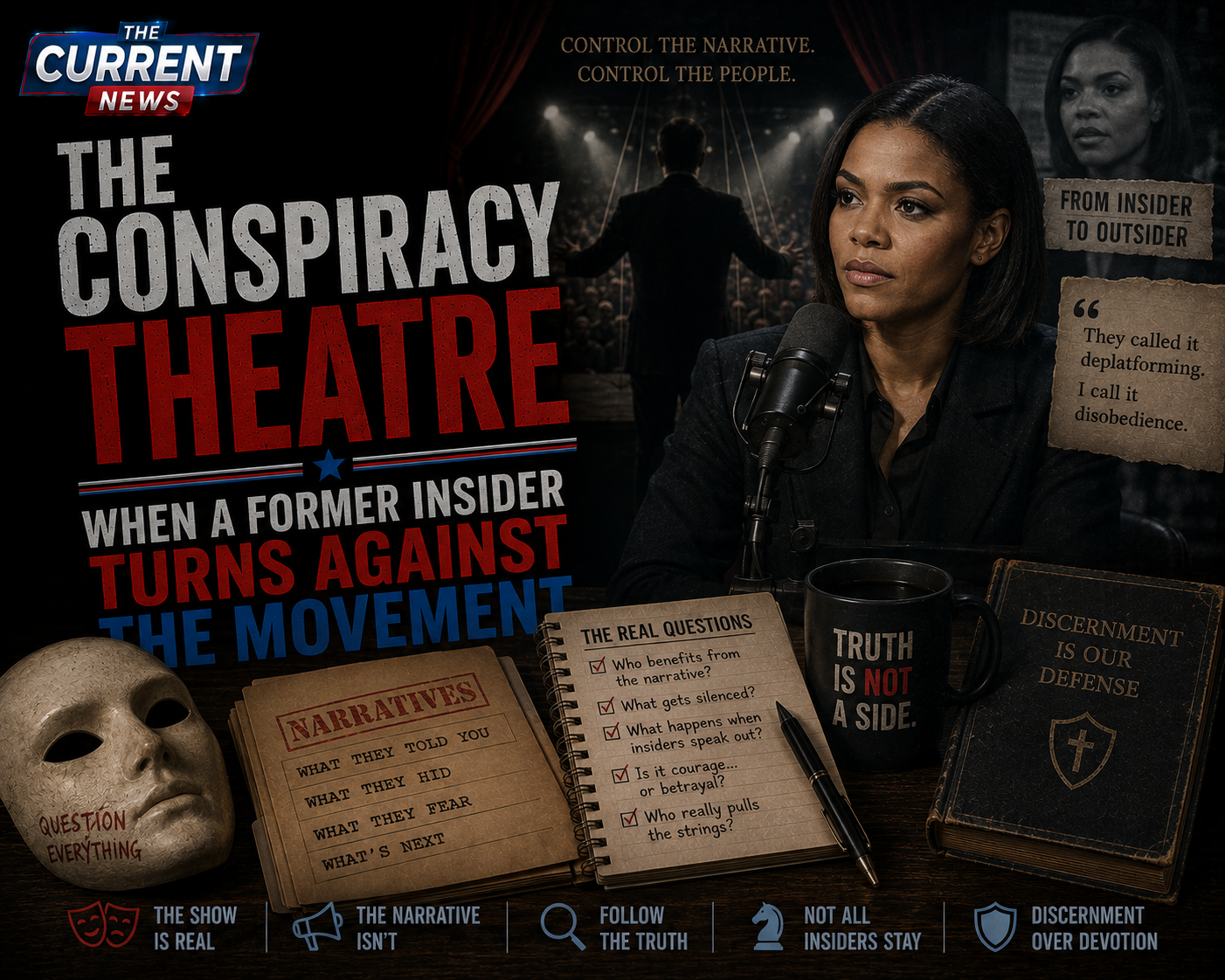
There is a strange phenomenon happening inside the modern conservative movement.
People who once stood on the same stages can eventually become each other’s greatest critics.
Friends become enemies.
Allies become opponents.
And sometimes, the people with the deepest knowledge of an organization become the people making the most serious accusations against it.
That brings us to Candace Owens.
Before the conspiracy theories surrounding Charlie Kirk’s death, before the public battles with Erika Kirk and Turning Point USA, there was another story.
Candace Owens was once part of Turning Point USA.
And according to people inside the organization, the relationship between Owens and TPUSA was considerably more complicated than the public may have understood.
Now the question is not simply whether Owens is asking legitimate questions.
It is whether the accusations she is making today can withstand the same scrutiny she demands from everyone else.
SHE WASN’T AN OUTSIDER
Candace Owens did not begin her relationship with Turning Point USA as an investigative journalist looking from the outside.
She was brought into the organization by Charlie Kirk.
In the interview contained in The Charlie Kirk Show transcript provided to The Current News, TPUSA producer Andrew Kolvet describes Kirk offering Owens a position after meeting her and believing she could help Turning Point and the broader movement. Kolvet says Owens subsequently “exploded onto the scene” and became increasingly difficult to work with.
That is an important piece of history.
Because it means Owens knew the organization from the inside.
She knew Charlie Kirk.
She knew the people who worked around him.
She knew how TPUSA operated.
And that makes her current accusations more significant.
But it also means her history with the organization cannot simply be ignored.
WHAT DOES “DIFFICULT TO WORK WITH” MEAN?
Kolvet was asked directly what he meant.
His answer was not that Owens suddenly became an enemy.
He described what he said was a gradual change.
As her profile increased, he said, she began making greater demands about scheduling, deployment and where she would appear.
He also described complaints from people who had worked with her and gave an example of an event that had to be replaced after Owens canceled.
These are Kolvet’s recollections, not independently established facts.
That’s an important distinction.
We aren’t going to turn one person’s account into an unquestionable historical record.
But his testimony does challenge the simplistic version of the story:
Candace was Charlie’s closest friend, everything was perfect between them, and she is now simply investigating the death of someone she loved.
According to Kolvet, that picture is incomplete.
“THEY WERE BESTIES”
This is perhaps one of the most revealing portions of the interview.
Andrew Wilson asked about the narrative that Candace Owens and Charlie Kirk were extremely close friends.
Kolvet pushed back on that characterization.
He said the assumption that Owens and Kirk were essentially “besties” who had always been great friends was not consistent with what he learned while working there.
That doesn’t mean they hated each other.
It doesn’t mean they weren’t friends at various points.
And it certainly doesn’t mean Owens’ current claims are automatically false.
But it does mean we should be careful about rewriting their history after Charlie’s death.
THEN CHARLIE WAS MURDERED
Charlie Kirk’s assassination changed everything.
Turning Point USA suddenly lost its founder.
Erika Kirk lost her husband.
The conservative movement lost one of its most recognizable young leaders.
And conspiracy theories immediately began circulating about what really happened.
Candace Owens became one of the most prominent people questioning the official narrative.
But the controversy eventually moved beyond simply asking questions.
It became a debate over whether Tyler Robinson was actually responsible for Kirk’s murder and whether other individuals or organizations were involved.
And that is where the standard of evidence becomes critical.
WHAT DOES THE EVIDENCE ACTUALLY SAY?
The transcript contains a fascinating exchange about this.
Andrew Wilson explains that his approach was not simply:
“Believe the official story because authorities said so.”
He says he actively attempted to falsify his own position.
He said he spoke with people promoting alternative theories, went into X Spaces, spoke with attorneys and investigated the competing claims.
His conclusion was that he could not falsify the prosecution’s basic case.
That is an important principle.
It is called attempting to falsify your own argument.
And it should be the standard for everyone.
QUESTION YOUR OWN THEORY
Here’s where this story becomes bigger than Candace Owens.
Suppose you believe:
“Tyler Robinson is a patsy.”
Fine.
That’s a hypothesis.
Now try to destroy it.
Ask:
What evidence would prove me wrong?
If you can’t identify anything that could possibly change your mind, you aren’t really testing your theory.
You’re protecting it.
Wilson argues that this is precisely what he believes happened with many of the alternative theories surrounding Kirk’s death. He says proponents did not sufficiently attempt to falsify their own evidence before building additional conclusions on top of it.
That criticism deserves consideration.
Not because Wilson is automatically correct.
But because the principle is sound.
THE ISRAEL QUESTION
One example discussed in the transcript illustrates the problem.
Wilson describes a chain of reasoning in which a message suggesting Charlie Kirk might leave the pro-Israel cause is used as part of an argument eventually pointing toward Israel being responsible for Kirk’s murder.
Wilson’s response is essentially:
How does the first fact logically establish the second?
A person considering leaving a political position is not, by itself, evidence that the organization or country associated with that position murdered them.
There has to be a chain of evidence connecting the two.
Otherwise, we aren’t investigating.
We’re connecting dots because we want the dots to form a picture.
THE “PATSY” CLAIM
The transcript gets even more interesting when the discussion turns to Tyler Robinson.
The hosts played clips in which they argued Owens’ statements about Robinson being a “patsy” appeared to shift.
Wilson characterized the issue as a comparative question:
Is there more evidence that Robinson committed the crime, or is there more evidence that he was framed?
His argument was that one side currently has evidence while the alternative theory lacks comparable evidence.
That’s a much stronger way to approach the question than simply asking:
“Can you imagine another possibility?”
Almost anything is possible.
The real question is:
Which explanation is best supported by the available evidence?
THEN THERE IS THE “COMPLICIT” QUESTION
Perhaps the most serious moment in the transcript concerns Erika Kirk.
During the debate, Owens reportedly objected to the suggestion that she had called Erika “complicit” in Charlie’s murder.
Wilson says he asked Owens what she meant by the word.
According to the transcript, Owens defined “complicit” in terms of Erika believing that Tyler Robinson killed Charlie.
Wilson then pressed the distinction further.
That distinction matters enormously.
Because believing the accused person committed a crime is not the same thing as participating in that crime.
Those are completely different claims.
If someone says:
“Erika believes Tyler Robinson killed Charlie.”
That is one claim.
If someone says:
“Erika was complicit in Charlie’s murder.”
That is an extraordinarily different claim.
The second carries an enormous evidentiary burden.
And that is exactly why language matters.
WORDS HAVE CONSEQUENCES
We’ve already written about the cost of defamation here at The Current News.
This story demonstrates why that subject matters.
Calling someone wrong is one thing.
Calling someone dishonest is another.
Calling someone corrupt is more serious.
Calling someone complicit in murder is extraordinarily serious.
The larger the accusation, the greater the responsibility to prove it.
That’s not censorship.
That’s accountability.
THE “INVESTIGATOR” PROBLEM
Wilson makes another argument in the interview that deserves attention.
He says he believes the people surrounding Owens have effectively given themselves permission to behave in ways they normally wouldn’t because they view themselves as investigators searching for the truth.
He specifically raises concerns about doxxing, harassment, attacks on families and other forms of online intimidation.
Again, these are his allegations and characterization.
But the underlying question is worth asking:
Does searching for the truth give someone permission to destroy another person’s life?
No.
Being convinced that you are exposing a conspiracy doesn’t automatically make every tactic legitimate.
Investigators need evidence.
Journalists need evidence.
Commentators need evidence.
And ordinary people posting on social media need to remember that real people are on the other side of the screen.
THIS IS WHERE THE CONSPIRACY THEATRE GETS DANGEROUS
A conspiracy theory can start with a legitimate question.
That’s what makes them difficult.
Someone notices something unusual.
They ask a question.
Another person notices something else.
The two facts are connected.
Then another theory is introduced.
Then another.
Eventually the original question becomes a giant narrative involving dozens of people.
But somewhere along the way, the evidence connecting each individual step can disappear.
The theory becomes self-reinforcing.
Anyone who disagrees becomes part of the conspiracy.
And anyone who provides contradictory evidence becomes suspect.
At that point, the theory becomes almost impossible to falsify.
And a theory that cannot be falsified is not necessarily a strong theory.
It may simply be an unfalsifiable one.
AND THIS BRINGS US BACK TO CANDACE
The question isn’t whether Candace Owens is allowed to investigate Charlie Kirk’s death.
She is.
The question isn’t whether she is allowed to criticize Erika Kirk.
She is.
The question isn’t whether she is allowed to criticize TPUSA.
She absolutely is.
The question is:
Can her claims survive independent scrutiny?
That’s the standard she should be held to.
And it is the standard we should hold TPUSA to as well.
DON’T TRUST PEOPLE. TRUST EVIDENCE.
This is perhaps the biggest lesson from this entire controversy.
If you support Candace Owens, don’t automatically believe her.
If you support Erika Kirk, don’t automatically believe her.
If you support TPUSA, don’t automatically believe TPUSA.
If you support Andrew Wilson, don’t automatically believe Andrew Wilson.
If you support The Current News, don’t automatically believe us.
Check the evidence.
That’s how a free society is supposed to work.
WHAT ABOUT THE THEORY THAT CANDACE WANTED TO BE CEO?
There is a theory circulating online that Owens expected to become CEO of TPUSA following Charlie’s death, or believed she should have received the position.
That theory may be interesting.
But we need to be disciplined.
The transcript provided to us does not establish that claim.
In fact, Wilson explicitly says that he thinks people may be incorrectly attributing Owens’ motivations to jealousy and says he believes the issue is more about power.
That is his interpretation.
Not proof of Owens’ motives.
And this is exactly where journalism needs to separate:
Evidence
from
Inference
from
Speculation.
We can discuss the theory.
We shouldn’t present it as fact.
MAYBE THE BIGGER ISSUE IS POWER
Wilson’s interpretation is worth considering even if we don’t accept it completely.
Perhaps this isn’t about jealousy.
Perhaps it isn’t about a job.
Perhaps it isn’t even primarily about personal relationships.
Perhaps it is about influence.
Who controls the narrative?
Who controls the audience?
Who gets to define Charlie Kirk’s legacy?
Who gets to decide what happened?
Who gets believed?
Those questions explain why this feud has become so intense.
Because this isn’t just a disagreement about a political organization.
It is a battle over who gets to tell the story.
CHARLIE’S LEGACY IS NOW A BATTLEGROUND
Charlie Kirk built TPUSA through coalition building.
And according to the people who worked with him, he often tried to repair relationships rather than permanently burn bridges.
The transcript specifically describes Kirk as someone who would keep personal disagreements private and attempt to rebuild bridges with people.
Now his death has produced the opposite.
Bridges are burning.
Former allies are fighting.
Audiences are choosing sides.
And the movement is increasingly divided over competing narratives.
THE QUESTION FOR THE CONSERVATIVE MOVEMENT
At some point, conservatives have to decide whether they want a movement based on:
personalities
or
principles.
Because personality-driven movements are fragile.
When the leader dies, leaves, changes his mind or makes a mistake, the entire coalition can fracture.
But principles can survive people.
That’s why evidence matters.
That’s why truth matters.
And that’s why Christians should be especially careful about turning political personalities into authorities.
THE BOTTOM LINE
Candace Owens has the right to ask questions.
She has the right to investigate.
She has the right to criticize TPUSA.
She has the right to challenge Erika Kirk.
And she has the right to believe the official narrative is incomplete.
But those rights come with a corresponding responsibility:
Bring the evidence.
The same standard applies to TPUSA.
It applies to Andrew Kolvet.
It applies to Andrew Wilson.
It applies to Erika Kirk.
It applies to Candace Owens.
And it applies to us.
Nobody gets a free pass simply because we like them.
Nobody gets condemned simply because we dislike them.
And nobody should be accused of participating in murder without evidence sufficient to support such an extraordinary claim.
Maybe there are still unanswered questions surrounding Charlie Kirk’s death.
If there are, investigate them.
But don’t confuse an unanswered question with an answered question.
Don’t confuse suspicion with evidence.
Don’t confuse possibility with probability.
And don’t confuse a compelling story with the truth.
Because once we stop demanding evidence from the people we agree with, we aren’t investigating anymore.
We’re participating in the conspiracy theatre.
WHAT DO YOU THINK?
Can someone who once worked inside an organization fairly investigate that organization?
Does Candace Owens’ history with TPUSA make her more credible—or create a potential conflict of interest?
What evidence would actually change your mind about the Charlie Kirk case?
Should commentators be required to distinguish clearly between evidence, inference and speculation?
When does legitimate skepticism become conspiracy theory?
Are conservatives becoming too loyal to personalities instead of principles?
**Don’t just tell us who you believe.
Tell us what evidence convinced you.**
Editorial & Legal Note
This article incorporates statements made by Andrew Kolvet and Andrew Wilson during the Charlie Kirk Showdiscussion provided to The Current News. Their statements are presented as their accounts and opinions, not independently established facts. Claims regarding Candace Owens’ employment history, workplace conduct, motives, alleged coordination, or statements concerning Charlie Kirk’s death should be evaluated according to the underlying evidence. The theory that Owens expected or sought the CEO position at TPUSA is not presented as fact, because the provided transcript does not establish it. References to criminal allegations and conspiracy theories should not be understood as findings of fact or determinations of criminal liability.
Source note: The transcript supplied for this article contains the discussion of Owens’ history with TPUSA, the debate over the Charlie Kirk assassination theories, the “patsy” and “complicit” claims, and the speakers’ arguments regarding evidence and falsification.