The Erika Kirk Romania Conspiracy Examined
Was Erika Kirk banned from Romania over child trafficking? We examine the Romanian charity, court records, government evidence and claims made online.
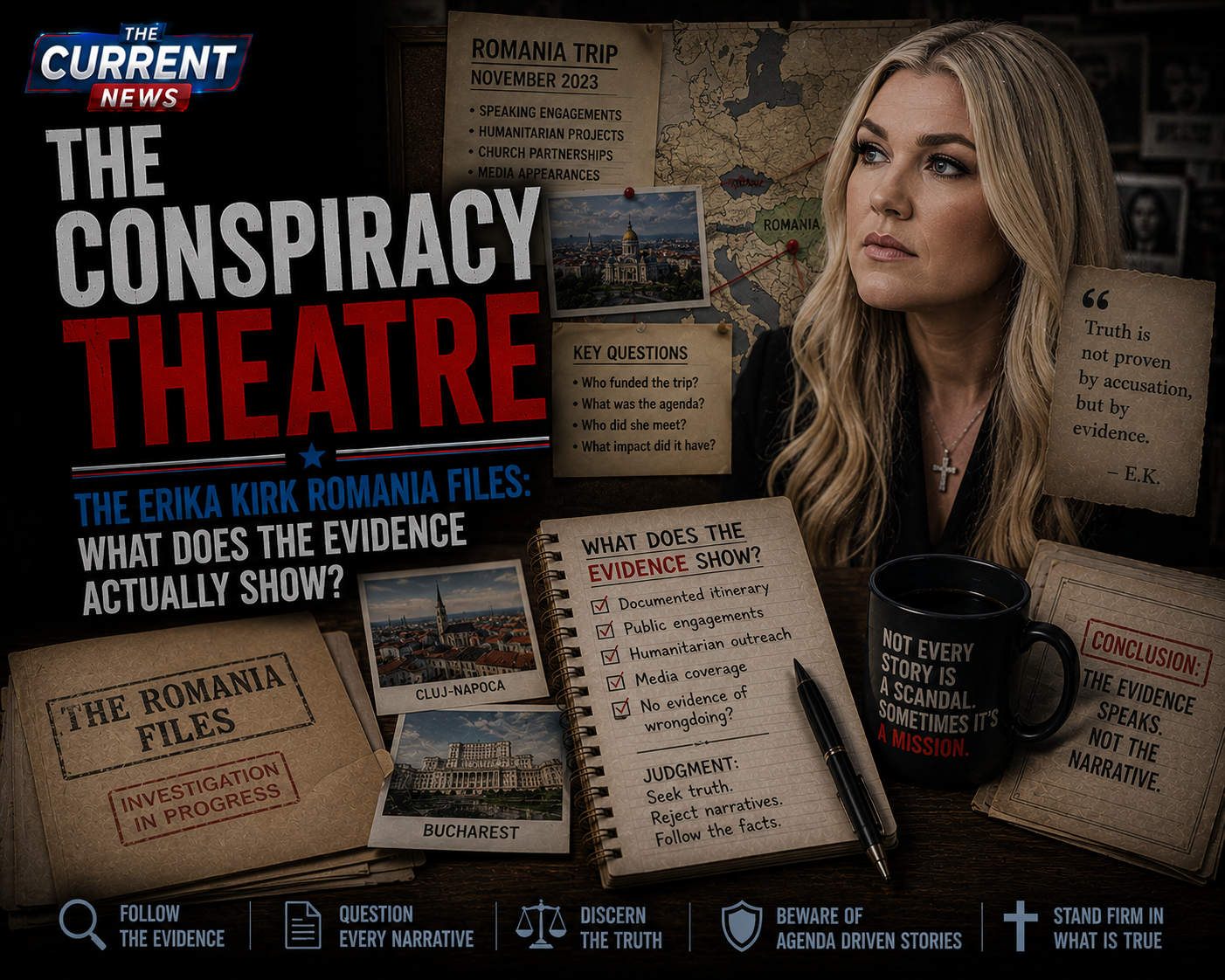
There is a powerful lesson buried inside one of the most controversial claims surrounding Erika Kirk.
Not because the allegation is proven.
But because it demonstrates how easily real facts can be assembled into a story that the available evidence does not actually support.
The allegation is serious:
Erika Kirk was supposedly banned from Romania because a charity she operated was involved in child trafficking.
Candace Owens has repeatedly raised questions about Kirk’s history in Romania and has made the subject part of her broader investigation into Erika Kirk. In February 2026, Owens announced a Bride of Charlie episode focused specifically on Romania, and her later reporting continued to raise allegations involving Kirk’s Romanian charity and trafficking.
If the allegation were true, it would be enormously important.
If an American citizen had actually been banned from a country because authorities believed she was involved in trafficking children, there should be a substantial documentary trail.
So we went looking for it.
And what we found is much more complicated.
START WITH WHAT IS ACTUALLY TRUE
This is where responsible investigation has to begin.
Erika Kirk really did have a connection to Romania.
She founded the nonprofit Everyday Heroes Like You, and one of its projects was called Romanian Angels.
The project worked with children in Romania and involved charitable activities including donations and sponsorships.
That part isn’t a conspiracy theory.
It happened.
And Kirk has publicly documented her involvement in Romania during the early 2010s. Reporting examining the controversy has found evidence of her visits there between 2012 and 2014.
So if someone says:
“Erika Kirk had a charity involving Romanian children.”
That statement is supported.
The problem begins when another claim is attached:
“Therefore, Erika Kirk was involved in trafficking those children.”
That is an entirely different allegation.
And it requires entirely different evidence.
THE ALLEGED BAN
The viral claim that circulated after Charlie Kirk’s assassination was remarkably specific.
It wasn’t simply:
“Erika Kirk worked in Romania.”
It was:
“Erika Kirk is banned from Romania because her evangelical group was accused of trafficking children out of Romanian villages.”
That claim circulated widely on social media in September 2025. PolitiFact documented examples of the allegation and investigated it.
That’s an extraordinary allegation.
So let’s apply an extraordinary-evidence standard.
Where is the Romanian government order banning her?
Where is the criminal case?
Where is the indictment?
Where is the Romanian court ruling?
Where is the police report?
Where is the Romanian prosecutor’s statement?
Where is the contemporary Romanian news report identifying Erika Kirk or Romanian Angels as participants in child trafficking?
Those are the documents that would turn this from a social-media allegation into an established fact.
They have not surfaced.
POLITIFACT LOOKED FOR THE RECORD
PolitiFact didn’t simply search Google and call it a day.
Its investigation searched the Nexis news database for reporting that Kirk had been banned from Romania.
It found no such reporting.
PolitiFact also contacted Romanian government bodies, including the Ministry of Internal Affairs, Romanian Police, General Inspectorate of Border Police and the National Agency Against Trafficking in Persons.
The investigation did not find confirmation of the alleged ban or trafficking accusation.
That’s important.
It doesn’t mathematically prove that something never happened.
But if someone claims a government banned a person from entering a country because of child trafficking allegations, the absence of the government’s own documentation is a major problem for the claim.
WHAT ABOUT ROMANIAN COURT RECORDS?
Lead Stories went further.
Its Romanian staff searched the country’s national justice portal using information connected with Kirk and the Antonio Placement Center.
The investigation did not find court cases connecting Kirk or her organization to child trafficking.
Instead, the Romanian reporting and records they found described charitable donations associated with Everyday Heroes Like You.
Again, consider what this means.
The allegation requires us to believe that an American charity was connected to child trafficking in Romania and that Erika Kirk was subsequently banned from the country.
Yet searches for the underlying legal record did not produce the expected criminal or civil case.
That doesn’t prove every question about the charity has been answered.
It does mean the central allegation is missing the kind of evidence we would reasonably expect to find.
THE MOST IMPORTANT PROBLEM WITH THE SOURCES
Perhaps the biggest weakness in the conspiracy narrative is where some of its supporting material actually comes from.
Some posts have connected Erika Kirk’s Romanian work to older reports about unrelated trafficking and adoption scandals in Romania.
And this is where we need to slow down.
Because Romania really did have serious problems involving child welfare, international adoption and trafficking.
Those problems are real.
But a country’s documented history of trafficking does not establish that every person who worked there was involved in trafficking.
That would be like saying:
“Crime occurred in this city while Person X lived there, therefore Person X was involved in the crime.”
That’s not evidence.
That’s association.
THE 2001 HAARETZ ARTICLE
One of the pieces of material that has circulated in connection with the allegations is a 2001 Haaretz article concerning an investigation into Israeli adoption agencies and allegations surrounding the sale of children’s organs.
That sounds shocking.
And it was a serious story.
But here’s the problem:
The article does not identify Erika Kirk or Romanian Angels.
More importantly, the timing is devastating to the theory.
Erika Kirk was a child when that article was published.
Her Romanian Angels project did not exist at the time.
So even if the underlying allegations in the 2001 article are historically important, they cannot serve as evidence that Kirk participated in them.
The timeline doesn’t work.
This is exactly the kind of thing journalists have to catch.
THE 2023 RFE/RL REPORT
Another source that has been circulated concerns a Radio Free Europe/Radio Liberty report about Romanian children who were internationally adopted and later believed they had been trafficked.
Again, this is a real issue.
But the report does not establish that Erika Kirk or Romanian Angels participated in the conduct described.
A report about Romanian trafficking isn’t evidence that a particular American charity was involved.
Those are two different propositions.
THE BBC REPORT
The same problem appears with reporting about Romanian girls being trafficked to the United Kingdom.
The BBC has reported extensively on human trafficking.
Those reports are important.
But again, reporting that trafficking existed in Romania does not establish that Kirk’s charity was involved.
The existence of a crime is not evidence against everyone who happened to be in the same country.
That may sound obvious.
But this is exactly how conspiracy narratives can be constructed.
THIS IS HOW THE CONSPIRACY GETS BUILT
Watch how easy it is.
Start with a true statement:
Erika Kirk worked with Romanian children.
Add another true statement:
Romania has a documented history of child trafficking and adoption scandals.
Add another true statement:
There were trafficking investigations involving people and organizations in Romania.
Then place all three statements next to each other.
The reader’s brain naturally begins connecting them.
And suddenly the conclusion becomes:
“Erika must have been involved.”
But notice what is missing.
The evidence connecting Erika to the trafficking.
That missing link is everything.
THE ASSOCIATION TRAP
This is one of the oldest problems in investigative reasoning.
Person A knows Person B.
Person B knows Person C.
Person C was involved in something illegal.
Therefore Person A must have known about it.
That doesn’t follow.
People interact with thousands of people throughout their lives.
Charities work with organizations.
Nonprofits interact with governments.
Volunteers work with military personnel.
People take photographs together.
People exchange emails.
People donate money.
None of those things automatically establish criminal involvement.
You need evidence of knowledge, intent and conduct.
WHAT ABOUT THE MILITARY CONNECTION?
Another part of the online narrative focuses on U.S. military personnel stationed in Romania.
This is another area where the underlying facts require careful separation.
American military personnel have been stationed in Romania.
Romanian Angels had interactions involving U.S. Marines and charitable activities.
There have also been documented criminal allegations involving other individuals connected to U.S. military installations in Romania.
But again:
A military base being near a charity does not establish that the charity participated in a crime.
Proximity isn’t proof.
Association isn’t proof.
And a photograph isn’t proof of criminal conduct.
CANDACE OWENS HAS A RIGHT TO ASK QUESTIONS
This is where our criticism of the theory needs to remain fair.
Candace Owens is allowed to investigate.
She is allowed to ask:
Why was Erika in Romania?
Who did she work with?
What organizations were involved?
How many times did she travel there?
What happened to the children?
Who were the people surrounding the project?
Those are legitimate questions.
And if Owens finds documentary evidence that changes what we currently know, that evidence should be examined.
But there’s a difference between:
“I have questions.”
and
“I have proven child trafficking.”
The second claim requires substantially more evidence.
EVEN OWENS’ CURRENT ROMANIA INVESTIGATION SHOWS THE QUESTION ISN’T DEAD
Owens has not simply abandoned the subject.
In her Bride of Charlie episode specifically focused on Romania, she said she had contacted Erika Kirk seeking details about her visits to the country and said that she did not receive a direct response from Kirk.
That is a legitimate part of the story.
If a public figure is the subject of serious allegations, refusing to answer questions can create suspicion.
But it is important to understand what that means.
Silence isn’t proof of guilt.
A person can refuse to comment for many reasons.
Legal advice.
Privacy.
Fear of misquotation.
Ongoing disputes.
Or simply because they don’t want to participate.
A lack of response may justify additional reporting.
It does not establish the underlying accusation.
THE BURDEN OF PROOF MATTERS
This is especially important because we’re talking about one of the most serious accusations a person can face.
Child trafficking.
That’s not a casual allegation.
It can destroy someone’s reputation.
It can end careers.
It can put families at risk.
It can lead to harassment and threats.
And once the accusation reaches the internet, correcting it becomes incredibly difficult.
That’s why the burden of proof must rise with the seriousness of the allegation.
WHAT WOULD CHANGE OUR MINDS?
This is perhaps the most important question in the entire article.
What would we need to see to take the allegation seriously?
A Romanian court document?
A police report?
An indictment?
A Romanian government statement?
Contemporary investigative reporting naming Kirk or Romanian Angels?
Financial records demonstrating payments connected to trafficking?
Testimony from a victim directly identifying the organization?
Something else that directly connects Kirk or her organization to the alleged conduct?
Yes.
If credible evidence emerges, investigate it.
If the evidence is authentic, report it.
If it establishes wrongdoing, call the wrongdoing what it is.
That’s the standard.
And notice what we’re not saying.
We’re not saying:
“Erika Kirk is incapable of doing anything wrong.”
We’re saying:
“Show us the evidence for this particular allegation.”
THIS IS WHERE THE CONSPIRACY THEATRE FALLS APART
The conspiracy theory requires several leaps.
Leap one: Erika worked in Romania.
True.
Leap two: Romania had trafficking problems.
True.
Leap three: Other people connected to Romania were accused of trafficking.
True.
Leap four: Therefore Erika’s charity was connected to trafficking.
Unsupported.
Leap five: Therefore Romanian authorities banned Erika.
Unsupported.
Leap six: Therefore Erika was personally involved in trafficking children.
Unsupported.
The first three facts may be real.
But they don’t automatically produce the final conclusion.
That’s the difference between investigation and conspiracy.
“BUT WHAT IF THE FACT-CHECKERS ARE WRONG?”
Fair question.
They could be.
Fact-checking organizations aren’t infallible.
PolitiFact isn’t infallible.
Lead Stories isn’t infallible.
Snopes isn’t infallible.
The Washington Post isn’t infallible.
The Current News isn’t infallible.
That’s why the answer shouldn’t be:
“Believe the fact-checker.”
The answer should be:
“Look at the underlying evidence.”
And in this case, the important thing is that multiple investigations describe the same fundamental problem:
They could not find the documentary evidence necessary to substantiate the allegation.
THAT DOESN’T MEAN EVERY QUESTION ABOUT ROMANIA IS SILLY
This is another distinction worth making.
Romania really did have serious child welfare problems.
International adoption has a complicated history.
Human trafficking is real.
Children have been exploited.
People have committed horrific crimes.
Those facts deserve investigation.
And perhaps the broader history of international adoption and trafficking in Romania deserves an entirely separate article.
But using those historical tragedies as circumstantial evidence against a particular person is dangerous.
We shouldn’t exploit the suffering of actual trafficking victims to build a narrative that the evidence doesn’t support.
WHY THIS MATTERS BEYOND ERIKA KIRK
This isn’t really about protecting Erika Kirk.
It’s about protecting a standard.
Because eventually, the target of an unsupported conspiracy theory may not be someone you like.
It could be someone you love.
A family member.
A pastor.
A police officer.
A business owner.
A political candidate.
Or you.
And if we establish a culture where accusations don’t require evidence, eventually everyone becomes vulnerable.
WE SHOULD BE ABLE TO SAY “I DON’T KNOW”
This may be the hardest phrase in modern media:
I don’t know.
It’s incredibly unpopular.
People want answers.
They want villains.
They want explanations.
They want a story that ties everything together.
But sometimes the honest answer is:
We don’t know.
Maybe additional evidence will emerge.
Maybe it won’t.
Maybe the original allegation will eventually be proven false.
Maybe some portion of the story will turn out to be true.
That’s why investigations exist.
Truth doesn’t need us to manufacture certainty before the evidence arrives.
AND THIS IS THE STANDARD WE SHOULD APPLY TO CANDACE OWENS TOO
Candace Owens has built a career challenging powerful institutions.
That’s part of the value of independent media.
But independence doesn’t mean immunity from scrutiny.
If Owens asks a question, investigate it.
If she produces evidence, examine it.
If she uncovers something real, report it.
But if she presents an allegation that lacks documentary support, we’re allowed to say:
“Where’s the evidence?”
That isn’t an attack on Owens.
It’s the same standard we should apply to everyone.
THE SAME STANDARD MUST APPLY TO ERIKA KIRK
And this works both ways.
Erika Kirk should not receive a free pass because she’s Charlie Kirk’s widow.
If there is evidence of wrongdoing, investigate it.
If she made false statements, challenge them.
If her charity’s history contains unanswered questions, ask those questions.
Public figures don’t get immunity from scrutiny.
But scrutiny requires evidence.
That’s the line.
THE BOTTOM LINE
The allegation that Erika Kirk was banned from Romania because her charity was involved in child trafficking is extraordinarily serious.
We searched for evidence that could substantiate it.
The available public record does not currently provide it.
There is evidence that Erika worked with Romanian children through the Romanian Angels project.
There is evidence that Romania has a documented history of child-trafficking and adoption scandals.
There are historical reports about trafficking in the region.
But investigators have not found credible evidence connecting Erika Kirk or Romanian Angels to those crimes, nor evidence establishing that Romanian authorities banned her from the country.
And that’s where we have to stop.
Not because we’re defending Erika.
Not because we’re attacking Candace.
But because evidence has to matter.
If new evidence emerges, we’ll examine it.
If the allegation is eventually substantiated, we’ll report that too.
But until then, the responsible conclusion is not:
“We know Erika Kirk was innocent of everything.”
Nor is it:
“We know Erika Kirk was involved in trafficking.”
The responsible conclusion is much simpler:
The evidence currently available does not substantiate the allegation that Erika Kirk was banned from Romania because of child trafficking.
And in an age where a viral post can become someone’s reputation in a matter of hours, sometimes the most important thing a journalist can do is refuse to turn an allegation into a fact.
THE CONSPIRACY THEATRE QUESTION
What evidence would actually change your mind?
That’s the question we should be asking every time we encounter a controversial claim.
Not:
“Do I like the person saying it?”
Not:
“Does this fit my political worldview?”
Not:
“Does this make a great video?”
But:
“What is the evidence?”
Because if our answer is always based on which side we already support, we’re not seeking truth.
We’re choosing a team.
And that’s how the Conspiracy Theatre keeps selling tickets.
What Do You Think?
Does the lack of Romanian government or court documentation substantially undermine the trafficking allegation?
Should a public figure’s refusal to answer questions be considered evidence of anything?
Where is the line between legitimate investigation and conspiracy theory?
Should commentators be required to provide primary documents when making serious accusations?
What evidence would convince you that the Romania allegations are either true or false?
Don’t just tell us which person you believe. Tell us what evidence you would require before reaching a conclusion.
Editorial & Legal Note
This article examines allegations circulating publicly about Erika Kirk, her former Romanian Angels charitable initiative and claims that she was banned from Romania or connected to child trafficking. The article does not make a finding that Kirk has committed no wrongdoing of any kind. Rather, it addresses the specific allegations for which supporting evidence was sought. Multiple published fact-checking investigations have reported finding no credible evidence that Kirk or Romanian Angels were accused, charged or banned in connection with child trafficking.
Statements attributed to Candace Owens are presented as statements or allegations made by Owens, not as established facts. If credible primary-source evidence emerges contradicting the conclusions described here, it should be independently examined and reported.