The Last of Her Kind: Remembering Dolly Parton
Dolly Parton has died at 80 after a brief battle with cancer. We remember the music, faith, philanthropy and uniquely American legacy she leaves behind.
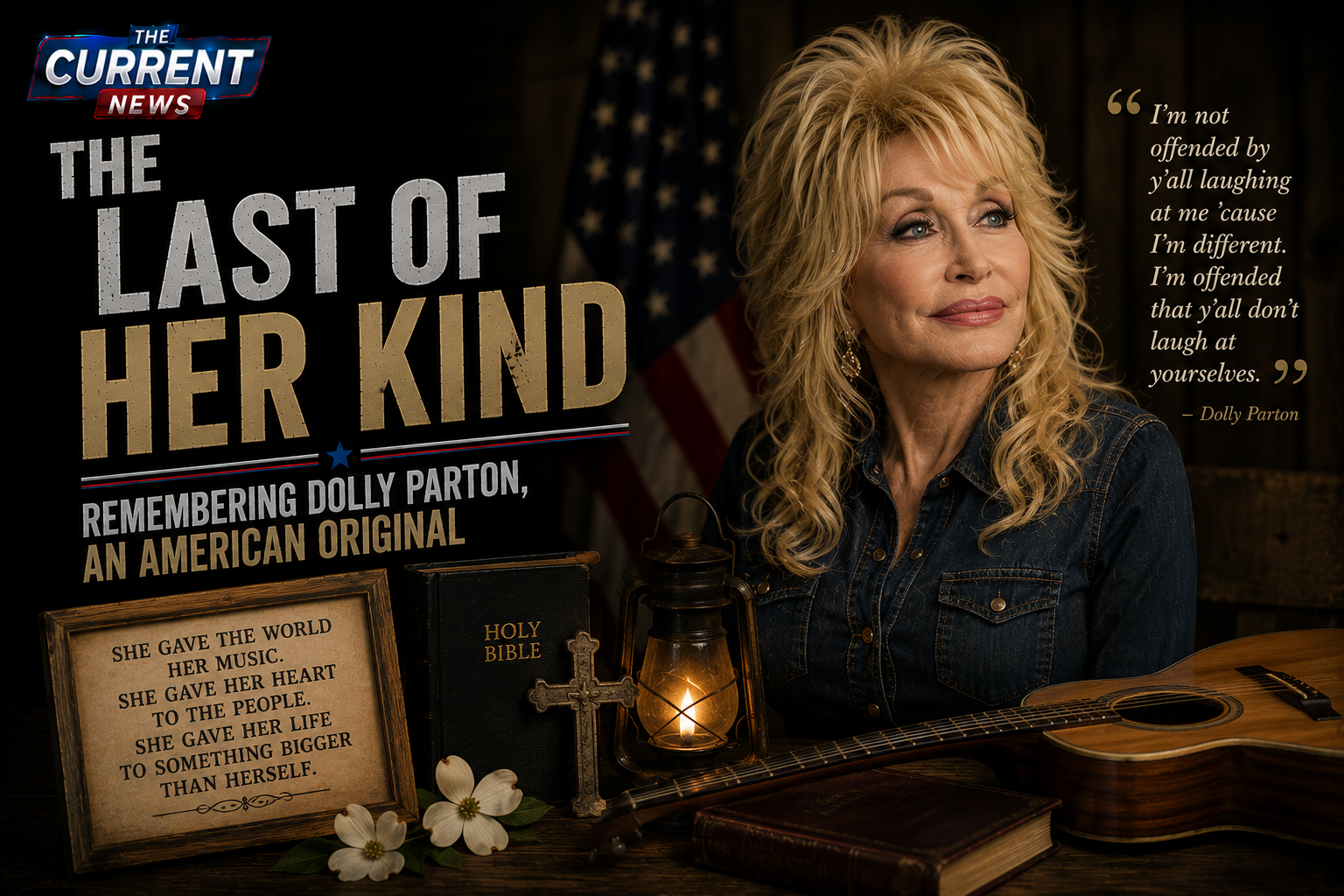
There are celebrities.
There are superstars.
And then there are people who somehow become part of the fabric of America itself.
Dolly Parton was one of those people.
On Tuesday, August 25, 2026, the woman who gave the world “Jolene,” “9 to 5,” “Coat of Many Colors” and “I Will Always Love You” died at 80 after what her representatives described as a brief battle with cancer. She died at Vanderbilt-Ingram Cancer Center in Nashville, surrounded by loved ones.
And suddenly, something feels different.
Not just in country music.
Not just in Tennessee.
But in America.
Because Dolly Parton wasn’t simply a singer.
She was Dolly.
And there may never be another quite like her.
THE GIRL FROM THE MOUNTAINS
Dolly Rebecca Parton was born in 1946 in rural Tennessee.
She came from a large family and grew up with very little money.
But she had something that couldn’t be measured in dollars.
A voice.
A determination.
And a dream.
Long before she became one of the most recognizable entertainers in the world, she was a little girl growing up in the Smoky Mountains.
That background never completely left her.
She could become a global superstar without pretending she came from somewhere else.
She didn’t abandon the mountains.
She carried them with her.
You could hear them in her music.
You could see them in Dollywood.
You could hear them when she talked about her family.
And you could see them in the way she remembered where she came from.
SHE DIDN’T JUST BECOME FAMOUS
She became Dolly Parton.
That distinction matters.
There are thousands of people who become famous.
Very few become recognizable enough that their first name is sufficient.
You don’t have to explain who Dolly is.
You don’t have to say:
“Dolly Parton, the country singer...”
You can simply say:
Dolly.
And almost everyone knows.
That is an extraordinary cultural achievement.
THE MUSIC WILL LIVE
Her music is going to outlive all of us.
“Jolene.”
“9 to 5.”
“Coat of Many Colors.”
“I Will Always Love You.”
“Here You Come Again.”
“Islands in the Stream.”
And countless others.
She became one of the most successful recording artists in history, selling more than 100 million records and earning 11 Grammy Awards. She was inducted into both the Country Music Hall of Fame and the Rock & Roll Hall of Fame.
But numbers don’t really explain Dolly.
Because her music became something more than statistics.
It became memory.
A mother singing Dolly in the kitchen.
A father listening to country radio.
A grandmother knowing every word.
A child discovering “9 to 5” decades after it was released.
A teenager discovering “Jolene” through a completely different generation of music.
That’s how cultural legacy works.
It gets passed down.
SHE CROSSED GENERATIONS
Maybe one of Dolly’s greatest accomplishments was her ability to remain relevant without constantly trying to become someone else.
That’s rare.
The entertainment industry is obsessed with youth.
New artists arrive.
New sounds appear.
New platforms emerge.
And yesterday’s stars are often forgotten.
But Dolly kept going.
She collaborated with younger artists.
She appeared in movies and television.
She became a cultural icon to people who weren’t even alive when many of her biggest songs were released.
Her connection with Miley Cyrus is a perfect example.
Dolly became Cyrus’ godmother and appeared alongside her in projects that introduced Dolly to another generation of young fans.
She didn’t have to become young again.
She simply remained Dolly.
And young people came to her.
BUT HER LEGACY WAS NEVER JUST MUSIC
This is where Dolly Parton’s story becomes even more remarkable.
She used her success to give.
Her Imagination Library has provided free books to children, inspired by her own father’s inability to read.
That program became one of the most recognizable literacy initiatives in America and expanded internationally.
Her philanthropy also extended to medical research, disaster relief and other causes.
She contributed $1 million toward COVID-19 vaccine research at Vanderbilt University, a gift that helped support the development of the Moderna vaccine.
She didn’t simply accumulate wealth.
She used her wealth to create things that would continue helping people after she was gone.
That’s legacy.
THEN THERE IS DOLLYWOOD
A mountain girl helped create one of America’s best-known theme parks.
Dollywood.
But even Dollywood tells part of Dolly’s story.
It’s not simply a collection of roller coasters.
It became an expression of her roots.
The mountains.
Music.
Family.
Food.
Faith.
Tradition.
Joy.
And now, even as America mourns, Dollywood says it will continue.
The park’s president said Dolly’s wish was for the park to remain a place of joy, hope and togetherness. Dollywood announced that it would remain open following her death, reflecting her belief that “the show must go on.”
Perhaps that’s the perfect way to honor her.
Not by pretending we’re not sad.
But by continuing the joy she spent her life creating.
SHE KNEW LOSS TOO
There is another part of Dolly’s final years that shouldn’t be forgotten.
She lost her husband, Carl Dean, in March 2025 after nearly six decades of marriage.
Their relationship was famously private.
While Dolly lived much of her life in front of cameras, Carl largely stayed away from them.
His death was a tremendous personal loss.
Dolly had spoken openly about grieving him while continuing to work.
And now, just over a year later, Dolly is gone too.
There is something strangely poetic about the thought that the woman who spent nearly 60 years married to the man she loved will now be laid to rest beside him.
A private family service is planned, with a public memorial to be announced later.
THE FAITH BEHIND THE MUSIC
For all the rhinestones, wigs, humor and larger-than-life personality, there was another part of Dolly that often received less attention:
her faith.
Christian themes ran through much of her music and upbringing.
She grew up singing gospel music.
She spoke frequently about God.
And her childhood in the Smokies was deeply connected to church and family.
Dolly’s public life was complicated, as every human life is.
But she never seemed particularly interested in pretending she had come from somewhere other than where she actually came from.
She knew the mountains.
She knew poverty.
She knew hard work.
She knew family.
She knew faith.
And she carried those things into the rest of her life.
“COAT OF MANY COLORS”
Perhaps no song better explains Dolly than “Coat of Many Colors.”
The song tells the story of a coat her mother made for her from pieces of fabric.
To a child, having a coat made from scraps could have been humiliating.
But Dolly turned it into something beautiful.
The coat wasn’t valuable because of what it cost.
It was valuable because of who made it.
Her mother.
That idea seems to run through so much of Dolly’s life.
She understood that value isn’t always measured by money.
A family.
A song.
A book.
A smile.
A mountain.
A memory.
A helping hand.
Sometimes the things that look ordinary are the things that matter most.
THE LAST OF HER KIND
Maybe that’s why her death feels so significant.
Dolly Parton belonged to a generation of entertainers who could become household names without social media.
They didn’t need to post every thought.
They didn’t need to livestream their breakfast.
They didn’t need to constantly manufacture controversy.
They built careers through talent.
Work.
Personality.
And time.
Dolly understood how to entertain without losing her humanity.
She could laugh at herself.
She could dress extravagantly.
She could make jokes about herself.
She could walk into a room and immediately command attention.
And somehow, she still seemed approachable.
That’s rare.
AMERICA IS LOSING MORE THAN A SINGER
When people die, we often reduce their lives to accomplishments.
Awards.
Albums.
Movies.
Money.
Records.
But the real measure of a person’s life is often found in the people they leave behind.
The children who received books.
The families who visited Dollywood.
The people who found comfort in her music.
The young artists she encouraged.
The people who heard her songs during the hardest moments of their lives.
The people who laughed because of her.
The people who dreamed because of her.
The people who were reminded that where you start doesn’t have to determine where you finish.
That’s a much bigger legacy than a trophy.
SHE MADE BEING YOURSELF LOOK EASY
One of the most remarkable things about Dolly Parton was that she never seemed embarrassed by being Dolly Parton.
The hair.
The clothes.
The makeup.
The accent.
The humor.
The country roots.
The mountains.
She didn’t spend her career trying to convince America she was sophisticated enough to belong.
She simply showed up as herself.
And eventually America decided that herself was more than enough.
Maybe that’s one of the lessons younger generations can take from her.
You don’t have to become somebody else to succeed.
You don’t have to erase where you came from.
You don’t have to be ashamed of your family.
You don’t have to hide your roots.
Sometimes the thing that makes you different is the thing that eventually makes you unforgettable.
NOW THE SONGS SOUND DIFFERENT
There is something about listening to an artist after they die.
The songs change.
The lyrics don’t.
But we hear them differently.
“I Will Always Love You” becomes something more than a love song.
“Coat of Many Colors” becomes a reflection on childhood and family.
“9 to 5” becomes a reminder of an era that shaped American work culture.
“Jolene” becomes another piece of musical history.
And the voice that once sounded like it would always be there suddenly belongs to history.
That’s the strange thing about death.
It doesn’t erase someone’s voice.
It makes us realize how much we had taken for granted that we could always hear it.
THE MOUNTAINS WILL STILL BE THERE
Tennessee will still wake up tomorrow.
The Smoky Mountains will still stand.
Dollywood will open its gates.
Radio stations will play Dolly.
Children will receive books through her literacy program.
Artists will sing her songs.
Families will tell stories about her.
And somewhere, someone who has never heard of Dolly Parton before will discover “Jolene” for the first time.
That’s how a legacy survives.
Not because someone refuses to let the person go.
But because the person left something behind that continues to live.
THE SHOW MUST GO ON
Dolly’s passing leaves an enormous hole.
But perhaps we should remember her the way Dollywood says she wanted to be remembered:
With joy, hope and togetherness.
Not because death isn’t sad.
It is.
Not because we shouldn’t mourn.
We should.
But because Dolly spent her life bringing happiness to people.
And perhaps the greatest way to honor someone who gave so much joy is to keep giving it.
Play the song.
Read the book.
Take the kids to Dollywood.
Give someone a hand.
Call your mother.
Tell your family you love them.
Dream a little bigger.
And don’t be ashamed of where you came from.
GOODBYE, DOLLY
There will be other singers.
There will be other actresses.
There will be other entertainers.
There will be other celebrities who sell millions of records.
But there probably won’t be another Dolly Parton.
Not exactly.
Because Dolly wasn’t manufactured.
She wasn’t created by an algorithm.
She wasn’t assembled by a marketing department.
She was a girl from the Tennessee mountains who dreamed big, worked hard and somehow turned that dream into a career that touched generations.
She became a singer.
A songwriter.
An actress.
A businesswoman.
A philanthropist.
A storyteller.
A mountain girl who became an American icon.
And now she has gone home.
The last of her kind.
Rest in peace, Dolly.
The mountains will remember you.
The music will remember you.
And America will remember you.
Thank you for the songs.
Thank you for the laughter.
Thank you for the books.
Thank you for the dreams.
And thank you for reminding generations of Americans that sometimes the biggest dreams can come from the smallest places.