The Patrick Clancy Conspiracy: Where's the Evidence?
TikTok users claim Patrick Clancy killed his children. But what evidence supports the theory—and why didn't Lindsay Clancy's defense make him the alternative suspect?
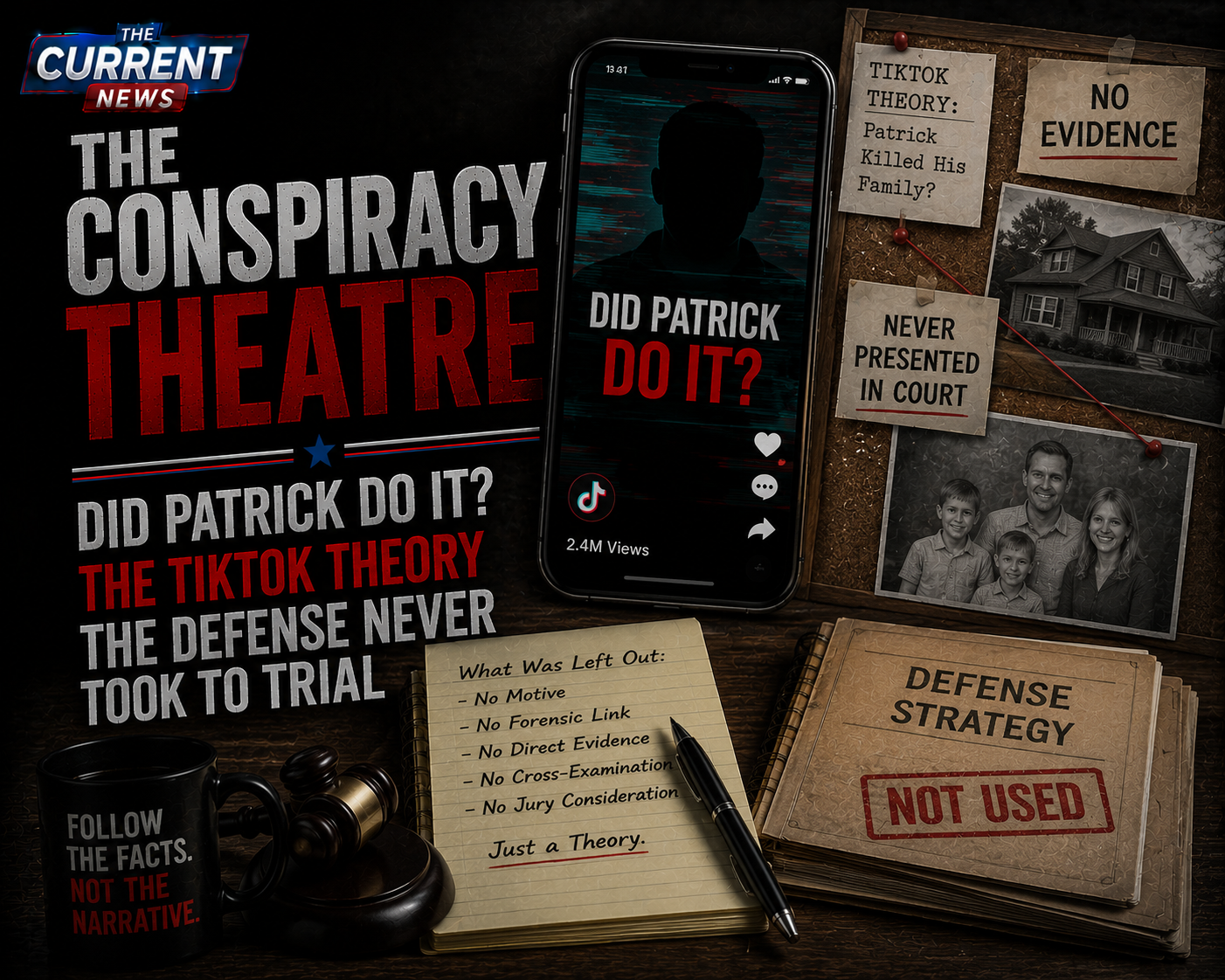
What if the husband did it?
That’s the question spreading across TikTok, Reddit and true-crime social media as the Lindsay Clancy trial reaches its final hours.
According to the theory, Patrick Clancy—not Lindsay—was responsible for the deaths of their three children, and Lindsay was somehow positioned to take the blame.
It sounds like the plot of a true-crime television series.
The grieving husband.
The wife left behind to take the fall.
The suspicious timeline.
The questions about what happened inside the house.
The internet detectives connecting dots from three years ago.
There is just one enormous problem:
Where is the evidence?
And perhaps an even more important question:
If Patrick actually killed the children, why didn’t Lindsay Clancy’s defense make that the case?
THE INTERNET HAS FOUND ITS ALTERNATIVE SUSPECT
The theory isn’t imaginary in the sense that nobody is talking about it.
People really are accusing Patrick Clancy online.
Recent reporting has documented TikTok users and other social-media commentators claiming Patrick was actually responsible for the killings despite no legal evidence connecting him to the murders.
The theory has become popular enough that Patrick’s attorney, Howard Cooper, issued a statement condemning the accusations and warning influencers about the consequences of spreading what he characterized as false and defamatory claims.
And that’s where our Conspiracy Theatre series comes in.
Because this is almost a perfect example of how a real tragedy can become transformed into a television-style mystery.
Except this isn’t television.
These were real children.
And the people being accused are real people.
THREE YEARS HAVE PASSED
The murders happened on January 24, 2023.
The case has now gone through years of investigation, legal proceedings, expert evaluations and finally a five-week murder trial.
The jury has heard from 85 witnesses.
More than 70 witnesses were called by prosecutors, including Patrick.
The defense presented its own witnesses, including mental-health experts and members of Lindsay’s family and support network.
Now the testimony is finished.
Closing arguments are beginning.
And the jury is preparing to deliberate.
If Patrick were actually the killer, this would be an extraordinary time for the defense to finally reveal that theory.
But it hasn’t.
THE DEFENSE’S ACTUAL THEORY
This is perhaps the most important fact in the entire discussion.
Lindsay Clancy’s defense has not told the jury:
“Patrick killed the children.”
It has not argued:
“Patrick framed Lindsay.”
It has not argued:
“The police arrested the wrong person.”
It has not built its case around Patrick being the true perpetrator.
Instead, the defense has spent weeks arguing something completely different:
Lindsay killed the children—but she was not criminally responsible because she was suffering from severe mental illness.
That is the defense.
And the defense has spent enormous amounts of time trying to prove it.
THE DEFENSE DIDN’T IGNORE PATRICK
This doesn’t mean Patrick wasn’t examined.
He was.
Patrick testified during the prosecution’s case.
And the defense cross-examined him.
But look at what the defense focused on.
The defense questioned Patrick about Lindsay’s deteriorating mental health.
It asked about her anxiety.
Her depression.
Her medications.
Her suicidal thoughts.
Her treatment.
Her behavior before the killings.
The defense used Patrick’s testimony to reinforce its central argument:
Lindsay had been deteriorating mentally for months.
The Boston Globe’s courtroom coverage shows defense attorney Kevin Reddington focusing on Lindsay’s relationship with her children and her mental-health decline when questioning Patrick.
That’s not the strategy of an attorney trying to establish that Patrick secretly murdered the children.
It’s the strategy of an attorney trying to establish that Lindsay was severely mentally ill.
BUT COULDN’T THE DEFENSE HAVE CHANGED STRATEGIES?
Technically, yes.
And we need to be fair about that.
A defense attorney doesn’t have to reveal every conceivable theory to the public.
Not raising a particular argument doesn’t mathematically prove that the argument is false.
But there’s a major difference between:
“The defense didn’t mention it.”
and:
“The defense had an alternative killer sitting right in front of them and chose not to pursue the theory.”
The latter would require evidence.
And so far, we’re not seeing it.
THINK ABOUT WHAT THAT THEORY WOULD REQUIRE
If Patrick were the real killer, the defense would need to establish some version of the following:
Patrick had the opportunity.
Patrick had the motive.
Patrick had the means.
Patrick was involved in the actual killings.
Patrick somehow avoided detection.
Lindsay somehow became the person blamed for the crime.
And investigators, prosecutors and forensic experts somehow missed the evidence.
That’s an enormous conspiracy.
And the larger a conspiracy becomes, the more evidence it requires.
WHAT HAPPENED WHEN PATRICK CAME HOME?
The prosecution presented evidence about what happened when Patrick returned home that evening.
According to his testimony, he returned after going out for food and medication.
He encountered Lindsay outside the home, injured after her suicide attempt.
He then discovered the children in the basement and called 911.
First responders described Patrick as frantic and screaming that Lindsay had killed the children.
That’s not proof of innocence.
A person’s reaction alone cannot establish whether they committed a crime.
But it is part of the evidence the jury has heard.
And if the defense believes Patrick staged the scene, that’s a massive issue it could have attacked.
“BUT HE DIDN’T CHECK THE CHILDREN IMMEDIATELY”
This is one of the online theories.
Some TikTok creators have pointed to Patrick’s actions after arriving home and asked why he didn’t immediately check the children.
One viral TikTok analysis specifically highlighted this as a supposed “hole” in the prosecution’s narrative.
That’s a legitimate question to ask.
But a question isn’t an answer.
And certainly isn’t evidence of murder.
There are countless possible explanations for why a person reacts in a particular way during a catastrophic emergency.
That’s why investigators don’t normally determine guilt based on whether someone’s reaction looks right on TikTok.
They examine physical evidence.
Witnesses.
Timelines.
Digital records.
Forensic evidence.
Statements.
And inconsistencies.
THE “TV SHOW” PROBLEM
This is where things get fascinating.
One TikTok creator who has been heavily discussing the case is Taylor Vaughn Lasley, a screenwriter and professor.
She explicitly approached the case through the lens of storytelling.
She said that if she were creating a television show about the case, there were certain details she would deliberately plant to make the audience question whether Lindsay was actually responsible.
That’s an interesting creative exercise.
But here’s the problem:
Real life isn’t a screenplay.
A television writer is trained to look for plot twists.
A criminal investigation is supposed to look for evidence.
In a screenplay, the husband acting strangely may be a clue.
In real life, strange behavior isn’t automatically evidence of homicide.
In a television show, the fact that a character remarried might be foreshadowing.
In real life, someone eventually rebuilding their life after a devastating loss isn’t evidence that they committed the crime.
The difference matters.
THE REMARRIAGE THEORY
One of the stranger pieces of internet speculation concerns Patrick’s current wife.
Patrick has since remarried.
Social-media users have examined his new marriage and his wife’s profession and attempted to connect those facts to the original tragedy.
Again:
That’s not evidence of murder.
People are allowed to rebuild their lives after unimaginable loss.
And we should be extremely careful about turning someone’s attempt to move forward into evidence that they were responsible for what happened.
The fact that Patrick remarried doesn’t prove his innocence.
But it certainly doesn’t prove his guilt.
THEN THERE’S THE TIMELINE
The prosecution has spent weeks building a timeline of Lindsay’s actions.
Digital evidence included phone activity, Safari searches, text messages and Apple Watch data.
Prosecutors have used that evidence to argue that Lindsay deliberately carried out the killings.
The defense has challenged aspects of the state’s interpretation and has emphasized her mental-health history.
But notice what’s missing:
A forensic timeline establishing Patrick as the killer.
If the defense wanted to make Patrick the alternative perpetrator, the timeline would be critical.
Where was he?
When?
What did he do?
What evidence places him at the crime scene during the killings?
What physical evidence connects him?
Where is the murder weapon evidence connecting him?
What evidence shows he staged the scene?
Those are the questions that matter.
“BUT THE POLICE DIDN’T INVESTIGATE HIM!”
This is another argument you’ll see online.
But we have to be careful with that claim.
Patrick was a central witness.
His movements and statements were investigated as part of the case.
And he testified at trial.
The defense has criticized aspects of the police investigation, and attorney Kevin Reddington attempted to raise investigative shortcomings during closing arguments. A request for a specific instruction allowing jurors to consider an insufficient investigation was denied, although the judge permitted the defense to discuss investigative gaps.
That’s important.
The defense did criticize the investigation.
But it didn’t turn that criticism into:
“Patrick Clancy was the murderer.”
That’s a major difference.
AND THEN THERE’S THE PROBLEM OF MOTIVE
What was Patrick’s motive?
The internet theories need an answer.
Not:
“He seemed suspicious.”
Not:
“Something about him feels wrong.”
Not:
“Look at his behavior.”
What was the actual motive?
Why would Patrick kill his three children?
Why would he do it?
Why would he leave evidence pointing toward Lindsay?
Why would he leave himself exposed to investigation?
Why would he then discover the children and call 911?
A theory doesn’t become stronger simply because the official explanation has questions.
It needs its own explanation.
THE DEFENSE’S OWN THEORY MAKES THIS EVEN MORE IMPORTANT
Think about what Lindsay’s attorneys have spent weeks trying to establish.
They have presented evidence that Lindsay:
experienced severe depression,
had suicidal thoughts,
reported thoughts of harming her children,
sought psychiatric treatment,
entered an inpatient program,
received multiple medications,
experienced worsening mental-health symptoms,
and allegedly experienced hallucinations.
Her mother testified that Lindsay told her and Patrick she had thoughts of harming the children.
Her former mother-in-law testified that Lindsay was “begging for help.”
Defense experts testified that she was experiencing psychosis.
That’s a complete defense narrative.
And it doesn’t require Patrick to be the killer.
THE MOST IMPORTANT QUESTION
Here’s the question I keep coming back to:
If Patrick was the real killer, why would Lindsay’s defense spend virtually the entire trial arguing that Lindsay committed the killings while mentally ill?
That’s not a minor detail.
That’s the entire structure of the defense.
The defense isn’t saying:
“The wrong person is on trial.”
It’s saying:
“The right person is on trial, but she was not criminally responsible.”
That’s a fundamentally different case.
COULD THE DEFENSE STILL BE WRONG?
Absolutely.
That’s why we have trials.
Maybe the prosecution is wrong.
Maybe the defense is wrong.
Maybe the jury finds the evidence doesn’t establish first-degree murder.
Maybe they find Clancy not criminally responsible.
Maybe they reach another verdict available under the judge’s instructions.
But the answer isn’t going to come from TikTok.
It’s going to come from the evidence presented in court.
WHAT ABOUT THE “SMOKING GUN”?
A true-crime theory needs more than suspicious behavior.
It needs something that connects the alternative suspect to the crime.
A fingerprint.
DNA.
A weapon.
Digital evidence.
A witness.
A confession.
A financial motive.
A communication.
Something.
The public record described in current reporting has not produced evidence that Patrick killed his children.
Boston.com reported directly that Patrick is not charged, prosecutors have not indicated he played a role, and the online accusations lack supporting legal evidence.
That’s the current state of the evidence.
THERE’S ANOTHER REASON THIS THEORY IS DANGEROUS
Patrick isn’t a fictional character.
He’s a father who lost three children.
He was then thrust into a nationally watched criminal trial involving the mother of those children.
And now strangers on the internet are accusing him of murdering his own kids.
His attorney has warned that these allegations are having real consequences.
That’s where true crime can cross a line.
There is nothing wrong with asking questions.
There is something wrong with turning a question into an accusation without evidence.
THE INTERNET LOVES THE TWIST
This is perhaps the most uncomfortable part.
The “Patrick did it” theory makes for a compelling story.
It’s dramatic.
It’s unexpected.
It has a villain nobody expected.
It turns the husband into a secret mastermind.
It creates a plot twist.
It gives viewers something to investigate.
And social-media algorithms reward exactly that kind of content.
Experts studying the online reaction to the Clancy case have pointed out that sensational conspiracy content can receive more engagement and spread more quickly than sober analysis.
That’s the Conspiracy Theatre.
The more shocking the theory, the more people click.
The more people click, the more the algorithm distributes it.
And suddenly speculation starts looking like consensus.
WE’VE SEEN THIS BEFORE
High-profile trials routinely create armchair detectives.
People examine every photograph.
Every facial expression.
Every text message.
Every search.
Every pause.
Every word.
Sometimes they uncover something meaningful.
But often they simply find things that look meaningful.
That’s the danger.
Human beings are incredibly good at finding patterns.
Sometimes we’re so good at finding them that we create patterns where none exist.
THE JURY DOESN’T GET TO DO THAT
The jury has a different job.
They don’t get to say:
“Patrick looked suspicious.”
They don’t get to say:
“I watched a TikTok that convinced me.”
They don’t get to say:
“The story would make more sense if Patrick did it.”
They have to evaluate admissible evidence and the law.
And that is precisely why the jury is so important.
SO WHY DIDN’T THE DEFENSE USE THE THEORY?
Maybe the simplest answer is the correct one.
Because the defense apparently didn’t believe it had the evidence necessary to make that argument.
That’s an inference—not something we can claim to know about the lawyers’ private strategy.
But their actual courtroom strategy tells us something.
They didn’t build their case around Patrick.
They built their case around Lindsay’s mental state.
And after 21 days of testimony and 85 witnesses, that remains the central issue going into closing arguments.
THE CONSPIRACY THEATRE TEST
So let’s apply the same test we’ve applied to other conspiracy theories.
What is the claim?
Patrick killed the children and Lindsay was framed.
What is the evidence?
Online commentators point to behavior, timelines and circumstances they find suspicious.
Is there evidence directly connecting Patrick to the murders?
Current reporting does not identify such evidence.
Did Lindsay’s defense present Patrick as the alternative killer?
No.
Did prosecutors charge Patrick?
No.
Has the prosecution indicated Patrick participated in the killings?
No.
Does that prove Patrick is innocent?
No.
But it does mean the conspiracy theory currently has a very serious evidentiary problem.
QUESTIONS ARE GOOD. ACCUSATIONS ARE DIFFERENT.
Let’s keep asking questions.
Why did Patrick do this?
Why did he do that?
Why didn’t he immediately check the children?
What exactly happened when he returned?
What did investigators find?
What does the timeline show?
Those are legitimate questions.
But the next step has to be:
What evidence answers them?
That’s the difference between investigation and conspiracy.
THREE YEARS LATER, WE ARE STILL LOOKING FOR THE PLOT TWIST
Maybe that’s the strangest part of all.
Three years have passed.
The case has been investigated.
A defendant has been charged.
Attorneys have prepared for trial.
Experts have examined the evidence.
Eighty-five witnesses have testified.
The jury is now preparing to deliberate.
And yet TikTok has created an entirely different courtroom.
One where the prosecution is wrong.
The defense is supposedly hiding the truth.
The husband is secretly the killer.
And every unexplained detail becomes another piece of the puzzle.
But that’s not how criminal justice works.
THIS ISN’T A TV SHOW
There isn’t a writer sitting in a room deciding that Patrick will be revealed as the murderer in the final episode.
There are three dead children.
A woman on trial.
A grieving father.
A jury.
And evidence.
That’s it.
And perhaps that’s the most important thing we can remember.
Real life doesn’t need a plot twist to be tragic.
THE BOTTOM LINE
Could Patrick Clancy theoretically have committed the murders?
Almost anything is theoretically possible.
But theoretical possibility isn’t evidence.
The current public record does not establish that Patrick killed his children.
He isn’t charged with their murders.
The prosecution hasn’t accused him of participating.
And Lindsay Clancy’s own defense has not presented Patrick as the alternative killer.
Instead, the defense has spent the trial arguing that Lindsay committed the killings while suffering from severe mental illness and therefore should not be held criminally responsible.
That doesn’t prove Lindsay’s defense is correct.
It doesn’t prove the prosecution is correct.
And it certainly doesn’t mean every question about the investigation has been answered.
But before we turn Patrick Clancy into the villain of a TikTok true-crime series, perhaps we should ask the simplest question of all:
Where is the evidence?
Because if the answer is:
“Well, the story just doesn’t make sense...”
that’s a reason to investigate.
It isn’t a reason to accuse someone of murdering his children.
Don’t confuse a plot twist with the truth.
That’s the entire point of the Conspiracy Theatre.
WHAT DO YOU THINK?
Is questioning Patrick’s actions legitimate investigative skepticism—or has social media crossed the line into accusing a grieving father without evidence?
And perhaps the bigger question:
If you believe Patrick was responsible, what specific piece of evidence would you point to?
Not a feeling.
Not a TikTok.
Not “it doesn’t add up.”
What evidence?
Editorial & Legal Note
Patrick Clancy has not been charged with killing his children, and current reporting does not identify evidence establishing that he participated in their deaths. The allegations discussed here are social-media conspiracy theories and should not be treated as facts. Patrick’s attorney has publicly condemned the claims.
Lindsay Clancy has admitted through her defense that she killed the children; her defense argues that she was not criminally responsible because of severe mental illness. The defense’s courtroom strategy has focused on postpartum psychosis, medication, her psychiatric history and her mental state—not on presenting Patrick as the perpetrator.
This article does not conclude that every aspect of the investigation was flawless or that every question raised online is illegitimate. It argues only that an accusation of murder requires evidence, and the publicly available evidence cited here does not establish that Patrick Clancy committed the killings.