Tucker Carlson: Changing Beliefs or Chasing Followers?
Has Tucker Carlson genuinely changed his beliefs, or is he adapting to his audience? We examine media influence, ideology, truth and intellectual independence.
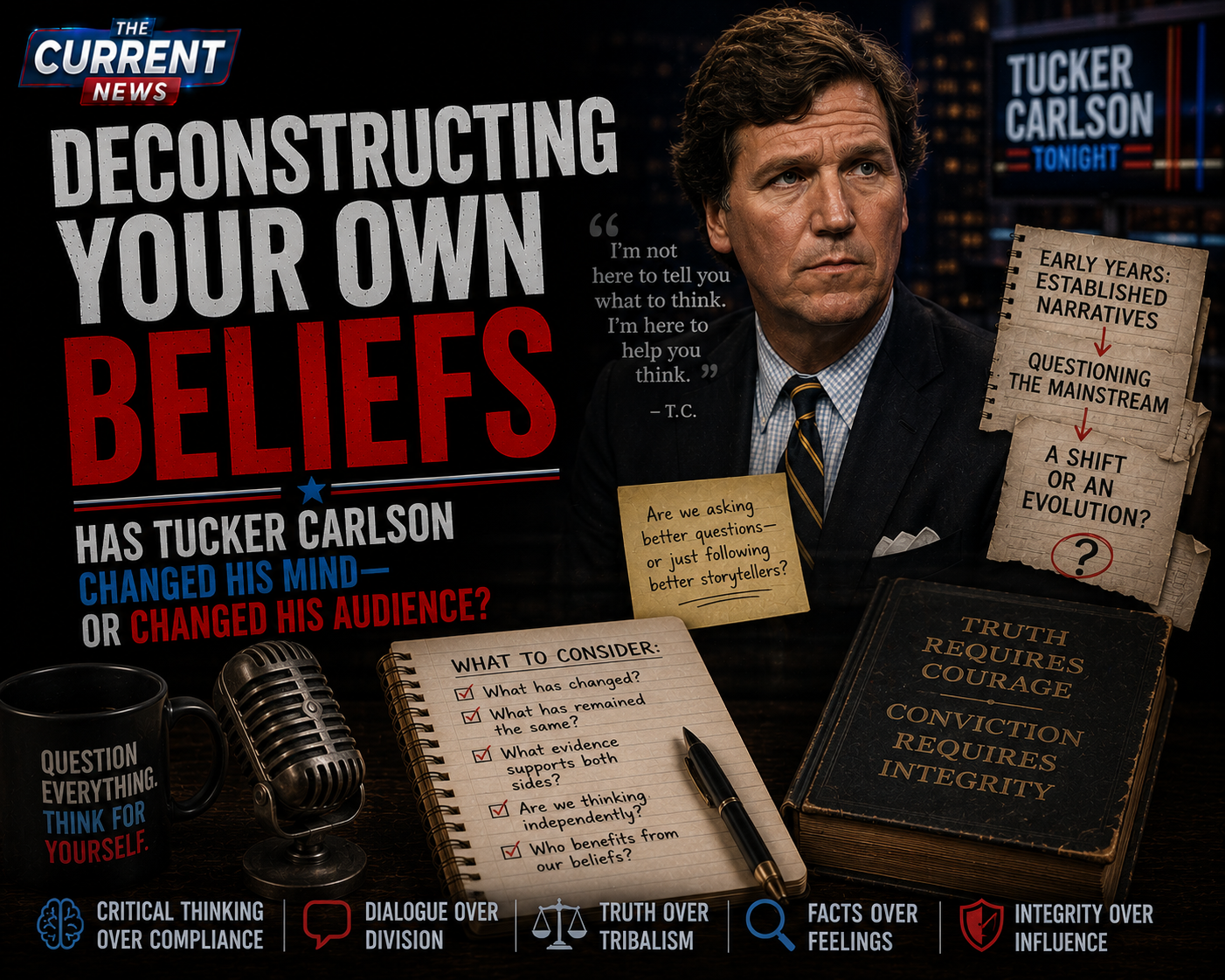
There is nothing inherently wrong with changing your mind.
In fact, sometimes changing your mind is a sign of intellectual honesty.
We should be willing to admit when we were wrong. We should be willing to examine evidence that challenges our assumptions. We should be willing to grow.
But there is another possibility that deserves just as much attention:
What happens when someone changes their beliefs because their audience changes?
That is the question worth asking about Tucker Carlson.
Over the past several years, Carlson has gone through some very public shifts in his political and foreign-policy positions. Some of those changes may represent genuine intellectual evolution. Others have caused critics to question whether he is increasingly positioning himself around what his audience wants to hear.
And that distinction matters.
Because there is a major difference between deconstructing your beliefs because you discovered they were wrong and deconstructing your beliefs because you discovered that another position gets more followers.
CHANGING YOUR MIND ISN’T THE PROBLEM
Let’s establish something first.
There is nothing wrong with Tucker Carlson—or anyone else—changing his mind.
If Carlson once supported something and now believes he was wrong, he should be allowed to say so.
In fact, we should encourage it.
A person who refuses to reconsider anything they believe isn’t necessarily principled.
They may simply be stubborn.
The problem begins when we can’t tell whether someone is following the evidence or following the audience.
That is where the media business becomes complicated.
TUCKER’S BREAK WITH TRUMP
One of the clearest examples is Carlson’s relationship with Donald Trump.
Carlson was an influential supporter of Trump during the 2024 campaign.
But by April 2026, Carlson publicly expressed regret for having supported Trump and apologized to his audience for what he described as having “misled” them. He said he and others who promoted Trump had reason to wrestle with their consciences.
That is a significant change.
But here’s the important part:
A change in position doesn’t automatically prove dishonesty.
Carlson may genuinely believe Trump changed.
He may genuinely believe he was wrong.
He may genuinely regret his previous position.
Those are legitimate possibilities.
The question is not whether Carlson is allowed to change.
The question is what caused the change.
THEN CAME IRAN
Carlson’s foreign-policy evolution has become even more dramatic.
As the United States became involved in the conflict with Iran, Carlson became one of the most outspoken conservative critics of the administration’s approach.
He argued that the conflict was not in America’s interest and sharply criticized Trump’s decision to participate.
Carlson has described the war as fundamentally an Israeli conflict rather than an American one and has argued that the United States should not be dragged into another Middle Eastern war.
Again, there is nothing inherently wrong with that position.
America has a long tradition of debate over interventionism versus noninterventionism.
The Republican Party itself contains competing traditions on foreign policy.
But Carlson’s transformation has been significant enough that it has raised questions about where his political philosophy is ultimately headed.
FROM FOX NEWS CONSERVATIVE TO SOMETHING ELSE?
This is where the Tucker Carlson story becomes fascinating.
The Carlson of the Fox News era was unquestionably a major conservative media figure.
The Carlson of today appears increasingly interested in something broader.
His politics have become more explicitly nationalist and skeptical of traditional conservative institutions and foreign-policy assumptions.
In August, Carlson unveiled a 10-point political manifesto and openly embraced the idea of creating a political movement separate from the traditional Republican establishment. Axios reported that he has become a major figure among a faction of MAGA supporters who believe Trump has abandoned some of the movement’s original principles.
That is no longer simply a commentator criticizing a president.
It begins to look like an attempt to redefine the movement itself.
And that creates an important question:
Is Tucker Carlson changing because he has discovered a better political philosophy—or because there is an audience waiting for one?
FOLLOWERS ARE A POWERFUL INCENTIVE
This isn’t unique to Carlson.
It is a problem throughout modern media.
A commentator discovers that one particular position gets enormous engagement.
The audience responds.
The clips go viral.
Subscribers increase.
Donations increase.
Podcast downloads increase.
And suddenly the incentive structure becomes obvious.
Say more of that.
That’s how an echo chamber can form around the person who was supposed to be leading the audience.
The audience begins influencing the commentator.
The commentator gives the audience more of what it wants.
The audience becomes more committed.
The commentator becomes even more dependent on that audience.
And eventually, nobody knows who is influencing whom.
THE DANGER OF BECOMING YOUR OWN ALGORITHM
Traditional media had editors.
They could tell a journalist:
“That’s not supported.”
“Find another source.”
“You’re getting ahead of the evidence.”
“That’s an opinion, not a fact.”
Independent media operates differently.
A podcaster can wake up, turn on a microphone and speak directly to millions of people.
There is enormous freedom in that.
But there is also enormous temptation.
The algorithm rewards:
outrage,
controversy,
novelty,
conflict,
and emotional certainty.
Nuance doesn’t always go viral.
“I need more evidence” doesn’t make the best thumbnail.
“Maybe I was wrong” isn’t necessarily the most clickable headline.
But:
“EVERYTHING YOU WERE TOLD IS A LIE”
will probably get attention.
And attention is the currency of modern media.
DECONSTRUCTION CAN BE GOOD
There is a legitimate intellectual process called deconstruction.
It can mean taking apart your assumptions and asking:
Why do I believe this?
Where did this belief come from?
What evidence supports it?
What evidence challenges it?
Would I believe the same thing if my political party disagreed?
Would I believe the same thing if my audience hated it?
Those are healthy questions.
Christians should ask them.
Conservatives should ask them.
Liberals should ask them.
Journalists should ask them.
And yes, Tucker Carlson should be allowed to ask them too.
BUT DECONSTRUCTION WITHOUT A FOUNDATION BECOMES DRIFT
There is another danger.
If you tear down every belief but never establish a standard for rebuilding, you can eventually become intellectually unmoored.
Today you believe one thing.
Tomorrow you believe its opposite.
Next month you discover another position.
Eventually, the only consistent principle becomes:
Whatever works.
That is not necessarily intellectual freedom.
It can become intellectual drift.
A person needs some standard by which they determine whether a belief is true.
Otherwise, changing your mind becomes less about discovering truth and more about responding to circumstances.
WHAT IS TUCKER’S STANDARD?
This is the question I think his audience should be asking.
Not:
“Do I agree with Tucker?”
Not:
“Is Tucker still conservative?”
But:
“What standard does Tucker use to determine what is true?”
When he changed his position on Trump, what evidence changed his mind?
When he changed his position on foreign policy, what evidence changed his mind?
When he challenges America’s relationship with Israel, what principles guide that argument?
When he talks about Ukraine, Russia or Iran, what consistent standard determines whether American involvement is justified?
And most importantly:
Would Tucker hold the same position if holding it cost him half of his audience?
That’s the real test.
THE COURAGE TO LOSE FOLLOWERS
This is where true intellectual independence becomes difficult.
Imagine a commentator has one million followers who believe X.
Then the commentator examines the evidence and concludes:
X is wrong.
If he changes his position, he may lose followers.
He may lose sponsors.
He may receive criticism.
His friends may turn against him.
His audience may accuse him of betrayal.
But if he refuses to change because he’s afraid of losing those people, he is no longer serving truth.
He’s serving the audience.
The opposite is also true.
If a commentator discovers that his audience loves Y and then suddenly begins supporting Y without adequate evidence, he’s not necessarily serving truth either.
He’s serving engagement.
THIS IS BIGGER THAN TUCKER
The Carlson story is simply a useful example of a much larger problem.
We are increasingly building personality-driven media ecosystems.
People don’t just follow ideas.
They follow people.
And when the person changes their position, the followers often change with them.
That is dangerous.
Because no commentator should become the substitute for independent thought.
Not Tucker Carlson.
Not Joe Rogan.
Not Candace Owens.
Not Ben Shapiro.
Not CNN.
Not Fox News.
Not MSNBC.
Not The Current News.
Nobody.
EVEN CHRISTIANS CAN FALL INTO THIS TRAP
This is especially important for Christians.
Our ultimate authority cannot be a podcast host.
It cannot be a politician.
It cannot be a political movement.
It cannot even be a pastor simply because we like him.
Our ultimate authority is Scripture.
Acts 17:11 praises the Bereans because they didn’t simply accept what they were told.
They examined the Scriptures to determine whether what they were hearing was true.
That’s a powerful model for the modern media age.
Listen.
Think.
Research.
Test.
Then decide.
THE BIBLE ACTUALLY TELLS US TO TEST THINGS
1 Thessalonians 5:21 says:
“Test everything; hold fast what is good.”
That should be printed above every podcast microphone in America.
Test everything.
Not:
“Believe everything your favorite commentator says.”
Not:
“Reject everything your political enemies say.”
Test everything.
That includes the person you agree with.
That includes the person you hate.
That includes Tucker Carlson.
That includes me.
MAYBE TUCKER REALLY HAS CHANGED HIS MIND
And here’s where fairness requires us to acknowledge something.
Maybe Carlson isn’t manipulating anyone.
Maybe he genuinely believes he was wrong about Trump.
Maybe he genuinely believes America should avoid foreign wars.
Maybe he genuinely believes the conservative movement needs to change.
Maybe he is sincerely deconstructing his own worldview.
If so, that’s not something we should condemn.
That’s something we should respect.
But respect doesn’t mean agreement.
And it doesn’t mean we stop asking questions.
THE TEST IS CONSISTENCY
If Carlson’s beliefs are changing because of evidence, we should see a consistent intellectual framework.
If his beliefs are changing because of audience pressure, we should eventually see something else:
Positions that move toward whatever generates the most attention.
That’s something the public should watch.
Not because Tucker Carlson is uniquely bad.
But because every media personality faces the same temptation.
YOUR FAVORITE COMMENTATOR DOESN’T HAVE TO BE RIGHT
This may be the healthiest lesson of all.
You can listen to Tucker Carlson and disagree with him.
You can listen to him and agree with him.
You can think he was right about Trump.
You can think he was wrong.
You can agree with his foreign-policy criticism while disagreeing with other parts of his worldview.
That’s called independent thought.
You don’t need to subscribe to an entire personality package.
Take the argument.
Examine the evidence.
Keep what survives scrutiny.
Reject what doesn’t.
THE BOTTOM LINE
Changing your mind isn’t weakness.
Changing your mind because the evidence changed is intellectual honesty.
Changing your mind because you discovered you were wrong is maturity.
But changing your mind because your audience demanded it is something very different.
And that’s the question hanging over the evolution of Tucker Carlson:
Is he deconstructing his beliefs in pursuit of truth—or reconstructing his beliefs around an audience?
We may not be able to answer that question today.
But we can watch.
We can examine his arguments.
We can compare what he says now with what he said before.
And we can ask whether there is a consistent philosophy underneath the changes.
Because the goal of independent media shouldn’t be to create millions of people who think exactly like the host.
The goal should be to create millions of people who are willing to think for themselves.
And perhaps that’s the greatest test of any commentator:
Can your audience disagree with you and still remain your audience?
If the answer is yes, you’ve built a community.
If the answer is no, you’ve built a following.
And there is a very big difference.
WHAT DO YOU THINK?
The Current News discussion:
Do you think Tucker Carlson is genuinely changing his beliefs, or adapting to a changing audience?
When should changing your mind be considered intellectual growth?
How can we tell the difference between genuine conviction and audience-driven positioning?
Have you ever changed a strongly held belief after examining the evidence?
Should commentators be judged by their current positions, their past positions, or the consistency of the principles behind both?
Don’t just tell us what you believe. Tell us why.