TWO DAYS, NO VERDICT: The Lindsey Clancy Trial
The Lindsay Clancy jury has deliberated for two days without a verdict and requested to review the suicide knife and prescription medication evidence.
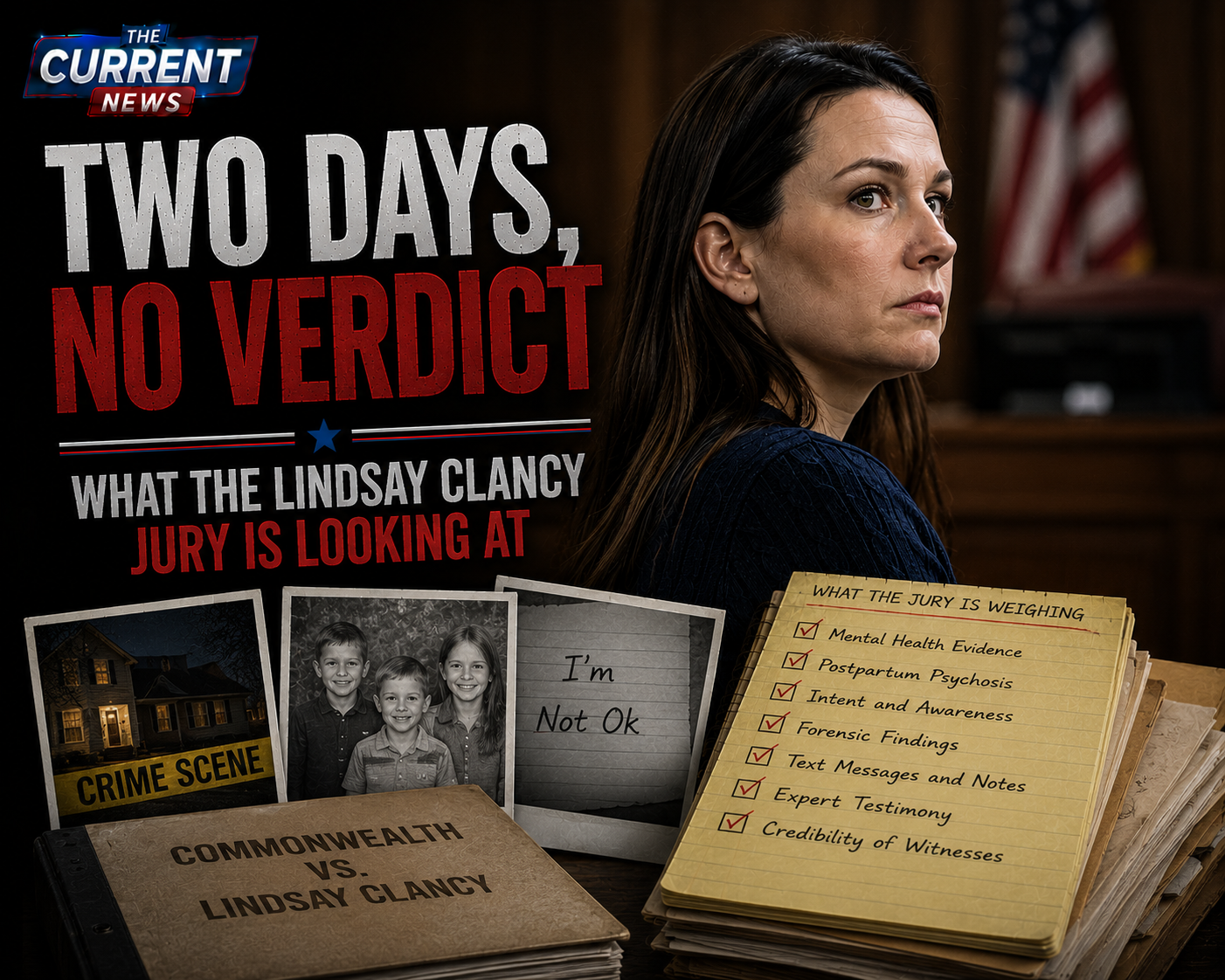
Two days.
Ten or so hours of deliberation.
And still no verdict.
The jury deciding the fate of Lindsay Clancy has gone home for the weekend without reaching a decision in one of the most closely watched murder trials in Massachusetts.
But something happened Friday that makes the wait even more interesting.
The jury asked to examine evidence that goes directly to the central battle of this case:
Lindsay Clancy’s state of mind.
According to defense attorney Kevin Reddington, jurors requested to see the knife Clancy used to cut her wrists and neck during her suicide attempt, along with bags containing prescription pill bottles recovered from the home.
The judge allowed the jury to review the exhibits.
And then they went home.
They’ll return Monday morning.
THIS IS NOT A QUICK VERDICT
The jury began deliberating Thursday afternoon after more than five weeks of testimony.
Thursday produced roughly three and a half hours of deliberation.
Friday brought several more hours.
By Friday afternoon, the jury had spent roughly nine to ten and a half hours considering the evidence, depending on the accounting used by different outlets.
And they still haven’t decided.
That doesn’t tell us which way they’re leaning.
It doesn’t mean they’re deadlocked.
It doesn’t mean they’re favoring the defense.
It doesn’t mean they’re favoring the prosecution.
It means they’re deliberating.
And perhaps that’s exactly what we should want them to do.
THEN CAME THE REQUEST
The jury didn’t simply ask the judge to repeat testimony.
They wanted to see physical evidence.
According to Clancy’s attorney, they requested the knife used in her suicide attempt and bags containing prescription pill bottles.
We need to be careful here.
We don’t know why they wanted those exhibits.
The judge hasn’t publicly explained their reasoning.
Reddington himself declined to speculate.
And we shouldn’t either.
But the request is notable because both pieces of evidence intersect with the central question of the trial:
What was happening to Lindsay Clancy mentally at the time of the killings?
THE DEFENSE’S CASE
The defense has argued that Clancy suffered from severe postpartum psychosis and that her mental illness left her unable to appreciate the wrongfulness of what she was doing.
Her attorney Kevin Reddington has repeatedly pointed to her psychiatric history, medication changes and efforts to obtain treatment.
During closing arguments, he argued that poor medical care and medication contributed to the deterioration of her mental state.
The defense doesn’t deny that Clancy killed her children.
Its argument is much narrower:
She wasn’t criminally responsible because she had lost her grip on reality.
THE PROSECUTION’S CASE
The prosecution sees the same evidence very differently.
Prosecutors acknowledge that Clancy had significant mental-health problems.
But they argue that she still understood what she was doing.
Assistant District Attorney Jennifer Sprague argued during closing arguments that Clancy deliberately created an opportunity to kill the children and then attempted suicide.
The prosecution has also argued that Clancy’s decision to hide certain thoughts from medical providers demonstrated that she understood those thoughts were wrong.
In other words:
Mental illness does not automatically eliminate criminal responsibility.
The prosecution wants the jury to find that Clancy was mentally ill but still legally responsible.
THE KNIFE
The knife could be significant because it is directly connected to what happened after the children were killed.
Clancy attempted suicide by cutting herself and then jumping from a second-story window.
She survived but suffered catastrophic injuries and has been paralyzed since the incident.
The defense has presented that suicide attempt as part of the larger picture of a woman experiencing an extreme psychiatric crisis.
The prosecution, however, has argued that Clancy’s actions were part of a deliberate plan in which she intended to die after killing her children.
So when jurors ask to physically examine the knife, we should not assume we know what they’re thinking.
But it is certainly an exhibit connected to one of the most disputed parts of the timeline.
THEN THERE ARE THE MEDICATIONS
The prescription bottles may be even more directly connected to the defense’s argument.
Clancy’s attorneys have repeatedly argued that medication changes and what they characterize as excessive or inappropriate treatment contributed to her mental deterioration.
The prosecution has challenged that interpretation.
So the jury asking to see the prescription evidence could simply mean they’re trying to understand the timeline more carefully.
Which medications?
When were they prescribed?
How much was she taking?
What was happening around the time of the killings?
What did her doctors know?
What did Clancy tell them?
Those are all questions the jury may be working through.
But again:
We don’t know what specific question prompted the request.
THIS IS WHY WE SHOULDN’T READ TOO MUCH INTO JURY REQUESTS
This is where social media can get dangerous.
One person sees the jury request and says:
“They’re clearly leaning toward insanity.”
Another says:
“They’re looking at evidence proving she planned it.”
Neither conclusion is justified yet.
Jurors can ask to see evidence because they’re confused.
They can ask because one juror wants to examine it.
They can ask because they’re trying to reconstruct a timeline.
They can ask because they’re considering competing arguments.
Or because they simply want to refresh their memory.
A request for an exhibit isn’t a verdict.
FIVE VERDICTS ARE POSSIBLE
The jury’s decision isn’t simply:
Guilty or not guilty.
They have several possibilities.
They can find Clancy guilty of first-degree murder.
They can find her guilty of second-degree murder.
They can find her guilty of manslaughter.
They can find her not guilty.
Or they can find her not criminally responsible because of mental disease or defect.
Those possibilities represent dramatically different outcomes.
A first-degree murder conviction could mean life without parole.
A finding of lack of criminal responsibility could result in commitment to a state psychiatric facility, potentially for an indefinite period subject to legal review.
AND THAT IS WHY THIS DELIBERATION MATTERS
The jury isn’t deciding whether the deaths were tragic.
They aren’t deciding whether postpartum psychosis exists.
They aren’t deciding whether the healthcare system is perfect.
They aren’t deciding whether Lindsay Clancy was once a loving mother.
They are deciding whether the evidence proves criminal responsibility.
That’s the legal question.
And it is an extraordinarily difficult one.
THREE CHILDREN ARE STILL AT THE CENTER OF THIS
Cora was five.
Dawson was three.
Callan was eight months old.
They were killed in their own home in January 2023.
No verdict can change that.
No verdict can give their father the years he expected to have with them.
No verdict can give their family another Christmas, birthday or school day with those children.
That’s why the legal argument over Clancy’s mental state can never be separated entirely from the human tragedy underneath it.
MONDAY WILL BRING THE NEXT CHAPTER
The jury has now been dismissed for the weekend.
They are scheduled to return Monday at 9 a.m. and continue deliberations.
There is no deadline requiring them to reach a verdict immediately.
They could reach a decision quickly Monday.
They could deliberate for several more days.
They could ask additional questions.
Or, if they ultimately cannot reach a unanimous decision, the case could enter a much more complicated legal situation.
For now, however:
There is no verdict.
DON’T TURN DELIBERATION INTO A PREDICTION
Perhaps the most responsible thing we can do this weekend is resist the temptation to predict.
The internet wants to know:
What are they thinking?
Which way are they leaning?
What does the knife request mean?
What do the medications mean?
But unless a juror speaks—which they generally cannot during deliberations—we don’t know.
And pretending we know would be manufacturing information.
The jury has something most of us don’t:
They’ve spent weeks sitting inside that courtroom listening to all of the evidence.
They’ve seen exhibits we haven’t.
They’ve heard testimony in context.
They’ve watched witnesses testify.
They’ve been instructed on the law.
Now they have to work through it.
TWO DAYS DOWN. MORE TO COME.
The jury has spent two days wrestling with an impossible question.
Was Lindsay Clancy a woman suffering from a devastating psychiatric illness who became incapable of understanding her actions?
Or was she mentally ill but still capable of understanding what she was doing and making the deliberate decision to kill her children?
The jury’s request to examine the knife and prescription evidence shows that they are still working through the details.
But it doesn’t tell us the answer.
Only the verdict will.
And for the families involved, this weekend will be another weekend of waiting.
Monday morning, the jury returns.
The deliberation continues.
THE CURRENT NEWS QUESTION
What do you think the jury’s request to examine the knife and prescription evidence tells us—if anything?
Or is the better approach to simply let the jury do its job without trying to interpret every move they make?
Tell us what you think.
Editorial Note
This article does not speculate about the jury’s private deliberations. The reasons for the jury’s request to examine the knife and prescription evidence have not been publicly stated. Any interpretation beyond the confirmed request would be speculation. The jury remains undecided and is scheduled to resume deliberations Monday, August 31.