Two Very Different Fates: What the Clancy Jury Decides
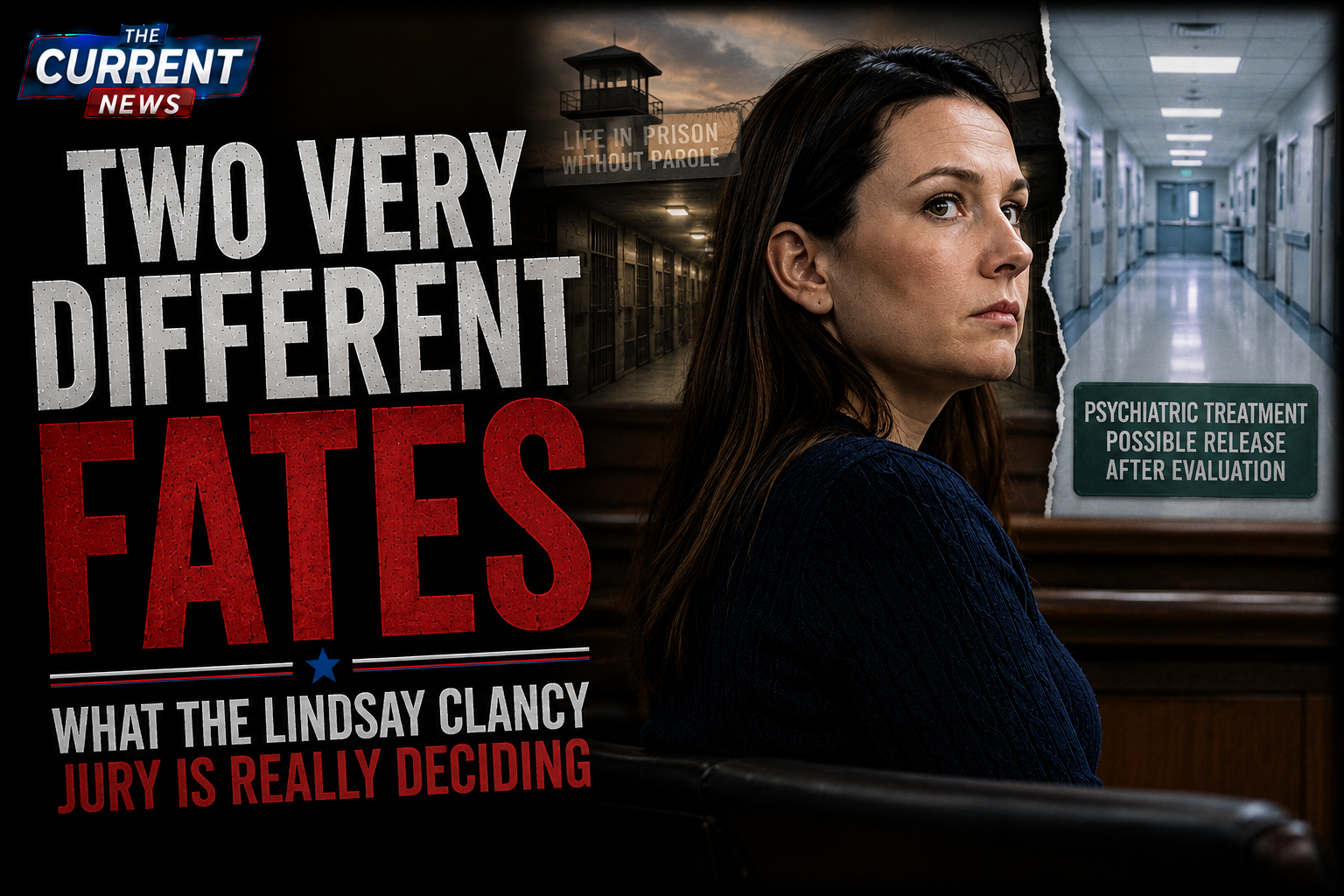
The Lindsay Clancy jury faces a crucial question: criminal responsibility or lack of responsibility due to mental illness? Here are the possible outcomes.
For more than three years, one question has followed the Lindsay Clancy case:
What happened inside her mind on January 24, 2023?
Now, after 21 days of testimony and more than 80 witnesses, that question is finally in the hands of a jury.
Closing arguments are set for today, Thursday, August 27. After the prosecution and defense make their final arguments, Judge William Sullivan will instruct the jurors on the law before 12 of the 18-member panel begin deliberating.
The jury is not deciding whether Clancy killed her three children.
Both sides agree that she did.
They are deciding something much more difficult:
Was Lindsay Clancy legally responsible for what she did?
And depending on their answer, the woman sitting in that courtroom could face two radically different futures.
ONE CASE. TWO VERY DIFFERENT FATES.
The prosecution and defense have presented fundamentally different pictures of the same woman.
The prosecution says Clancy intentionally killed her children and understood what she was doing.
The defense says she was experiencing postpartum psychosis and was so mentally ill that she could not appreciate the wrongfulness of her actions or control herself.
Those arguments lead to two dramatically different outcomes.
One could mean life in prison without parole.
The other could mean commitment to a secure psychiatric facility rather than a prison sentence.
This isn’t simply a question of punishment.
It is a question of criminal responsibility.
FATE ONE: PRISON
If the jury finds Clancy criminally responsible and convicts her of first-degree murder, Massachusetts law calls for life in prison without the possibility of parole.
That would mean Clancy would spend the remainder of her life in the Massachusetts prison system.
There would be no parole hearing decades from now.
No opportunity to earn release based on rehabilitation.
No second chance through the normal parole process.
The case would effectively end with a life sentence.
That is the enormous weight behind the prosecution’s argument.
THE PROSECUTION’S STORY
The Commonwealth’s case is that Clancy knew what she was doing.
Prosecutors have argued that she planned the killings and understood that what she was doing was wrong.
They have pointed to the sequence of events on January 24, 2023, including her husband’s absence from the home while the children were killed and the subsequent attempt on her own life.
The prosecution’s theory is not that Clancy had no mental-health problems.
Instead, it argues that mental illness did not eliminate her criminal responsibility.
That distinction is critical.
Someone can be mentally ill and still be legally responsible for a crime.
The prosecution says that’s what happened here.
THE FINAL PROSECUTION WITNESS
The prosecution’s final witness was Dr. Gregory Saathoff, a forensic psychiatrist who has worked with the FBI’s Behavioral Analysis Unit.
His testimony directly challenged Clancy’s account of hearing a male voice ordering her to kill her children.
Saathoff questioned why the alleged voice would have stopped immediately after the children were killed and pointed to inconsistencies in Clancy’s accounts of when the voice began.
He also focused on what happened during the killings.
The children were killed with exercise bands.
Saathoff testified that the alleged voice did not tell Clancy where to go, what to use, how to kill the children or the order in which to do it.
His argument was that Clancy nevertheless carried out the sequence in a controlled and methodical manner.
To the prosecution, that is evidence of agency.
She wasn’t simply being controlled by a hallucination.
She was making decisions.
BUT THE DEFENSE SEES THE SAME EVIDENCE DIFFERENTLY
The defense has spent the trial presenting a very different picture.
Clancy’s attorneys argue she was suffering from postpartum psychosis, a rare but serious psychiatric condition that can occur after childbirth.
They have presented evidence of a deteriorating mental state, suicidal thoughts, psychiatric treatment and medication changes.
Clancy sought professional help.
She was hospitalized at McLean Hospital.
And according to defense witnesses, her condition continued to deteriorate.
The defense argues that this history matters because it shows what was happening before the tragedy.
Their position is essentially:
This wasn’t a healthy person making a cold calculation.
It was a psychiatric crisis that ultimately became catastrophic.
FATE TWO: A PSYCHIATRIC FACILITY
This is where the public conversation sometimes becomes confused.
A verdict of not guilty by reason of lack of criminal responsibility does not necessarily mean Lindsay Clancy simply walks out of court.
According to legal experts cited by CBS and Boston 25, such a finding could result in commitment to a state psychiatric facility. Her continued confinement would then be subject to legal and medical review.
That could mean years—or potentially the rest of her life—in a secure psychiatric setting.
The difference is that the legal system would be treating her primarily as someone who was not criminally responsible because of mental disease, rather than as someone who knowingly committed murder and deserves a prison sentence.
That distinction is enormous.
THIS IS NOT “SHE GETS TO GO HOME”
This is worth emphasizing.
A finding of lack of criminal responsibility does not necessarily mean:
“She’s innocent and gets to go home.”
The court can impose psychiatric confinement.
And that confinement can be indefinite depending on the circumstances and subsequent evaluations.
Legal experts have pointed to the case of Andrea Yates, who was found not guilty by reason of insanity after killing her five children and remains in a psychiatric facility years later.
So the choice before the jury isn’t simply:
Prison or freedom.
It is closer to:
Criminal punishment or psychiatric commitment based on a finding of lack of criminal responsibility.
THEN THERE’S A THIRD PATH
The jury also has another significant option.
Manslaughter.
The judge has ruled that involuntary manslaughter will be available on the verdict form.
That means jurors don’t have to view this case in only two extremes.
They can determine that Clancy was criminally responsible but that the evidence does not establish first-degree murder.
They can consider second-degree murder.
They can consider manslaughter.
They can find her not criminally responsible.
And a straight not-guilty verdict is also legally possible, although it is considered unlikely because Clancy’s own defense has acknowledged that she killed her children.
THE JURY HAS A DIFFICULT JOB
Imagine being one of those 12 people.
You’ve spent weeks sitting in a courtroom.
You’ve heard testimony about three children.
You’ve heard their father’s testimony.
You’ve heard psychiatrists disagree over the state of Clancy’s mind.
You’ve heard evidence about medications.
You’ve heard about postpartum mental illness.
You’ve heard about suicide.
You’ve heard competing explanations for the same behavior.
And now you’re told:
Forget what the internet thinks.
Forget what the media thinks.
Forget what your emotions tell you.
Decide based on the evidence and the law.
That’s an enormous responsibility.
THE EXPERTS DON’T EVEN AGREE
One of the most important things to come out of the trial is that psychiatric experts haven’t presented one unified conclusion.
Defense experts have argued that Clancy was experiencing psychosis.
Prosecution experts have disputed that conclusion.
Recent testimony from prosecution experts even revealed differences in how some evaluators diagnosed Clancy after interviewing her.
That doesn’t mean the jury has to choose whichever expert sounds most convincing.
They have to evaluate the underlying reasoning.
What evidence did the expert consider?
What did the expert reject?
What assumptions were made?
Does the diagnosis explain Clancy’s behavior?
Does the evidence contradict it?
Those are difficult questions.
THE VOICE
Perhaps nothing illustrates the battle better than the alleged male voice.
Clancy reportedly told people that a male voice instructed her to kill her children and then herself.
Defense witnesses have presented that as evidence of psychosis.
Prosecution experts have questioned the reliability and timing of that account.
Saathoff testified that he found it unusual that Clancy had not previously reported hearing such a voice to her medical providers and that her reported timeline changed between evaluations.
But here’s the important point:
The jury doesn’t have to decide whether the voice “sounds crazy.”
They have to determine what the evidence shows about Clancy’s mental state at the exact time she killed her children.
THAT’S THE LEGAL BATTLE
The prosecution doesn’t necessarily have to prove:
“Lindsay Clancy was perfectly mentally healthy.”
The defense doesn’t simply have to prove:
“Lindsay Clancy had mental-health problems.”
The real question is whether her mental disease or defect reached the legal threshold for lack of criminal responsibility.
That’s a much higher standard than simply establishing that someone was depressed, anxious, suicidal or mentally ill.
And that distinction could determine everything.
THE CHILDREN ARE STILL AT THE CENTER
It can be easy to lose sight of the victims when a case becomes a debate over psychiatric diagnoses and legal standards.
Cora was 5.
Dawson was 3.
Callan was 8 months old.
Their lives ended inside their own home in January 2023.
Whatever the jury ultimately decides about Lindsay Clancy’s mental state, that fact doesn’t change.
Three children are dead.
Their father will never get to watch them grow up.
Their family will never see the adults they might have become.
And there is no verdict that can change that.
COMPASSION DOESN’T HAVE TO MEAN EXCUSES
There is an important conversation happening alongside this trial about postpartum mental health.
That conversation matters.
Postpartum psychiatric disorders can be serious.
Women experiencing severe symptoms need access to care.
Families need to know warning signs.
Doctors need to take suicidal or intrusive thoughts seriously.
And people in psychiatric crisis need help before that crisis becomes catastrophic.
But recognizing the seriousness of mental illness doesn’t require us to abandon accountability.
We can say:
Mental illness is real.
And:
Victims deserve justice.
At the same time.
AND ACCOUNTABILITY DOESN’T MEAN IGNORING MENTAL ILLNESS
The opposite is also true.
If the evidence ultimately convinces the jury that Clancy was genuinely incapable of understanding the wrongfulness of her actions, acknowledging that doesn’t mean the jury is saying what happened was acceptable.
It means the jury is applying a legal principle:
Criminal punishment requires criminal responsibility.
That’s why insanity defenses exist.
The question isn’t whether the conduct was horrific.
It unquestionably was.
The question is whether the person who committed it possessed the mental capacity required for criminal responsibility.
THE INTERNET HAS ALREADY DECIDED
One of the strangest parts of this case has been watching the public debate online.
Some people have already decided Clancy is a monster.
Others have already decided she was completely detached from reality.
Others have turned the case into an argument about antidepressants.
Others have made it about postpartum healthcare.
Others have made it about feminism.
Others have made it about motherhood.
But the jury has a narrower assignment.
Decide the case.
Not the entire mental-health system.
Not every postpartum mother.
Not every psychiatric medication.
Not every insanity defense.
Just this defendant.
And what the evidence establishes about her criminal responsibility.
TOMORROW, THE ARGUMENTS END
The attorneys will have one final opportunity to tell the jury what they believe the evidence means.
Each side will have approximately an hour for closing arguments. Afterward, the judge will instruct the jury on the law.
Then the 12 jurors will deliberate.
And the lawyers won’t be able to argue anymore.
The commentators won’t decide.
The social-media campaigns won’t decide.
The public won’t decide.
The jury will.
TWO VERY DIFFERENT FATES
On one side is a prison cell.
A life sentence without parole if she is convicted of first-degree murder.
On the other is psychiatric confinement if she is found not criminally responsible.
Between those possibilities are second-degree murder and manslaughter.
And behind every one of those verdicts is the same terrible reality:
Three children will never come home.
WHAT IS THE JURY REALLY DECIDING?
Not:
“Did Lindsay kill her children?”
That isn’t really the question.
Not:
“Was Lindsay suffering?”
There appears to be substantial evidence that she was experiencing serious mental-health difficulties.
And not even:
“Do we feel sorry for her?”
The jury cannot make its decision based on sympathy.
The real question is:
Did her mental illness make her legally incapable of appreciating the wrongfulness of what she was doing or complying with the law?
If the answer is yes, the consequences could look radically different.
If the answer is no, the jury could find her criminally responsible.
And if the jury believes she was responsible but the evidence doesn’t establish first-degree murder, other verdicts are available.
That’s why this case is not as simple as the headlines make it appear.
THE FINAL WORD BELONGS TO THE JURY
There is no perfect verdict for a tragedy like this.
No verdict brings Cora back.
No verdict brings Dawson back.
No verdict brings Callan back.
But the justice system still has a responsibility to determine what the evidence and law require.
And that means giving the jury room to wrestle with an extraordinarily difficult question.
Was Lindsay Clancy a criminal who deliberately killed her children?
Or was she a profoundly mentally ill woman whose mind had deteriorated to the point that she could no longer understand the wrongfulness of what she was doing?
Tomorrow, both sides will make their final case.
Then the jury will deliberate.
And eventually, Lindsay Clancy will learn which of those two very different futures awaits her.
The courtroom has heard the evidence.
Now twelve people must decide what it means.
THE CURRENT NEWS DISCUSSION
What do you think the jury’s most important question should be?
How much weight should the jury give Clancy’s documented mental-health history?
Does evidence of planning necessarily prove criminal responsibility?
How should conflicting psychiatric experts be evaluated?
Should someone who is found not criminally responsible remain in a secure psychiatric facility?
Can we have compassion for severe mental illness while still demanding accountability for victims?
This isn’t a case where an easy answer exists.
And perhaps that’s exactly why the jury’s decision matters so much.
Editorial & Legal Note
Lindsay Clancy is presumed innocent of the charged offenses unless and until the jury reaches a guilty verdict. The defense has pleaded not guilty by reason of lack of criminal responsibility and argues that Clancy was experiencing postpartum psychosis when she killed her children. The prosecution argues that she intentionally planned the killings and understood her actions. The jury will consider first-degree murder, second-degree murder, manslaughter, lack of criminal responsibility due to mental disease, and other legally available verdict options.
This article does not characterize Clancy as “insane” or “cold-blooded” as a factual conclusion. Those concepts describe competing interpretations of the evidence and the legal issue before the jury.