What Defines a Woman? The WNBA Debate
Royce White's WNBA draft challenge raises a deeper question: What defines a woman, and should women's sports be based on sex or gender identity?
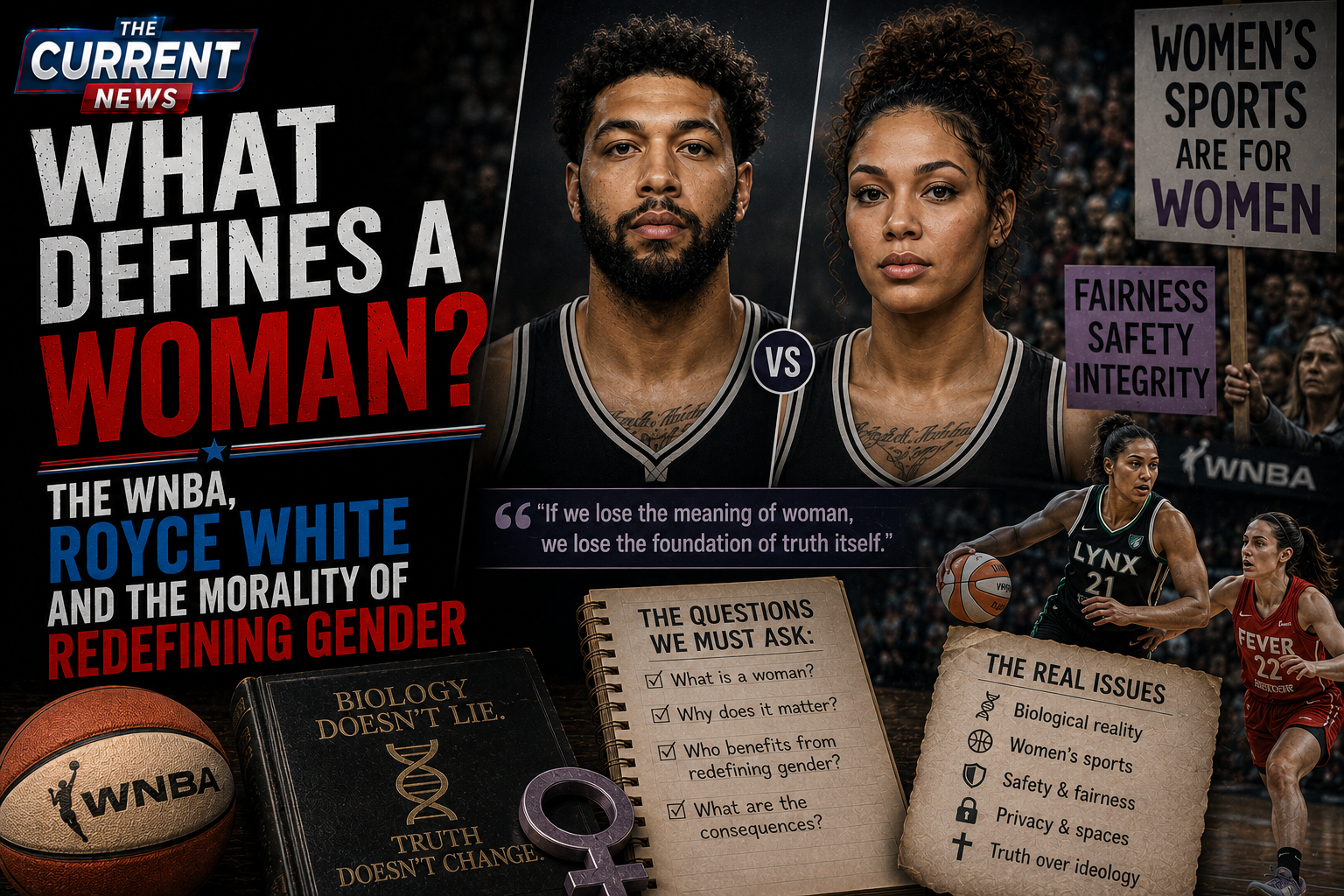
When Does a Woman Become a Woman?
It sounds like a simple question.
But apparently, in 2026 America, it has become one of the most difficult questions to answer.
The debate over transgender athletes has returned to the center of women’s basketball after former NBA players Royce White and Enes Kanter Freedom announced plans to enter the 2027 WNBA Draft while identifying as women for purposes of professional basketball. White has now formally filed his draft declaration, with former congressman Matt Gaetz serving as legal counsel.
And suddenly, a debate that has often been framed around inclusion has encountered an uncomfortable question:
What exactly does the word “woman” mean when the rules of a women’s professional sports league are being written?
That question isn’t meant as an insult.
It is the question the WNBA ultimately has to answer.
THE WNBA’S OWN LANGUAGE CREATED THE QUESTION
The WNBA’s collective bargaining agreement says that only women are eligible to play.
But there is an obvious problem.
The word isn’t clearly defined within the rule in terms of:
biological sex,
gender identity,
chromosomes,
hormone levels,
transition status,
or some other standard.
That ambiguity has become the foundation of the current controversy. The Los Angeles Times reported that the league’s CBA says only women may play but does not specifically address transgender eligibility.
That leaves a very basic question:
If “woman” means biological female, the policy means one thing.
If “woman” means anyone who identifies as female, it means something very different.
The league needs to decide which standard it actually means.
ENTER ROYCE WHITE
Royce White isn’t simply making a social-media statement.
He has formally submitted paperwork seeking entry into the 2027 WNBA Draft.
White, a former NBA player and current Republican political candidate, has said that he identifies as transgender and, at times, identifies as a woman for the purpose of professional basketball.
And that’s where the situation becomes fascinating.
Because if gender identity alone makes someone eligible for women’s basketball, White’s argument becomes difficult to dismiss based solely on the existing wording.
If it doesn’t, then the WNBA needs to explain what additional standard applies.
White’s challenge is therefore exposing something larger than a sports controversy.
It is exposing a philosophical question:
What objective standard is being used?
THIS ISN’T JUST ABOUT ROYCE WHITE
It would be easy to turn this into a story about one former NBA player.
That would miss the point.
The real issue is whether women’s sports are based on:
sex
or
identity.
Those are not identical concepts.
A person can identify as a woman.
But biological sex involves reproductive development, chromosomes, anatomy, hormones and the effects of puberty.
Sports exist in part because biological differences matter to athletic performance.
That’s why basketball has different men’s and women’s leagues in the first place.
If biological sex were irrelevant to athletic competition, there would be little reason to maintain separate categories.
WHY DO WOMEN’S SPORTS EXIST?
This is the question that gets lost in the political shouting.
Why do we have the WNBA?
Why do we have women’s college basketball?
Why do we have women’s Olympic events?
Why not simply have one giant basketball league where everyone competes together?
Because biological differences can affect athletic performance.
On average, males who experience male puberty develop greater:
muscle mass,
bone density,
height,
strength,
lung capacity,
and cardiovascular capacity
than females.
Those differences don’t mean every man is stronger than every woman.
They mean that biological sex can create population-level differences that matter in competitive sport.
And professional sports are built around precisely those differences.
THE ARGUMENT ABOUT HORMONES
Supporters of transgender inclusion often point toward testosterone suppression.
That’s an important part of the discussion.
But it doesn’t automatically answer every question.
The effects of puberty are not simply erased overnight.
Bone structure doesn’t simply reverse.
Height doesn’t reverse.
Some anatomical and physiological changes associated with male puberty remain.
That’s why sports organizations around the world continue debating how to establish fair eligibility rules.
The issue isn’t as simple as:
“Are testosterone levels currently low?”
The broader question is:
“What physical advantages or disadvantages remain relevant to the sport?”
THEN WHY ARE PEOPLE UPSET ABOUT ROYCE WHITE?
Here’s where the political contradiction becomes interesting.
If the argument is:
“Transgender women are women, and women should be allowed to compete in women’s sports,”
then White’s declaration creates a test of that principle.
But if the response becomes:
“Well, not you.”
then people are entitled to ask:
Why not?
What makes one person sufficiently transgender to qualify while another does not?
What objective standard determines eligibility?
And who gets to decide?
THE “BAD-FAITH” ARGUMENT
The WNBA has described the former NBA players’ declarations as a “bad-faith” effort to provoke controversy. The league has also said that it does not currently have a transgender-player eligibility issue and has emphasized the need for respectful discussion.
That may be the league’s position.
But even if White’s motives are entirely political, it doesn’t make the underlying question disappear.
A person can ask a legitimate question for an illegitimate reason.
The question can still be legitimate.
If the WNBA believes White does not qualify, the league should simply explain why.
THIS IS WHERE MORALITY ENTERS THE DISCUSSION
The deeper question isn’t really basketball.
It is anthropology.
What is a man?
What is a woman?
Are these categories based on biological reality or personal identity?
And if identity determines sex, what happens when identity conflicts with biology?
These questions have consequences far beyond basketball.
They affect:
medicine,
education,
prisons,
sports,
employment,
family law,
statistics,
and public policy.
That’s why Americans should be able to discuss them without immediately treating the discussion as hatred.
THE CHRISTIAN WORLDVIEW IS CLEAR
For Christians, the starting point is not a sports league.
It is creation.
Genesis 1:27 says:
“Male and female he created them.”
Genesis presents humanity as created male and female.
Jesus later refers directly to this distinction in Matthew 19:4:
“He who created them from the beginning made them male and female.”
The Christian position therefore isn’t based on modern political parties.
It isn’t based on Donald Trump.
It isn’t based on Royce White.
It predates all of them.
Christianity teaches that sex is part of God’s created order.
That doesn’t mean Christians should treat people who disagree with contempt.
Quite the opposite.
Every person is made in the image of God.
That means Christians can defend a belief about biological sex while still treating every person with dignity.
BUT THIS IS ALSO ABOUT WOMEN
There’s another side of this discussion that deserves attention.
Women’s sports were not created because women needed another political category.
They were created because female athletes deserved an opportunity to compete against other female athletes.
For decades, women fought for:
scholarships,
athletic opportunities,
professional leagues,
equal access,
recognition,
and fair competition.
The question today is whether those protections should be based primarily on biological sex.
That’s a legitimate question.
And women deserve to participate in that discussion.
WHAT HAPPENS IF THE RULES AREN’T CLEAR?
Imagine the WNBA says:
“Anyone who identifies as a woman is eligible.”
Then the league has established identity as the standard.
But what happens when someone says:
“I identify as a woman because I want to compete professionally.”
Is that sufficient?
If not, what additional requirements exist?
Hormones?
Medical transition?
Legal documentation?
Length of transition?
Age?
Previous male athletic development?
The league cannot avoid these questions forever.
AND WHAT HAPPENS IF THE RULE IS BIOLOGICAL SEX?
Then the WNBA has another responsibility.
It needs to say so clearly.
There should be no ambiguity.
The rule should state that eligibility for the women’s category is based on biological sex and explain how eligibility is determined.
People may disagree with that policy.
That’s fine.
But at least everyone knows the rules.
YOU CANNOT HAVE FAIRNESS WITHOUT A STANDARD
This may be the most important point.
Fairness requires a standard.
If the standard changes depending on who is asking, then the word “fair” loses meaning.
Sports require rules.
A three-point shot is three points because the rules say it is.
A foul is a foul because there is a standard.
A player is eligible because the league establishes eligibility criteria.
And women’s sports need an objective definition of who qualifies for the women’s category.
Otherwise, the category itself becomes difficult to define.
THIS DOESN’T HAVE TO BECOME A CULTURE WAR
Americans are exhausted by culture wars.
They want sports.
They want their daughters to play.
They want athletes to compete.
They want leagues to be successful.
They want people to be treated with dignity.
Those goals don’t have to be mutually exclusive.
The WNBA can protect transgender people from harassment.
It can condemn hateful behavior.
It can maintain a respectful environment.
And it can still establish clear eligibility rules for women’s competition.
Those things can coexist.
THE QUESTION ROYCE WHITE HAS FORCED INTO THE OPEN
Maybe White’s declaration is a publicity stunt.
Maybe it is a political strategy.
Maybe it is an attempt to expose what he believes is hypocrisy.
Maybe the WNBA is right that the effort is being conducted in bad faith.
But none of that answers the fundamental question.
What makes someone eligible to play in the WNBA?
If the answer is:
“Being a woman,”
then Americans have a right to ask:
“What is the league’s definition of woman?”
And that is not hate.
It is a policy question.
THE BOTTOM LINE
This debate isn’t ultimately about Royce White.
It isn’t about Enes Kanter Freedom.
It isn’t even really about the WNBA.
It is about whether America can still have a serious conversation about biological sex without immediately turning that conversation into a battle over people’s worth.
A person’s dignity should never depend on whether we agree with them.
But neither should our compassion require us to abandon objective definitions.
Women’s sports deserve protection.
Transgender people deserve dignity.
Athletes deserve clear rules.
And the public deserves honesty from the institutions making those rules.
The WNBA has a decision to make.
Not simply about Royce White.
But about what the word “woman” means within its own league.
Because if the league cannot clearly answer that question, the controversy isn’t going away.
It is only getting started.
WHAT DO YOU THINK?
The Current News discussion:
Should women’s professional sports be defined by biological sex or gender identity?
What objective standard should the WNBA use?
Does Royce White’s declaration expose an inconsistency in the current policy?
Can women’s sports protect female athletes while treating transgender people with dignity?
Should professional sports leagues be required to clearly define “woman” in their eligibility rules?
Keep the discussion respectful. You can disagree with someone’s beliefs without denying their humanity.
Legal & Editorial Note: This article discusses Royce White’s reported declaration for the WNBA Draft as part of what he has described as an effort to test or challenge the league’s transgender-athlete eligibility policies. References to biological sex and gender identity are used specifically in the context of the eligibility debate and should not be interpreted as a statement about any individual’s personal identity beyond what has been publicly reported. The article’s discussion of White’s motives is presented as analysis and commentary, not as a definitive statement of his intent. The WNBA has not necessarily determined his eligibility, and no conclusion is being made regarding whether he would qualify under any future transgender-athlete policy.